Free Shipping on US orders above $49







What You Need to Know
One Amplifier. Every Source You Own.
An integrated amplifier is the heart of a two-channel audio system. It combines a preamplifier — which selects your sources and controls volume — with a power amplifier that actually drives your speakers. The result is a clean, simple setup that sounds great and takes up less space on your shelf.
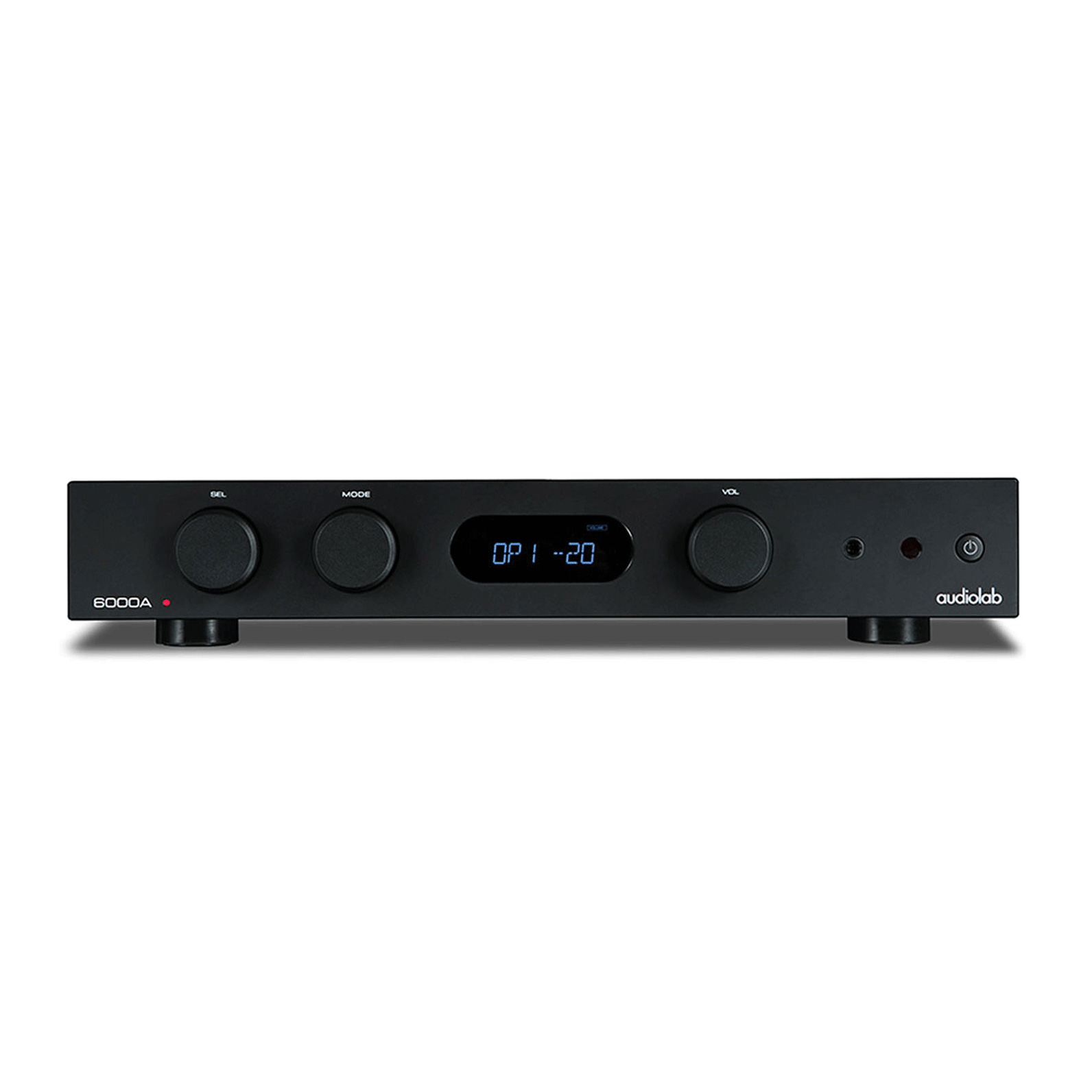
The Audiolab 6000A takes that idea further than most. Inside a single, slim chassis, it packs a 50-watt-per-channel stereo amplifier, a built-in digital-to-analog converter (DAC), a moving magnet phono stage for your turntable, and a dedicated headphone amplifier. Whether you’re spinning vinyl, streaming over Bluetooth, playing CDs, or connecting a digital streamer, the 6000A handles it all without asking you to buy extra components.
Audiolab has been building respected British audio components since 1983, and the 6000A was designed by Jan Ertner — the same engineer behind Audiolab’s more expensive 8300A series. His goal was to bring 8300A-level engineering to a more accessible price point, and by most accounts, he succeeded.
The Amplifier Section: More Power Than It Seems
The 6000A runs a discrete Class AB power amplifier stage — Class AB is the sweet spot between efficiency and sound quality, widely used in high-end audio. It delivers 50 watts per channel into 8-ohm speakers, rising to 75 watts per channel into 4 ohms. That’s enough to drive most bookshelf and floor-standing speakers with ease.
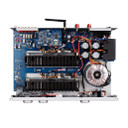
Under the hood, the circuit uses a Complementary Feedback (CFB) topology. In plain terms, this design approach gives the amplifier better linearity (meaning it adds less distortion to the signal) and keeps the output stable even as the amp warms up. It’s the same topology used in considerably more expensive amplifiers. A substantial 200VA toroidal transformer — think of it as the amp’s dedicated power plant — backed by 60,000µF of reservoir capacitance ensures the 6000A can deliver clean, dynamic peaks without strain. Maximum current output is rated at 9 amps, which means it can handle demanding speaker loads without breaking a sweat.
Three operational modes add flexibility you won’t find at this price: use it as a traditional integrated amplifier, run it as a standalone preamplifier feeding a separate power amp, or use it purely as a power amplifier with a separate preamp upstream. As your system evolves, the 6000A can evolve with it.
The Built-In DAC: Better Than the Competition Expects
A DAC — digital-to-analog converter — translates digital audio signals (from a CD player, streaming device, or computer) into the analog signal your amplifier can actually use. Many integrated amplifiers skip this entirely, requiring a separate DAC component. The 6000A includes one, and it’s genuinely high-caliber.
Audiolab chose the ESS Sabre ES9018 chip — the same converter used in their well-regarded M-DAC standalone unit — paired with ESS Technology’s 32-bit HyperStream architecture and Time Domain Jitter Eliminator. Jitter refers to tiny timing errors in the digital signal that can blur fine detail; the 6000A’s circuitry actively suppresses it. Four digital inputs (two coaxial, two optical) accept signals up to 24-bit/192kHz — more than enough resolution for any current streaming service or hi-res audio file. Three selectable digital filters — Fast Roll-off, Slow Roll-off, and Minimum Phase — let you tune the character of the DAC to your taste and system.
Vinyl, Headphones, and Wireless — All Covered
The 6000A includes a moving magnet (MM) phono stage built around a JFET circuit with precise RIAA equalization. If you own a turntable with a standard MM cartridge, you can plug it straight in without an outboard phono preamp. The dedicated headphone amplifier uses current-feedback circuitry — an approach that ensures high bandwidth and low distortion for a wide range of headphone types. Output impedance measures at 2.3 ohms, low enough to pair cleanly with most full-size headphones and many in-ear monitors. Bluetooth with aptX support is built in as well, so you can stream wirelessly from your phone or tablet at near-CD quality.
What Reviewers Are Saying
What Hi-Fi? — September 2018
Reviewers at What Hi-Fi? praised the 6000A as “clean and articulate” with “a gorgeous sense of clarity and ample detail.” They noted voices cut through with emotion and nuance, piano notes landed with satisfying weight, and bass was pulled taut — describing it as “a wonderfully confident performance.” The publication concluded it was “an excellent amplifier that takes the fight to a formidable class leader.”
Paul Rigby, The Audiophile Man — July 2019
Paul Rigby called the 6000A “even handed” and praised its balanced presentation, noting that unlike many budget amplifiers, it did not sacrifice bass. His conclusion: “The 6000A is one of the best value amplifiers on the market. If you want to hear how your money has been spent, buy a 6000A.”
SoundStage! Access (Roger Kanno) — October 2019
Roger Kanno at SoundStage! Access found the 6000A sounded well above its price class, noting it “mostly got out of the way of the music.” He highlighted its build quality, OLED display, and DAC as standout features compared to rivals at similar prices, calling it a clear step up in appearance and features. He concluded he would “happily plunk down the extra money” for the 6000A over less expensive alternatives.
Hi-Fi Choice — May 2019
Hi-Fi Choice praised the 6000A’s “spacious nature” and “confident and expansive soundstage,” noting it performed well across all inputs. The reviewer noted the DAC section “proves way better than many similarly priced rivals” with a wide and confident sound and lots of detail.
Tomasz Karasiński, Stereo Life Magazine — November 2018
“Its sound is musically engaging, yet also refined. The soundstage it produces is broad and deep, with crisply defined detail revealing the character of voices and instruments. Impressive dynamic range conveys natural impact, while the amp’s transient ability keeps feet tapping with rhythmic music.”
Who Is the 6000A Best For?
-
 You want to simplify your system — one amp that handles your turntable, digital sources, and wireless streaming without extra components.
 -
You’re building your first serious hi-fi system and want a component with genuine audiophile credentials at a real-world price.
-
You own a turntable and want a built-in phono stage that won’t embarrass your cartridge.
-
You use headphones regularly and want a dedicated headphone amp rather than an afterthought 3.5mm jack.
-
You want a system that can grow — the 6000A’s preamp and power amp modes let you add components over time without replacing the amp.
How Does It Connect to Your System?
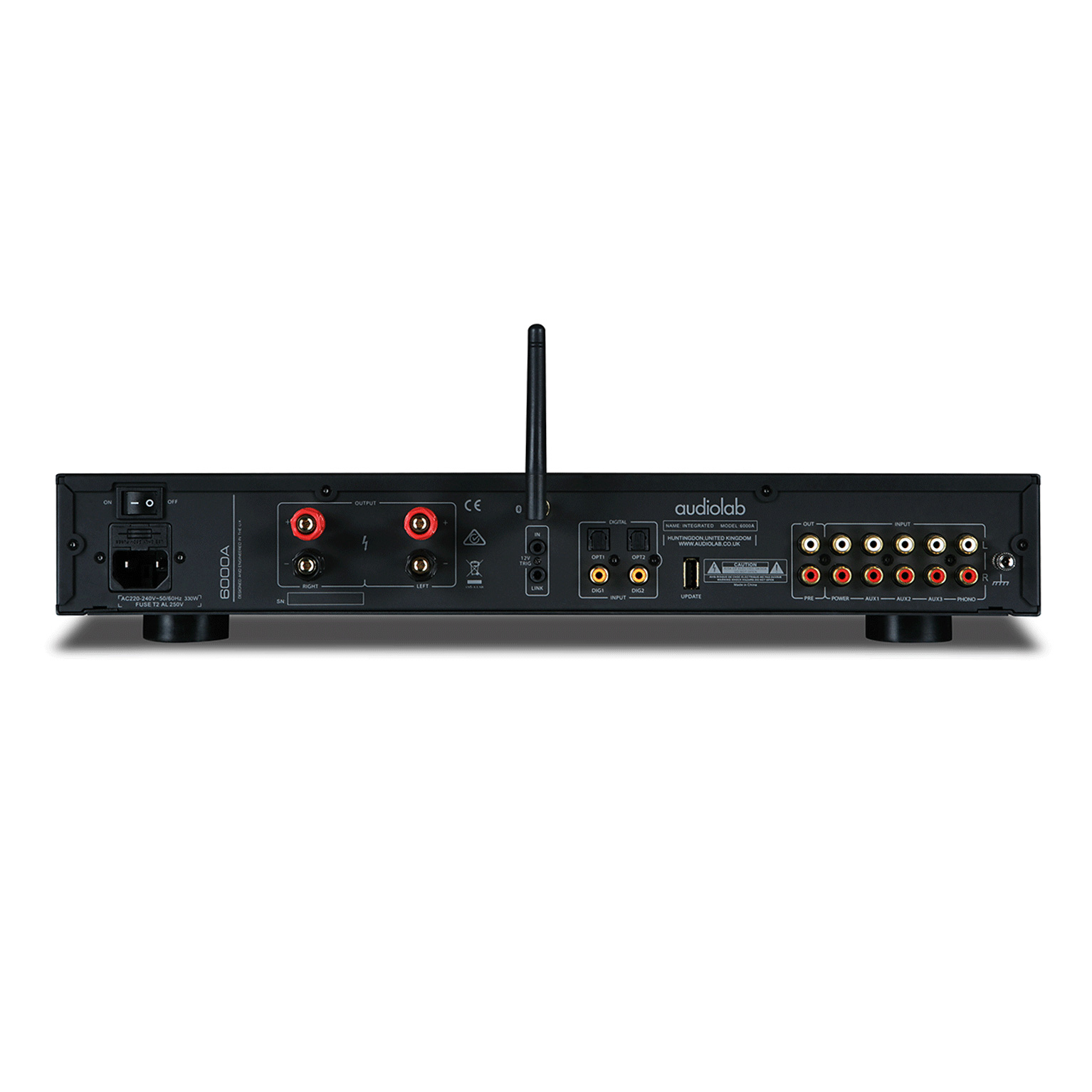
On the analog side, the 6000A offers four line-level RCA inputs plus a dedicated phono input with a ground screw terminal. Preamp outputs let you connect a subwoofer or external power amplifier. On the digital side, two coaxial (RCA) and two optical (Toslink) inputs connect CD players, streamers, and other digital sources. Bluetooth with aptX lets you stream wirelessly. Speaker terminals on the rear accept standard binding posts for your left and right speakers. A 6.3mm (1/4-inch) headphone jack is located on the front panel for convenient private listening.
What’s in the Box
- Audiolab 6000A Integrated Amplifier
- Remote control
- Bluetooth antenna
- Power cable
- Owner’s manual
Pairs Well With
- CD Transport: The Audiolab 6000CDT CD Transport is a natural partner — it connects directly via coaxial, and they share the same remote. Browse Audiolab
- Speakers: The 6000A pairs well with bookshelf and floor-standing speakers in the $300–$1,500 range. Browse loudspeakers
- Turntable: Its built-in MM phono stage is ready for any moving magnet turntable. Browse turntables
- Interconnects & Speaker Cables: A quality cable makes a real difference. Browse cables
- Streaming Source: Pair with a dedicated network streamer for lossless and hi-res service streaming. Browse streamers
Features & Specifications
Power Amplifier
50 Watts Per Channel, Class AB — The discrete Class AB output stage delivers 50W/channel into 8Ω and 75W/channel into 4Ω, with a maximum current delivery of 9A. CFB (Complementary Feedback) topology ensures excellent linearity and thermal stability. A 200VA toroidal transformer and 60,000µF of reservoir capacitance provide deep, authoritative power reserves.
Built-In DAC
ESS Sabre ES9018 — 32-bit/192kHz — The same DAC chip used in Audiolab’s award-winning M-DAC. Utilizes ESS’s 32-bit HyperStream architecture and Time Domain Jitter Eliminator for ultra-low noise and high dynamic range. Accepts signals up to 24-bit/192kHz from four digital inputs. Three selectable digital filters — Fast Roll-off, Slow Roll-off, and Minimum Phase — let you tailor the presentation to your system and taste.
MM Phono Stage
JFET-Based, RIAA Equalized — A high-quality, low-noise JFET phono circuit with precise RIAA equalization means your turntable plugs straight in. Compatible with moving magnet (MM) cartridges only; MC cartridges require an outboard step-up.
Dedicated Headphone Amplifier
Current-Feedback Design, 2.3Ω Output Impedance — The headphone amp is a fully discrete circuit, not a simple tap off the speaker outputs. Low output impedance means it works cleanly with a wide range of headphones. THD rated below 0.01% at 1kHz/50mW.
Three Operational Modes
Integrated / Preamp / Power Amp — Use the 6000A as a full integrated amp, as a preamp feeding a separate power amp, or as a power amp connected to a separate preamp. These modes are selected in the on-screen menu and reflect the discrete, modular nature of the internal circuit architecture.
Connectivity
Digital Inputs: 2 × coaxial S/PDIF (RCA), 2 × optical (Toslink) — all supporting up to 24-bit/192kHz. Analog Inputs: 4 × line-level RCA (including 1 dedicated phono/MM), plus power amp input. Outputs: 1 × stereo RCA preamp output, speaker binding posts, 6.3mm headphone jack. Wireless: Bluetooth with aptX. Remote Control: Full-function remote included; compatible with Audiolab 6000CDT and 6000N.
Design & Build
Slim, aluminum-front chassis with a large central OLED display. Rotary controls for input selection, mode, and volume. 12V trigger input and output for system automation. Available in black (this listing) or silver. Shares design language with the 8300A series.
Quick-Reference Specifications
| Power Amplifier | |
| Rated Power Output | 2 × 50W (8Ω, THD <1%) / 2 × 75W (4Ω, THD <1%) |
| Max Output Current | 9A |
| Topology | Discrete Class AB, CFB (Complementary Feedback) |
| Frequency Response | 20Hz–20kHz (±0.3dB) |
| THD | <0.0004% |
| SNR (Line) | >110dB |
| SNR (Phono MM) | 76dB |
| Power Supply | 200VA toroidal transformer, 4 × 15,000µF reservoir (60,000µF total) |
| DAC | |
| DAC Chip | ESS Sabre ES9018K2M (32-bit HyperStream) |
| Max Sampling Frequency | 192kHz / 24-bit |
| Digital Filters | Fast Roll-off, Slow Roll-off, Minimum Phase |
| Output Voltage | 2.3V max (Volume = 0dB) |
| Headphone Amp | |
| Output Impedance | 2.3Ω |
| THD (Headphone) | <0.01% (1kHz, 50mW) |
| Output Jack | 6.3mm (1/4-inch) front panel |
| Digital Inputs | |
| Coaxial S/PDIF | 2 × RCA (up to 24-bit/192kHz) |
| Optical S/PDIF | 2 × Toslink (up to 24-bit/192kHz) |
| Analog Inputs | |
| Line Inputs | 4 × RCA (3 line-level, 1 phono MM) |
| Input Sensitivity (Line) | 720mV |
| Input Sensitivity (Phono MM) | 3.1mV |
| Power Amp Input | 1 × RCA (direct power amp bypass) |
| Outputs | |
| Preamp Output | 1 × stereo RCA pair |
| Speaker Outputs | Binding posts (one pair) |
| Wireless | Bluetooth with aptX |
| Trigger | 12V in/out |
| Dimensions & Weight | |
| H × W × D | 65.5 × 445 × 300mm (2.6" × 17.5" × 11.8") |
| Weight | 7.8kg (17.2 lbs) |
| Finish | Black (Silver also available) |
| Power Supply | 100–240V AC, 50/60Hz (universal) |
Frequently Asked Questions
What is an integrated amplifier, and how is it different from a separate preamp and power amp?
An integrated amplifier combines a preamplifier (source selection and volume control) and a power amplifier (which drives your speakers) in a single box. Separates can offer higher performance at a given price point but add cost, cables, and complexity. The 6000A is a smart choice if you want excellent performance without the hassle of building a full separate system — and its switchable preamp and power amp modes give you upgrade flexibility if your priorities change later.
Do I need a separate DAC to use digital sources with the 6000A?
No. The 6000A has a built-in ESS Sabre ES9018 DAC with four digital inputs that handle up to 24-bit/192kHz. You can connect a CD player, streaming device, or a computer via coaxial or optical and play high-resolution audio right out of the box. If you ever want to upgrade to an external DAC, the preamp input lets you do that too.
Can I connect my turntable directly to the 6000A?
Yes, if your turntable uses a moving magnet (MM) cartridge — which covers the vast majority of turntables sold today. The 6000A has a dedicated phono input with RIAA equalization, so no outboard phono preamp is needed. If you have a moving coil (MC) cartridge, you’ll need to add a step-up device or phono preamp with MC support.
What headphones work well with the 6000A?
The 6000A’s dedicated headphone amplifier has a 2.3-ohm output impedance, which keeps it well-matched to a wide range of headphones from around 16 ohms and up. Reviewers at eCoustics found it performed well with HiFiMAN Sundara planar magnetic headphones, noting they sounded “more open and transparent” than with other headphone stages. Most full-size dynamic and planar headphones will be a great match.
How does the 6000A compare to the Audiolab 8300A?
The 8300A is Audiolab’s analog-only integrated amplifier, offering 75W/channel into 8 ohms and a more premium build but no built-in DAC or phono stage. The 6000A delivers 50W/channel and adds the ES9018 DAC, phono input, and Bluetooth, making it a more versatile all-in-one solution. Both share a similar power amp circuit topology and were designed by the same engineer, Jan Ertner. If you don’t need digital inputs and want more power, the 8300A steps up nicely. If you want one box that does it all, the 6000A is the smarter value.
What do the three digital filter settings do?
The 6000A’s built-in DAC offers three filters that gently change how the digital signal is processed: Fast Roll-off is the standard setting with a sharp cutoff above the audio band; Slow Roll-off uses a gentler slope and many listeners find it slightly warmer; Minimum Phase has characteristics similar to an analog filter and can sound more relaxed on some systems. Paul Rigby at The Audiophile Man specifically recommended trying all three before settling on a preference — each one genuinely changes the character of the sound.
What else do I need to complete my system?
The 6000A is a full integrated amplifier, so all you need to start is a pair of speakers and a source (turntable, CD player, streaming device, or a phone via Bluetooth). Speaker cables and interconnects are the only other essentials. If you have questions about which speakers or cables pair well with the 6000A, give us a call at 800-942-0220 — our team is happy to help.
Is Bluetooth audio quality good enough for serious listening?
The 6000A uses Bluetooth with aptX support, which streams at near-CD quality — significantly better than standard Bluetooth. Reviewers at What Hi-Fi? noted that while Bluetooth was “the least sonically convincing” input on the 6000A, it was “decently implemented” and “sounds surprisingly engaging.” For casual listening and convenience it’s excellent; for critical listening sessions, the coaxial or optical digital inputs will always sound better.
 40+ Years of Expertise — Since 1981, we’ve helped over a million music lovers find the right gear.
 60-Day Money-Back Guarantee — Take your time. Listen, enjoy, and make sure it’s right for you.
 Real Experts, Real Help — Our team is here to answer your questions at 800-942-0220, weekdays 9am–6pm EST.
 Free Shipping — On orders over $49, delivered to your door.
 Flexible Payment Options — Financing available so you can start listening now.
Want to learn more about integrated amplifiers and how to choose the right one for your system? Visit our Learning Center for guides, tips, and expert advice.