 Free Shipping on US orders above $49






What You Need to Know
What Is the audiolab D7?
A DAC—short for digital-to-analog converter—is the part of your audio chain that turns digital music files into the analog signal your speakers or headphones can play. Every phone, computer, and streamer has a DAC built in, but a dedicated one like the audiolab D7 is built to do the job much better.
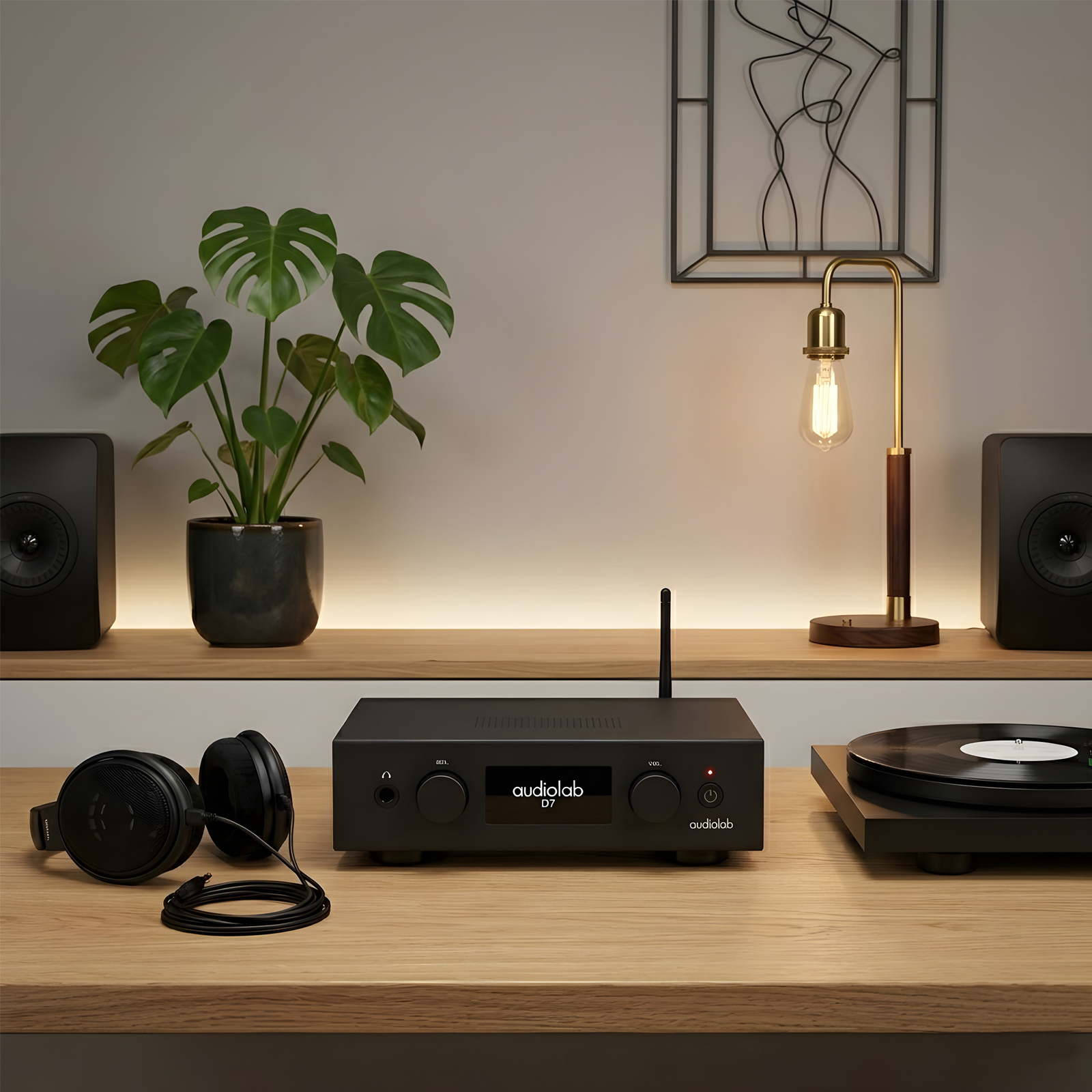
The D7 is more than just a DAC, though. It’s also a headphone amplifier and a preamp, all packed into a compact aluminum box that fits on a desk or a shelf. It’s the successor to audiolab’s famous M-DAC, which won awards for nearly a decade. The D7 carries that tradition forward with updated technology at a very approachable price.
What Makes It Special?
At the heart of the D7 is the ESS Sabre ES9038Q2M—a 32-bit DAC chip known for clean, precise sound. It’s the same chip used in audiolab’s more expensive 7000A and 6000A MkII amplifiers. But a great chip is only part of the story. audiolab adds its own clock circuit, a Class A post-DAC filter (which smooths the signal in the purest way possible), and a dedicated low-noise power supply to get the most out of it.
The D7 handles just about every digital format you can throw at it. Over USB, it supports PCM files up to 32-bit/768kHz and DSD512—formats that go far beyond CD quality. It also does full MQA decoding and is Roon Tested, so it works smoothly with popular streaming setups. You even get Bluetooth 5.1 with aptX HD for wireless listening from your phone or tablet.
There are five DAC filter settings that let you fine-tune how the music sounds. You can also upsample your audio to 352.8kHz or 384kHz. These are small adjustments, but they let you tailor the D7 to your ears and your system.
What Are Reviewers Saying?
What Hi-Fi? — 5 Stars — Ketan Bharadia, December 2025
What Hi-Fi? awarded the D7 five stars, calling it a well-built and generously equipped performer. The reviewers praised its neutral, even-handed sound with pleasing clarity, detail, and spaciousness. They noted that music rarely sounds cluttered through the D7, and it handles everything from classical to rock with composure.
AVForums — Highly Recommended — Ed Selley, July 2025
Ed Selley at AVForums gave the D7 a Highly Recommended award. He found the D7 delivered more bass, more detail, and more believable tonality than comparably priced DACs. He called it a superb preamp and headphone amplifier, concluding that audiolab has not forgotten what it does well.
Alpha Audio — Highly Recommended — March 2026
Alpha Audio praised the D7 as a benchmark in its price range. Their reviewers described a balanced, slightly warm sound that encourages long listening sessions. They highlighted the above-average bass and the fact that you quickly forget you’re listening to a budget device.
Who Is This Best For?
 You want to upgrade the built-in DAC in your amplifier, streamer, or computer for noticeably better sound.
You listen to headphones and want a dedicated amp that can drive everything from earbuds to full-size planar magnetics.
You’re building a desktop system and need one compact box that handles DAC duties, volume control, and headphone output.
You want balanced XLR outputs to connect directly to active speakers or a power amplifier.
You stream from Tidal, Qobuz, Apple Music, or Spotify and want the cleanest possible conversion of those digital streams.
How Does It Connect to Your System?
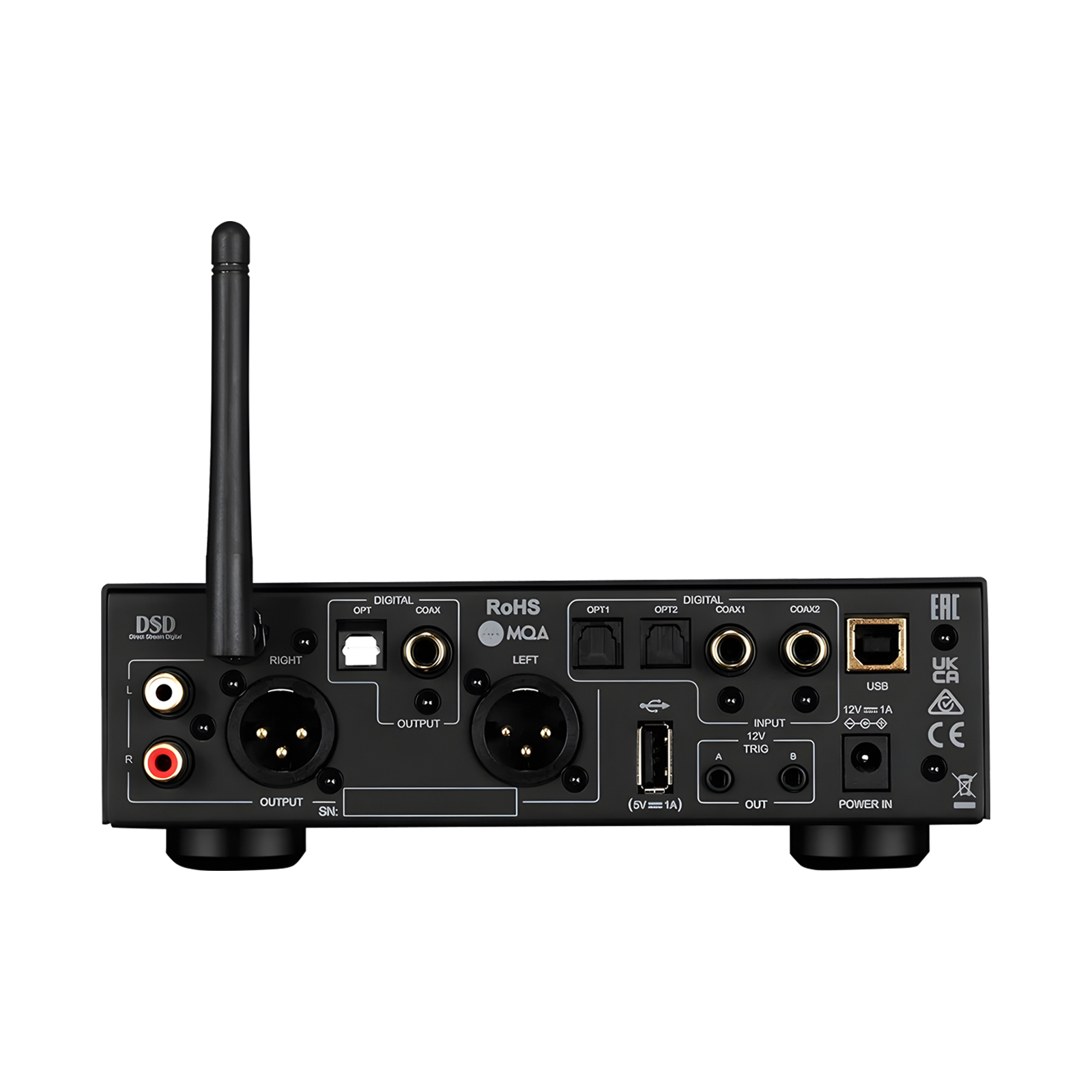
The D7 is loaded with connections. On the digital input side, you get two coaxial and two optical S/PDIF inputs (for CD transports, TVs, or streamers), a USB Type-B input (for computers, Macs, or phones), a USB Type-A input (for playing files from a flash drive), and Bluetooth 5.1 with aptX HD.
For outputs, there are balanced XLR and single-ended RCA analog outputs, plus coaxial and optical digital outputs if you want to pass the signal along to another device. The analog outputs can run in fixed mode (when you’re feeding an integrated amp that handles its own volume) or variable mode (when you’re going straight into a power amp or active speakers and want the D7 to control volume).
On the front panel, a 6.3mm headphone jack lets you plug in for private listening. The built-in headphone amp uses a current-feedback design that can drive headphones from 20Ω to 600Ω, delivering up to 500mW into 33Ω.
A handy OLED display shows your current input, volume level, and sample rate. The included remote control makes everything easy from across the room.
Keep in mind, the D7 is a DAC and headphone amp—it does not stream on its own. You’ll need a source like a computer, streamer, CD transport, or phone to feed it digital audio. If you need help choosing a source, give us a call.
What’s in the Box
- audiolab D7 DAC and Headphone Amplifier
- 12V DC power supply adapter
- Remote control (batteries included)
- User manual
- USB Type-B cable
Features & Specifications—Benefit-Driven
Audio Performance
High-Precision 32-Bit Conversion — The ESS Sabre ES9038Q2M DAC chip converts your digital files with exceptional accuracy. It supports PCM up to 32-bit/768kHz and DSD512 over USB, meaning it can handle every high-resolution format available today with room to spare.
Ultra-Low Noise, High Dynamic Range — audiolab’s proprietary clocking circuit and Class A post-DAC active filter work together to keep the signal clean and quiet. The result is a signal-to-noise ratio greater than 115dB (RCA) and 117dB (XLR), with total harmonic distortion below 0.001%.
Five Digital Filters — Choose from five DAC reconstruction filter settings to fine-tune how your music sounds. Each filter subtly changes the way the DAC processes the audio signal, letting you match the sound to your system and your taste.
Upsampling — Optionally upsample your incoming audio to 352.8kHz or 384kHz for an even smoother presentation.
Full MQA Decoding — The D7 performs the complete three-stage MQA unfolding process internally, not just the final render. This means you get the full benefit of MQA-encoded files without needing another device.
Headphone Amplifier
Drive Almost Any Headphone — The built-in headphone amp uses a current-feedback design that delivers up to 500mW into 33Ω. It handles headphones from 20Ω to 600Ω, including power-hungry planar magnetic models. The low output impedance (2.35Ω), high slew rate, and wide bandwidth mean clean, controlled playback with headphones of all types.
Connectivity
Wired Digital Inputs — Two coaxial S/PDIF, two optical S/PDIF (Toslink), one USB Type-B (for computers), and one USB Type-A (for flash drives and firmware updates).
Wireless Input — Bluetooth 5.1 with aptX HD for high-quality wireless streaming from phones, tablets, and computers.
Analog Outputs — One pair of balanced XLR and one pair of single-ended RCA, switchable between fixed and variable modes.
Digital Outputs — One coaxial and one optical, for passing the signal to another device.
Headphone Output — Front-mounted 6.3mm (1/4″) jack.
12V Trigger — Two trigger connections for system automation.
Design & Build
Compact Aluminum Chassis — The D7 fits neatly on a desk or shelf. It matches the look and feel of audiolab’s 6000 and 7000 series.
OLED Display — A front-panel OLED screen shows input, volume, sample rate, and settings at a glance.
Remote Control — A compact remote handset gives full control from your listening chair.
Roon Tested — Certified to work smoothly with the Roon music platform.
Quick-Reference Specifications
| DAC Performance | |
| DAC Chip | ESS Sabre ES9038Q2M (32-bit, HyperStream II) |
| Signal-to-Noise Ratio | >115 dB (A-weighted, RCA) / >117 dB (A-weighted, XLR) |
| THD+N | <0.001% |
| PCM Support (USB) | Up to 32-bit / 768 kHz |
| PCM Support (Optical/Coaxial) | Up to 24-bit / 192 kHz |
| PCM Support (USB HDD) | Up to 24-bit / 96 kHz |
| DSD Support (USB) | DSD64, DSD128, DSD256, DSD512 |
| MQA | Full hardware decoding (three-stage unfold) |
| Digital Filters | 5 selectable reconstruction filters |
| Upsampling | Optional to 352.8 kHz or 384 kHz |
| Headphone Amplifier | |
| Topology | Current-feedback |
| Output Power | 500 mW into 33Ω |
| Max Output Voltage | 4.8 Vrms |
| Max Output Current | 180 mA |
| Output Impedance | 2.35Ω |
| Impedance Range | 20Ω to 600Ω |
| Headphone Output | 6.3mm (1/4") single-ended |
| Digital Inputs | |
| Coaxial S/PDIF | 2× RCA |
| Optical S/PDIF | 2× Toslink |
| USB (PC/Mac) | 1× USB Type-B (asynchronous, up to 768 kHz PCM / DSD512) |
| USB (Storage) | 1× USB Type-A (flash drive playback, up to 96 kHz) |
| Bluetooth | Bluetooth 5.1 (aptX, aptX HD, AAC, SBC) |
| Analog Outputs | |
| Balanced | 1× XLR pair (fixed or variable, 4.1 Vrms) |
| Unbalanced | 1× RCA pair (fixed or variable, 2.05 Vrms) |
| Digital Outputs | |
| Coaxial | 1× RCA |
| Optical | 1× Toslink |
| Other | |
| 12V Trigger | 2× 3.5mm jacks (in/out) |
| Dimensions & Weight | |
| Width × Height × Depth | 180 × 56 × 208 mm (7.1" × 2.2" × 8.2") |
| Weight | 1.42 kg (3.1 lbs) — unit only |
| Finish | Black or Silver aluminum |
| Display | OLED |
| Power | External 12V DC adapter (included) |
| Warranty | 3-year manufacturer warranty |
Frequently Asked Questions
Do I need an amplifier to use the D7 with speakers?
Yes. The D7 is a DAC and preamp, not a speaker amplifier. To play music through passive speakers, you’ll need a separate power amplifier or integrated amplifier. However, you can connect the D7 directly to active (powered) speakers using its variable XLR or RCA outputs—in that case, no extra amp is needed.
Can the D7 replace my integrated amplifier’s built-in DAC?
It sure can, and that’s one of the best ways to use it. Connect your digital source (streamer, CD transport, or computer) to the D7, then run an analog cable from the D7’s outputs to a line-level input on your integrated amp. Set the D7 to fixed output mode, and your amp handles the volume as usual. Many listeners find this is a clear step up from the DAC built into most amplifiers.
What’s the difference between fixed and variable output mode?
In fixed mode, the D7 sends a full-strength signal out of its RCA and XLR outputs—your amplifier controls the volume. In variable mode, the D7 acts like a preamp and controls the volume itself, which is useful when connecting directly to a power amp or active speakers. You can switch between the two in the menu.
How does the D7 compare to the audiolab D9?
The D9 is audiolab’s step-up model. It uses the more advanced ES9038PRO DAC chip (an eight-channel version for fully balanced processing), includes a larger IPS LCD display, adds an AES/EBU input and LDAC Bluetooth support, and has a built-in linear power supply with a toroidal transformer instead of an external adapter. If your budget allows, the D9 offers more refinement. But the D7 shares the same headphone amplifier design and covers the same core features at a much lower price.
Does the D7 work with my TV?
Yes. If your TV has an optical (Toslink) or coaxial digital audio output, you can connect it to the D7. The D7 will convert that signal and send it to your amplifier or headphones. This is a great way to improve the sound of your TV for music, movies, and shows.
What headphones can the D7 drive?
The D7’s headphone amp handles headphones from 20Ω to 600Ω, delivering up to 500mW of power. That covers the vast majority of headphones on the market, including most planar magnetic models. If you have an especially hard-to-drive pair, give us a call and we’ll help you figure out if the D7 is a good match.
Can I use the D7 wirelessly?
Yes. The D7 includes Bluetooth 5.1 with aptX HD, so you can stream directly from your phone, tablet, or computer without any cables. Just pair your device and play. Keep in mind that Bluetooth quality, while very good with aptX HD, won’t match a wired USB or S/PDIF connection for the absolute best resolution.
What are the DAC filter settings for?
The D7 offers five digital reconstruction filters that subtly shape how the DAC processes audio. The default is Linear Phase (Slow Roll-Off), which works well for most music. The other options let you experiment—some sound a touch warmer, others a bit more precise. The differences are subtle, and there’s no wrong answer. Pick the one that sounds best to your ears with your system.
Does the D7 support Roon?
Yes. The D7 is Roon Tested, meaning it has been verified to work smoothly with the Roon music management platform. Connect it to your Roon Core via USB and you’re ready to go.
Why Audio Advisor?
 40+ Years of Expertise — Since 1981, we’ve helped over a million music lovers find the right gear.
 60-Day Money-Back Guarantee — Take your time. Listen, enjoy, and make sure it’s right for you.
 Real Experts, Real Help — Our team is here to answer your questions at 800-942-0220, weekdays 9am–6pm EST.
 Free Shipping — On orders over $49, delivered to your door.
 Flexible Payment Options — Financing available so you can start listening now.
Learn More
Want to learn more about DACs, headphone amps, and digital audio? Visit our Learning Center for guides, tips, and expert advice.


