Free Shipping on US orders above $49




What You Need to Know
What Is This Product and What Does It Do?
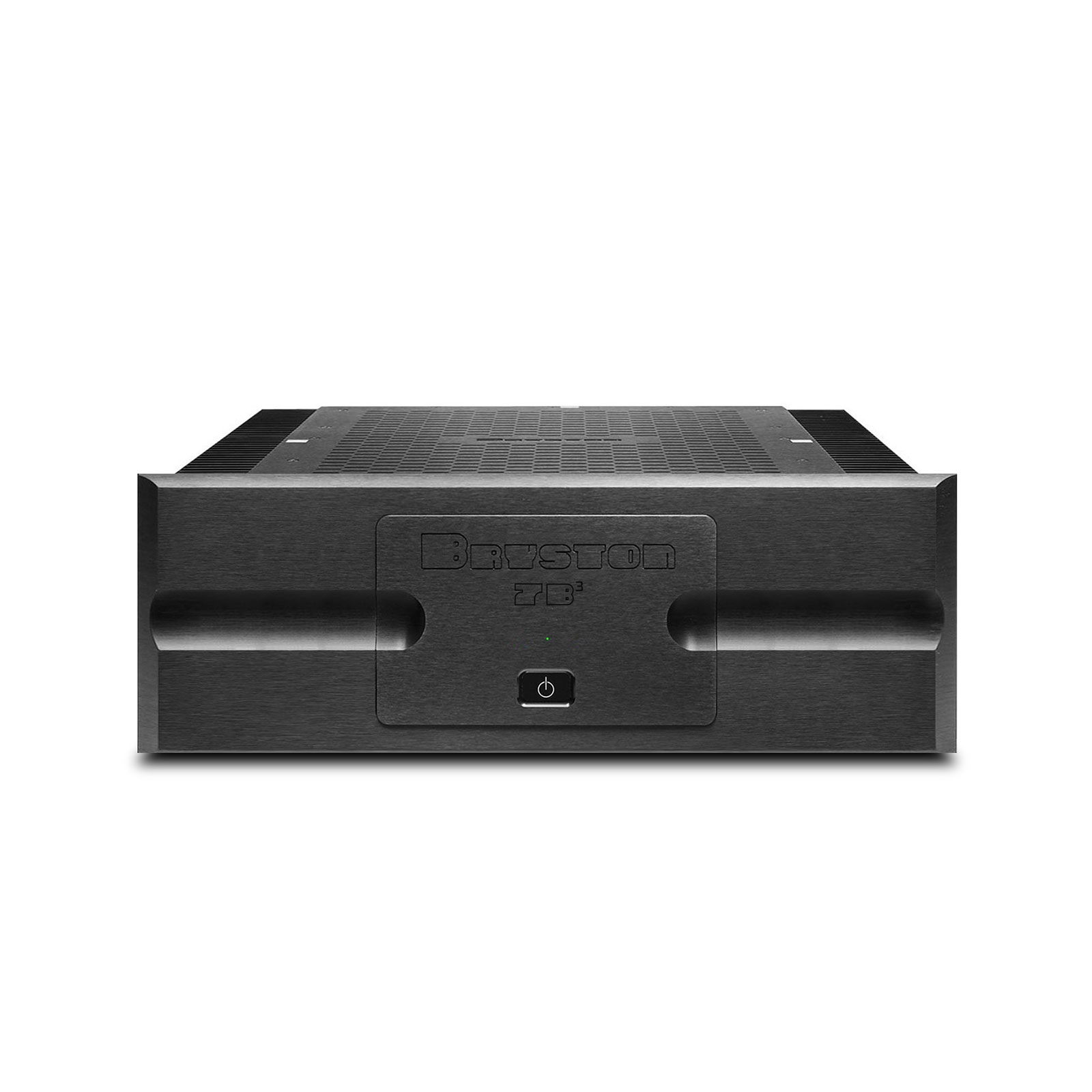
The Bryston 7B³ is a power amplifier — it takes the line-level signal from a preamplifier and converts it into the current that drives your speakers. It is a monoblock, meaning each chassis handles exactly one channel. A stereo system requires two units.
What you get with a dedicated monoblock design is full commitment of engineering resources — and full commitment of space — to a single channel. The 7B³ has its own transformer, its own power supply, and its own amplification circuitry for that one channel. Nothing is shared with another channel, because there is no other channel. That is different from a two-channel amplifier, where both channels draw from a shared power supply under load.
The 7B³ delivers 600 watts into 8-ohm speakers and 900 watts into 4-ohm loads. Those are substantial figures. The reason they matter is not that most music requires anywhere near that much power. It is that a large reserve of headroom — power capacity that is present but rarely used — allows the amplifier to handle sudden peaks without strain. Sudden peaks are where much of music’s emotional impact lives: the crack of a snare drum, the attack of a piano chord, a full orchestral fortissimo.
The 7B³ is part of Bryston’s Cubed Series — the generation of amplifiers that introduced the patented Salomie input circuit developed with the late Dr. Ioan Alexandru Salomie. This circuit uses 12 active devices in a tightly configured array to provide the first 6 dB of gain while simultaneously trapping and eliminating distortion and radio-frequency interference before they can reach the amplification stage. According to Bryston, it achieves less than 0.001% distortion — the lowest input stage distortion of any amplifier the company has produced.
The output stage uses Bryston’s Quad-Complementary topology, which was introduced in the SST² generation and carried forward into the Cubed Series. This arrangement uses four matched output devices per half-cycle rather than the more common two, which improves linearity and significantly reduces higher-order harmonic distortion. Bryston describes the harmonic distribution of the Quad-Complementary output as mimicking the characteristics of a Class A design, but with lower distortion and without the heat and inefficiency of a true Class A circuit.
Gain is user-selectable between two settings — 29 dB (high) and 23 dB (low) — via a switch on the rear panel. The low-gain setting is the right choice when your preamplifier has a high output voltage, or when you want a wider, more useful volume range on your preamplifier’s control. The high-gain setting works well with preamplifiers that have lower output voltages.
Every 7B³ goes through a 100-hour factory burn-in at Bryston’s facility before it ships. At the end of that process, Bryston measures the actual performance of your specific unit on the test bench and includes a printed individual specification sheet in the box. When you open the 7B³, you’ll see exactly how your amplifier tested — not how the average unit tests.
The 19-inch faceplate on this version adds front-mounted handles. The handles make the amp easier to move and position — at 42 pounds per chassis, you’ll appreciate them. The 19-inch faceplate is not rack-mountable in the standard sense; there are no rack-mounting holes. It is simply a wider panel that accommodates the handles.
The 7B³ carries Bryston’s 10-year warranty on analog electronics, covering parts and labor.
What Are Reviewers Saying?
Midtskog reviewed the 7B³ for The Absolute Sound and described it as “more refined sounding and more musically rewarding than previous Bryston amps I have heard.” He noted that the musicality was less about warmth or euphonics and more about what he called “a winning, agile tunefulness” — a quality that kept him engaged across long listening sessions, following the musical line rather than analyzing individual details. The 7B³ earned an Editors’ Choice designation from The Absolute Sound.
Fisher described the 7B³ pair as “probably as delightful-sounding as any amps I’ve auditioned.” He singled out their absence of a recognizable sonic signature as a distinguishing quality — the amps were “completely without a familiar sonic signature, yet immensely melodious and transparent, and absolutely effortless in reproducing the kind of dynamic range one may get at live performances of large orchestral music.”
Carter reviewed the 7B³ alongside the BP-173 preamplifier and concluded the combination was “truly amazing.” His overall verdict: the 7B³ monos and BP-173 “should be on any serious short list” and the entire Bryston Cubed Series lineup is “worth evaluating.” He gave the pairing his highest recommendation.
Who Is This Best For?
 You have demanding or low-sensitivity loudspeakers that need real power to come alive — electrostatics, large floor-standers, or any speaker with a nominal impedance that dips low under load. The 7B³’s 900 watts into 4 ohms and dedicated single-channel power supply mean it doesn’t run out of headroom with difficult loads.
You listen to music with wide, sudden dynamic swings — orchestral, large-scale jazz, or anything recorded with high dynamic range. A large power reserve lets the amp reproduce peaks without compression or strain.
You want the maximum isolation between channels. Because each 7B³ is a completely independent unit — its own transformer, its own power supply, its own enclosure — there is zero electrical crosstalk between left and right. This is the monoblock advantage.
You want a component built to last decades. The 100-hour factory burn-in, individual test sheet, machined aluminum enclosure, and 10-year warranty are all signals of an engineering philosophy focused on long-term reliability.
You prefer a power amplifier with no frills. No digital processing, no internal DAC, no streaming, no room correction. Just an amplifier that takes what the preamplifier sends it and delivers it to the speakers with as much fidelity and as little alteration as possible.
How Does It Connect to Your System?
The 7B³ is a power amplifier only — it requires a preamplifier or an integrated amplifier or DAC with a volume-controlled line output to feed it a signal. It has no volume control of its own, no input selection, and no source inputs beyond what an amplifier needs: one signal in, one speaker output.
On the rear panel you’ll find three input options: a balanced XLR, a balanced TRS (1/4-inch), and a single-ended RCA. An input select switch on the rear panel picks between the balanced and single-ended inputs. The balanced input is the preferred connection — it provides better rejection of noise picked up on the cable run between your preamplifier and the amp. Use the RCA input if your preamplifier doesn’t offer balanced outputs.
The gain select switch lets you choose between 29 dB and 23 dB of gain. Most systems work well at the low 23 dB setting; if your preamplifier’s output voltage is on the lower side, or if you find yourself running the preamp’s volume control near maximum, switch to 29 dB.
Speaker cables connect to a single pair of five-way binding posts. The binding posts accept spade lugs, banana plugs, pin connectors, or bare wire. Bryston orients the binding posts so the spade slots face upward, which makes cable management easier — you can route the cables up and away from the floor rather than having them droop forward.
A 12V DC trigger input and output let you automate the 7B³ in a multi-component system. Connect a trigger cable from your preamplifier’s trigger output to the 7B³’s trigger input and the amplifier powers on automatically when the preamp does. The trigger output on the 7B³ can pass the signal downstream to additional components. A SoftStart microprocessor controls the power-up sequence to prevent the inrush current spike that can trip household breakers.
Earned Recognition
Category: Monoblock Power Amplifiers
The Absolute Sound’s Editors’ Choice designation is awarded by the reviewing editor to components considered standout recommendations within their category and price range.
Category: Power Amplifiers
The Absolute Sound’s annual Best Audio Gear list recognizes components the magazine’s reviewers consider standout recommendations of the year. The 7B³ was described as “a wonderfully musical product.”
Category: Power Amplifiers
Inclusion in TAS’s annual Buyer’s Guide represents the magazine’s ongoing endorsement of a product as a strong recommendation within its competitive category. The 7B³ entry noted that “soundstage width and height are exceptional.”
Pairs Well With
The 7B³ is a power amplifier — it needs a preamplifier to complete the system.
- A preamplifier — required. The 7B³ has no volume control. Bryston’s own BR-20 or BP-17³ are natural partners — same Cubed Series engineering, balanced XLR connections, and 12V trigger outputs that control the 7B³ automatically. Any quality preamp with line-level balanced outputs will work equally well. Shop preamplifiers »
- A second 7B³ for stereo. This listing is for one amplifier. A stereo system requires a pair — one per channel. Add two to your cart or call us at 800-942-0220.
- Speakers. With 600 watts into 8 ohms and 900 into 4 ohms, the 7B³ can drive almost any loudspeaker, including difficult low-sensitivity designs and electrostatics. Shop speakers »
- Speaker cables. A high-current monoblock like the 7B³ rewards a good speaker cable. Keep run lengths equal between the two channels. Shop speaker cables »
- Balanced (XLR) interconnects. Use a quality balanced cable from your preamplifier to the 7B³’s XLR input to take full advantage of the balanced signal path. Shop XLR interconnects »
- A digital source — DAC or streamer. The 7B³ does not include a DAC. A quality DAC with balanced outputs feeds the preamplifier, which feeds the 7B³. Shop digital audio »
- Power conditioning. A high-current amplifier benefits from clean AC. Shop power conditioners »
- Amplifier stands. At 42 lbs per chassis, the 7B³ deserves proper support, and two dedicated stands keep the heat sinks clear on all sides. Shop stands »
Features & Specifications
Amplifier Performance
600 Watts per Channel into 8 Ohms, 900 Watts into 4 Ohms — These are continuous power figures, not peak or burst measurements. Bryston’s factory test sheets routinely show the 7B³ measuring above its rated power — audio-activity.com noted their specific review samples measured 679 watts into 8 ohms from the printed test sheets included in the boxes. The rated 600 watts is conservative.
Very Low Distortion — Total harmonic distortion plus noise measures below 0.005% across the 20 Hz to 20 kHz audio band at rated power. That figure reflects not just the quality of the output stage but the contribution of the Salomie input circuit, which eliminates distortion components before they reach the amplification stage.
Exceptional Bandwidth — The 7B³ is flat from below 1 Hz to 100 kHz at the –3 dB point. The upper limit of 100 kHz is far beyond audibility, but a wide bandwidth indicates an amplifier that doesn’t roll off or distort at the frequency extremes where music’s harmonic overtones live.
High Damping Factor — A damping factor greater than 300 at 20 Hz into 8 ohms means the amplifier maintains tight control over the woofer even during deep bass passages. Damping factor measures the amplifier’s ability to check the back-EMF generated by a woofer after the signal stops — a higher figure translates to more accurate bass reproduction.
Very Low Noise Floor — Signal-to-noise ratio measures –117 dB with the balanced XLR input (–78 dBu) and –112 dB with the single-ended RCA input (–75 dBu). In practice, the 7B³ is essentially silent between notes, even through efficient speakers in a quiet room.
Topology & Design
One Channel, Total Dedication — A monoblock amplifier commits everything — transformer size, power supply capacity, heat management, enclosure volume — to a single channel. The 7B³ has no electrical relationship with its partner amplifier beyond a common mains outlet. Left channel and right channel share nothing: no transformer, no power supply rails, no chassis. The result is the lowest possible crosstalk and complete channel independence under any load condition.
Patented Salomie Input Circuit — The input stage of every Cubed Series amplifier uses a circuit developed in conjunction with the late Dr. Ioan Alexandru Salomie, a physicist and computer scientist who held patents across multiple fields including audio circuit design. Twelve active devices are configured in a precisely matched array that simultaneously buffers the input, provides the first 6 dB of gain, and acts as a filter for audio- and radio-frequency noise from the power line and the outside world. Bryston states the circuit achieves below 0.001% distortion — a lower figure than any previous Bryston input stage.
Quad-Complementary Output Topology — The output stage uses four matched output devices per half-cycle instead of the more common two. This arrangement produces higher linearity and dramatically reduces higher-order harmonic distortion components — the ones the ear finds most unpleasant. Bryston describes the harmonic profile as similar to that of a Class A amplifier in character, while avoiding the heat and power consumption a true Class A design at this power level would demand.
Dedicated Single-Channel Power Supply and Transformer — Each 7B³ is built around a custom-wound transformer that Bryston describes as substantially more efficient than a standard design. Because the transformer and power supply serve only one channel, their full capacity is always available to that channel, with no competition from a second channel during loud or demanding passages.
Switchable Gain — A rear-panel switch selects between 29 dB (high gain) and 23 dB (low gain). This allows the 7B³ to match cleanly with a wide range of preamplifiers — those with high output voltages benefit from the low-gain setting, which puts the preamplifier’s volume control in a more useful range.
Fully Convection Cooled — No Fans — The machined aluminum enclosure acts as a heatsink. The 7B³ runs warm at idle and warmer under heavy use, but it is silent. There are no fans to fail and no fan noise to intrude on a quiet listening room.
SoftStart and <500 mW Standby — The SoftStart microprocessor controls the power-on sequence to prevent the inrush current that can trip household breakers. In standby, the 7B³ draws less than 500 milliwatts.
Quality Assurance
100-Hour Factory Burn-In — Every 7B³ is run at Bryston’s facility for 100 hours under power before it ships. This process stabilizes component values and identifies any early-life failures before the amplifier reaches you.
Individual Performance Certificate — At the end of the burn-in period, Bryston measures your specific amplifier on the test bench. The printed sheet showing those measurements — your amplifier’s actual performance, identified by its serial number — is packed in the box. It is a rare practice in the amplifier business and a demonstration of Bryston’s confidence in their product.
Build & Finish
Machined and Anodized Aluminum Enclosure — The chassis is machined aluminum. The 19-inch silver anodized faceplate on this version includes front-mounted handles — functional for moving the 42-pound chassis. The 19-inch faceplate is not rack-mountable; there are no rack-mounting holes.
Upward-Facing Binding Posts — The five-way speaker binding posts are oriented so the spade slots face upward, which lets speaker cables route away from the floor rather than forward. This is a small detail that makes a real difference in cable management.
Handmade in Canada — Built at Bryston’s facility in Ontario using many locally sourced components.
Quick-Reference Specifications
| Configuration | Single channel monoblock — each unit sold individually |
| Amplifier Class | Class A/B |
| Power Output | 600 W (8 Ω) | 900 W (4 Ω) |
| THD+N | < 0.005% (20 Hz–20 kHz, rated power, 8 Ω) |
| IMD | ≤ 0.005%, typically ≤ 0.002% |
| Frequency Response | < 1 Hz – 100 kHz (–3 dB) |
| Damping Factor | > 300 at 20 Hz, 8 Ω |
| Signal-to-Noise Ratio | RCA –112 dB (–75 dBu) | XLR –117 dB (–78 dBu) (input shorted, 20 Hz–20 kHz) |
| Gain (switchable) | High: 29 dB | Low: 23 dB |
| Input Sensitivity | High gain: 1.0 V / 100 W | Low gain: 2.0 V / 100 W |
| Input Impedance | Unbalanced: 7.5 kΩ | Balanced: 30 kΩ (+) / 6 kΩ (–) |
| Inputs | 1 × balanced XLR | 1 × balanced TRS (1/4”) | 1 × single-ended RCA (rear-panel select) |
| Outputs | 1 pair five-way speaker binding posts |
| Trigger | 12V DC trigger input and output |
| Standby Power | < 500 mW |
| Cooling | Fully convection cooled (no fans) |
| Weight | 42 lb | 19 kg (per unit) |
| Dimensions — 17” version (W × H × D) | 17” × 6.3” × 16.2” | 432mm × 160mm × 411mm |
| Dimensions — 19” with handles (W × H × D) | 19” × 6.3” × 17.8” | 483mm × 160mm × 452mm |
| Finish (this SKU) | Black, 17” faceplate with front handles (non-rack-mount) |
| Available Options | Silver or black faceplate | 17” (no handles) or 19” (with handles) |
| Country of Origin | Handmade in Canada (Ontario) |
| Warranty | 10 years, parts & labor (Bryston analog electronics) |
Frequently Asked Questions
What else do I need to use the 7B³?
Three things: a preamplifier (the 7B³ has no volume control), speakers, and speaker cables. The preamplifier takes your sources, handles volume, and feeds the 7B³ a line-level signal. Any quality preamplifier with line-level balanced or single-ended outputs will work. For a complete Bryston system, the BR-20 or BP-17³ preamplifiers are natural partners — they share the same Cubed Series engineering, have balanced XLR outputs, and include 12V trigger outputs that power the 7B³ on automatically. If you’d like help building a full system, give us a call at 800-942-0220.
This listing is for one amplifier — how many do I need for stereo?
Two. Each 7B³ handles one channel. For a standard two-channel stereo system, you need a pair — one for the left channel, one for the right. This listing is sold per unit. Add two to your cart, or call us at 800-942-0220 and we’ll set it up for you.
Is the 7B³ a good match for my speakers?
With 600 watts into 8 ohms and 900 watts into 4 ohms, the 7B³ has more than enough power and current for the vast majority of loudspeakers on the market — including electrostatics, planars, and large low-sensitivity floor-standers. But the right amp for your speakers also depends on your room size, your listening levels, and your specific speaker’s sensitivity and impedance behavior. Our team deals with exactly this kind of question every day. Give us a call at 800-942-0220, weekdays 9am–6pm EST.
What are the differences between the 3B³, 4B³, and 7B³?
The 3B³ is a two-channel amplifier at 200 watts per channel into 8 ohms. The 4B³ is a two-channel amplifier at 300 watts per channel into 8 ohms. Both are excellent for most two-channel systems. The 7B³ is a single-channel monoblock at 600 watts into 8 ohms — you need two for stereo. The 7B³ also has its own dedicated transformer and power supply for that single channel, which two-channel designs necessarily share between channels. If your speakers are genuinely power-hungry, or if you want the maximum channel separation and power headroom, the 7B³ pair is the step up to make.
What are the differences between Class A, Class A/B, and Class D?
Class A keeps its output devices conducting at all times, producing the most linear operation but consuming significant power and generating substantial heat, even at idle. Class A/B — the 7B³’s design — operates in Class A at low power levels, then transitions to a more efficient mode as output increases. Most listening happens in the Class A region. Class D uses high-frequency switching to achieve very high efficiency and low heat. Excellent modern Class D amplifiers exist, but the approach is architecturally different from Class A/B. The 7B³’s Quad-Complementary output stage is specifically designed to minimize the higher-order harmonic distortion that Class A/B operation can generate, making its harmonic character closer to that of a Class A design.
What is the difference between the 17-inch and 19-inch versions?
The amplifier inside is identical. The 17-inch version has a clean, handleless faceplate and slightly shallower depth (16.2”). The 19-inch version — this listing — has a wider faceplate with two front-mounted handles, making it easier to move the 42-pound chassis. The 19-inch version is 17.8” deep. Neither version is rack-mountable — there are no rack-mounting holes in either faceplate. If the clean look matters more than the handles, go with the 17-inch. If you’ll be repositioning the amp frequently or simply prefer the more robust appearance, the 19-inch is the one to choose.
What does the individual performance specification sheet mean?
It means the sheet in your box shows the measured performance of your specific amplifier — not the specification Bryston publishes for the model in general. After a 100-hour burn-in run, Bryston measures each unit on the test bench. Power output, distortion, noise — these readings are from your amplifier, identified by its serial number. It is an unusual practice in the industry and it means you can verify that what you received actually performs as specified.
Does the 7B³ run hot?
Warm, not hot. It’s fully convection cooled — the aluminum chassis is the heatsink. At idle it will feel noticeably warm on the top and sides; under heavy load it gets warmer. Give each chassis a few inches of clear space on all sides — and particularly above — for heat to escape. Don’t stack anything on top of them.
What is the 7B³’s warranty?
Bryston covers the 7B³ with a 10-year warranty on parts and labor for analog electronics. Keep your original purchase receipt from Audio Advisor as your proof of purchase, or register your product at bryston.com.
What’s in the Box
- Bryston 7B³ Monoblock Power Amplifier — Silver, 19” faceplate with handles (one unit)
- Detachable IEC AC power cable
- Individual performance specification sheet (measurements from your specific unit)
- Owner’s manual
- Warranty and registration information
A stereo system requires two units — this listing covers one.
 40+ Years of Expertise — Since 1981, we’ve helped over a million music lovers find the right gear.
 60-Day Money-Back Guarantee — Take your time. Listen, enjoy, and make sure it’s right for you.
 Real Experts, Real Help — Our team is here at 800-942-0220, weekdays 9am–6pm EST.
 Free Shipping — On orders over $49, delivered to your door.
 Flexible Payment Options — Financing available so you can start listening now.
Want to understand the difference between monoblock, stereo, and bridged amplifier configurations? Or how to match an amplifier to demanding loudspeakers? Visit our Audio Advisor Learning Center for guides and expert advice.