Free Shipping on US orders above $49




What You Need to Know
Why Furman, and why these models?
Every high-end audio and video component depends on clean, stable AC power — but the outlet in your wall rarely delivers it. AC coming into your home carries noise from motors, LED drivers, switching power supplies, wireless routers, HVAC systems, appliance compressors, and every neighbor sharing your utility transformer. That noise rides the power line into your gear, where it masks low-level detail, softens transients, and adds a faint haze to the midrange.
Furman has built AC-power products for professional audio, video, and broadcast use since 1974. The Elite and Reference series you're looking at are Furman's home-theater and audiophile lines — the same engineering discipline found in studios and live-sound rigs, packaged for a rack at home. In our experience, a good power conditioner will almost always noticeably improve the sound of any high-end audio system.
What makes the Elite-20 PFi unique
The Elite-20 PFi is the top of the Elite line, and three specifications explain the step up from the Elite-15 PFi:
- Full 20-amp service. The Elite-20 PFi is designed to be fed from a dedicated 20-amp wall circuit (NEMA 5-20R outlet and matching power cord). Reference systems with multiple high-current amplifiers, big powered subwoofers, and a stack of front-end components can easily exceed 15A on peaks; the Elite-20 PFi accommodates that without tripping breakers or running close to its current ceiling.
- Bigger Power Factor Technology reserve. The four amplifier outlets are fed by a PFT reservoir with roughly 4.5 amps RMS reserve and over 55 amps of peak charge — up from ~3 amps and 45 amps on the 15A version. More headroom when your amp calls for a huge transient.
- Wider-bandwidth ultra-linear filtering. The Elite-20 PFi's LiFT implementation starts its differential-mode attenuation curve at about 5 kHz, versus 10 kHz on the Elite-15 series — meaning it is cleaning more of the audio-band-adjacent RF and EMI that can muddy a high-resolution system. Every outlet benefits, not just the amp bank.
You also get two retractable front-panel LED work lights, a front-panel outlet, and the same SMP / EVS / zero-ground-contamination protection as every other model in the line. There are no meters — if you want metering plus PFT plus 20A service, you have to step up into the Reference series.
Bottom line: the Elite-20 PFi is for a reference two-channel or home-theater system whose owner wants Furman's top filtration and current-reservoir capability without crossing into isolation-transformer territory. If your dedicated circuit is already a 20A run, this is the Elite model to buy.
One footnote worth mentioning: the engineer who developed Furman's SMP, LiFT, and Power Factor Technology circuits is Garth Powell. Powell spent years refining Furman's AC designs before moving on to lead power-product engineering at AudioQuest, where his work on the Niagara line carries forward many of the same design principles you see in the Elite and Reference conditioners. When you buy a Furman from this era, you're buying into that engineering lineage.
The technology inside the Elite-20 PFi
Series Multi-Stage Protection (SMP) — non-sacrificial surge protection
Most power strips and surge protectors rely on MOVs (metal-oxide varistors) that physically sacrifice themselves when they absorb a large spike. After a big surge, you don't know the protection is gone until your next spike takes your gear with it. Furman's SMP circuit is non-sacrificial — it clamps surges without destroying itself, which means one unit keeps protecting after hit after hit. SMP also avoids sending voltage to circuit ground, a common MOV side effect that can actively damage digital components.
Linear Filtering Technology (LiFT) with wider bandwidth — noise reduction without choking dynamics
Furman's LiFT circuit is a linear low-pass filter engineered to attenuate AC line noise smoothly across a wide frequency band, instead of the narrow notch-and-ring curve that typical filter circuits produce. On the Elite-20 PFi, the LiFT implementation starts its differential-mode attenuation curve around 5 kHz — extending the filtering deeper into the audio-adjacent RF range than the 15-amp Elite models. You get cleaner AC without the current-limiting that some "filtered" outlets impose on power amplifiers.
Extreme Voltage Shutdown (EVS) — protection from sustained over- and under-voltage
EVS monitors the incoming line and cuts power to everything downstream if the voltage drifts outside a safe window — too low (below about 85V) or too high (above about 140V). Brownouts and sustained overvoltage events cause more damage to audio gear than most surges do, and EVS is specifically designed to stop them before your amplifier's power supply ever sees them.
Zero ground contamination
Older surge-protection designs shunt surge energy to circuit ground, which sounds reasonable until you realize that your preamp, DAC, and digital sources all reference signal to that same ground. "Contaminated" ground shows up as hum, noise, and digital hash in the listening chair. Furman's design deliberately avoids this — spikes are clamped without dumping anything to ground.
Power Factor Technology (PFT) — current reservoir for amplifier peaks
Class A/B amplifiers draw current in huge momentary spikes on musical transients — a kick drum, a cymbal crash, a bass note. If the wall and the conditioner can't deliver that current fast enough, the amp's power supply sags, dynamics compress, and bass loses punch. Power Factor Technology places a large energy reservoir upstream of the amplifier outlets that provides surplus instantaneous current on demand, while simultaneously lowering the AC input impedance seen by the amp. The amplifier "sees" a much stiffer power source than your wall provides on its own.
Outlets and features
Outlet configuration
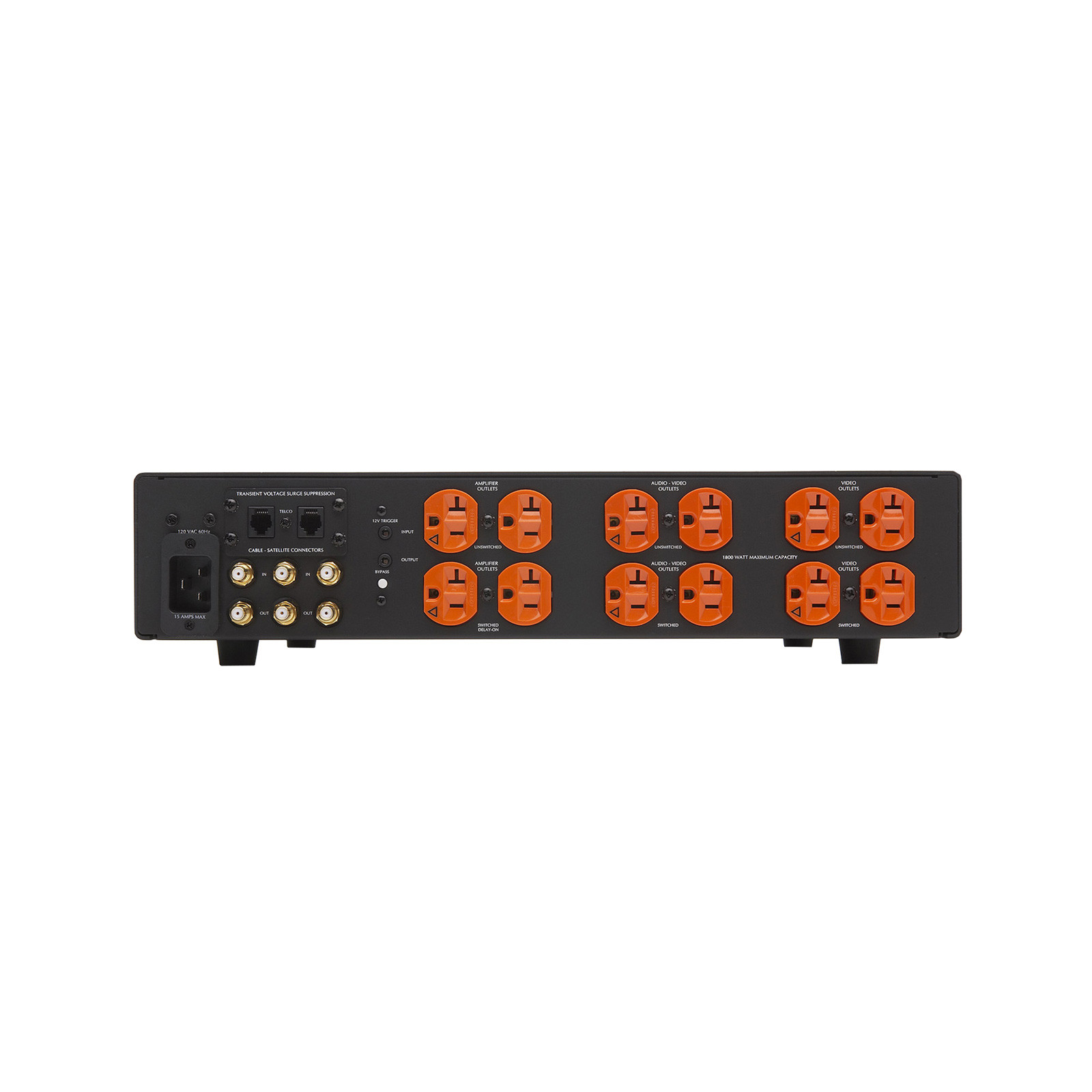
- 1 ultra-linearly filtered front-panel outlet.
- 8 ultra-linearly filtered outlets with additional bi-directional ultrasonic filtering for either video or audio components (4 switched via 12V trigger).
- 4 Power Factor Technology amplifier outlets with ~4.5 amps RMS reserve and over 55 amps peak charge (2 switched with a 5-second delay via 12V trigger).
- Total 13 outlets across 3 isolated banks.
- Requires a dedicated 20-amp wall circuit (NEMA 5-20R outlet).
Front-panel controls and displays
2 retractable LED work lamps with dimmer; power switch; front-panel outlet.
Product specs
- Family: Elite Series
- Line voltage: 120V
- Maximum current rating: 20-amp
- Number of outlets: 13
- Rack-mountable: Yes — rack ears included
- Chassis height: 2U
- Dimensions (H x W x D): 4" H x 17" W x 14.75" D
- Weight: 18 lbs
- Protection: Series Multi-Stage Protection (SMP), Extreme Voltage Shutdown (EVS), non-sacrificial with zero ground contamination
- Under-voltage shutoff: 85V
- Over-voltage shutoff: 140V ±3V
- Filtration: LiFT Linear Filtering Technology
- Power Factor Technology amplifier bank: ~4.5 amps RMS reserve, over 55 amps peak charge
- Initial clamping level: 188 VAC peak at 3,000 amps
- Signal-line protection: 1 telco, 3 cable/satellite
- Compliance: NRTL-C
- Warranty: 3-year limited
Frequently asked questions
Do I really need a power conditioner?
The short answer: yes, almost certainly. Modern AC power is noisier than it has ever been, and that noise ends up in your listening chair as reduced detail and a flatter soundstage. The longer answer is in the "Why Furman" section above — the engineering case for AC conditioning is straightforward once you understand what's riding on the line. In our experience, a good power conditioner will almost always noticeably improve the sound of any high-end audio system.
Will a conditioner limit the current my amplifier needs?
It can, if the conditioner is badly designed. Cheap "filtered" power strips use series chokes that do restrict current — which is why audiophiles rightly worry about plugging big amps into them. Furman's LiFT filter is engineered specifically to avoid that trade-off, and the PFi and IT-Reference models go further by adding a dedicated high-current amplifier bank with Power Factor Technology that actively supplies surplus current on musical peaks. In practice, a well-designed Furman improves amp dynamics rather than limiting them.
What is Power Factor Technology actually doing?
Your power amplifier draws current in large instantaneous bursts on musical transients — not a steady draw. Wall wiring has real impedance, and when the amp calls for 30+ amps in a millisecond, the wall simply can't deliver that fast. Power Factor Technology places a large energy reservoir upstream of the amplifier outlets, sized specifically to fill in those instantaneous peaks. The amp "sees" a far stiffer power source than the wall provides on its own. The audible result is tighter bass, faster transients, and less dynamic compression on loud passages.
What happens to the Furman after a big surge?
Ordinary surge protectors sacrifice their MOVs on a major hit — after one significant event, the protection is used up even though the unit looks fine and the power LED still glows. Furman's SMP circuit is non-sacrificial; it clamps surges without destroying itself and keeps protecting afterward. Multiple large hits do not void the protection.
Which outlets should I use for what?
Plug your power amplifier(s) and any powered subwoofer into the four Power Factor Technology outlets — those are the high-current bank with the energy reservoir behind them. The linearly filtered outlets with ultrasonic filtering are tuned for digital and video components (DAC, streamer, disc player, display). The standard linearly filtered outlets handle everything else — preamp, phono stage, tuner, and similar analog source gear.
What power cord should I use?
Your wall-to-conditioner power cord is the only one that sees raw, unconditioned mains — so this is where a better cable has the biggest audible impact. A high-quality shielded cord rated for the conditioner's input current (15A or 20A depending on model) is a sensible pairing. The captive cord on the Furman is fine out of the box, but aftermarket cords from AudioQuest, Shunyata, or similar can make a meaningful difference once the conditioner is broken in.
What's the warranty?
Furman backs the Elite series with a 3-year limited warranty. Important note: Furman's warranty is only valid on units purchased from authorized dealers. Audio Advisor is an authorized Furman dealer, so your warranty is in place when you buy from us. Purchases from unauthorized internet dealers or auction sites do not qualify.
Why buy the Elite-20 PFi from Audio Advisor?
40+ Years of Expertise — Audio Advisor has helped over one million audiophiles build better-sounding systems since 1981.
60-Day Money-Back Guarantee — Listen in your own room, on your own system, for 60 days. If it's not right, send it back.
Real Experts, Real Help — Our staff has decades of combined experience. Call us: 800-942-0220, weekdays 9am–6pm EST.
Free Shipping on orders over $49.
Flexible Payment Options — Affirm financing available at checkout.
Want to learn more about power conditioning? Visit our Learning Center for guides, tips, and expert advice on AC power quality and system setup.