 Free Shipping on US orders above $49





What You Need to Know
What Is a Phono Preamp, and Why Do You Need One?
If you play vinyl records, a phono preamp (also called a phono stage) is one of the most important components in your system. The signal that comes out of a turntable cartridge is extremely tiny and follows a special equalization curve called RIAA — a standard that boosts high frequencies and cuts bass during the record-cutting process to fit more music into the grooves. A phono preamp does two critical jobs: it amplifies that tiny cartridge signal to a level your amplifier can use, and it applies the reverse of the RIAA curve to restore the music to its natural tonal balance.
The quality of your phono preamp directly affects how your records sound. A good one reveals the detail, dynamics, and warmth that vinyl is loved for. A mediocre one adds noise, blurs fine detail, or colors the sound in ways the recording engineer never intended.
What Makes the UltraPhono Pro Special?
The UltraPhono Pro was designed by Peter Madnick, the same engineer behind MoFi’s flagship MasterPhono ($6,000). According to MoFi, the UltraPhono Pro distills the core architecture of the MasterPhono into a streamlined, single-input design at $2,495. The goal was to bring that same level of musical accuracy and low-noise performance to a more accessible price point without cutting corners where it counts.
At the heart of the design are fully discrete J-FET and MOSFET gain stages. “Fully discrete” means the amplification circuit is built from individual transistors rather than integrated circuit chips — an approach that gives the designer more control over how the circuit handles the delicate cartridge signal. J-FETs (junction field-effect transistors) are particularly well-regarded in phono circuits for their low noise and smooth, natural character.
The RIAA equalization network uses a passive, zero-feedback design with polypropylene film-foil capacitors matched to better than 1%. “Zero feedback” means the circuit doesn’t loop a portion of the output signal back to correct itself — a design philosophy that preserves the natural timing and transient character of the music. MoFi specifies RIAA accuracy within ±0.05 dB, which is exceptionally tight for a phono stage at any price.
The power supply is a seven-stage regulated balanced design, providing the quiet electrical foundation that low-level phono signals demand. Noise is the enemy of phono reproduction — the signal coming from a moving coil cartridge can be as small as 0.2 millivolts — and MoFi has specified ultra-low-noise components throughout to keep the noise floor well below the music.
Front-Panel Cartridge Matching: A Real-World Advantage
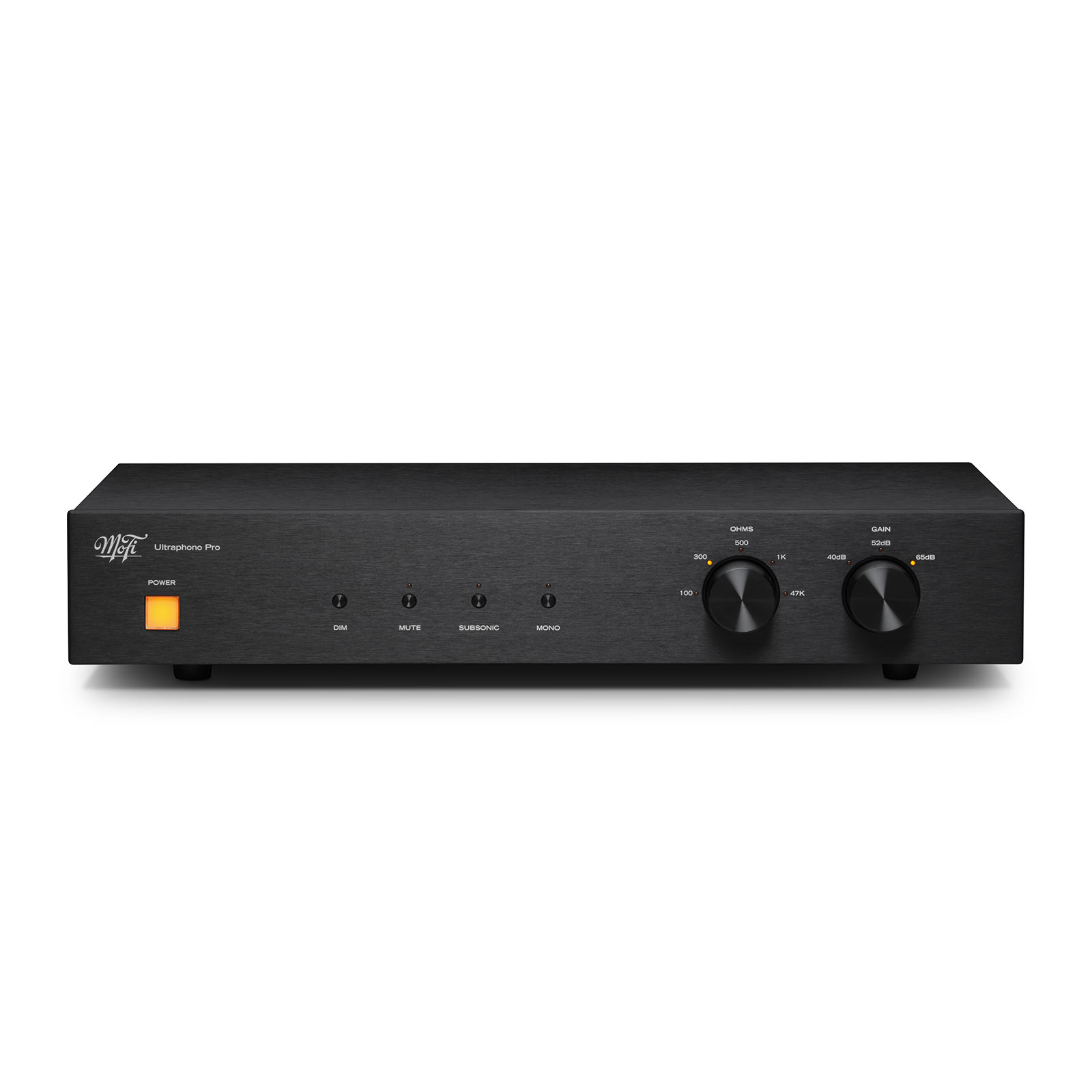
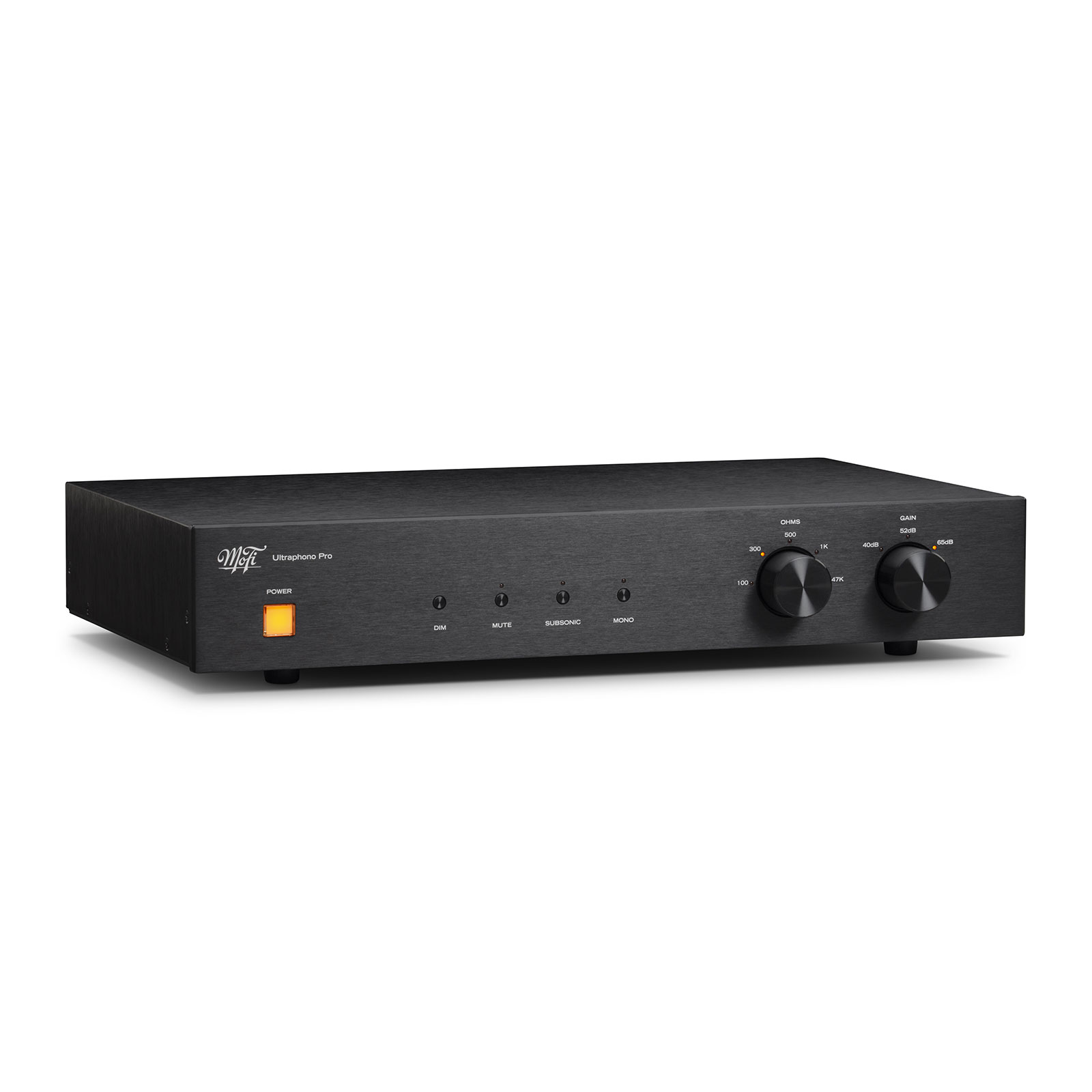
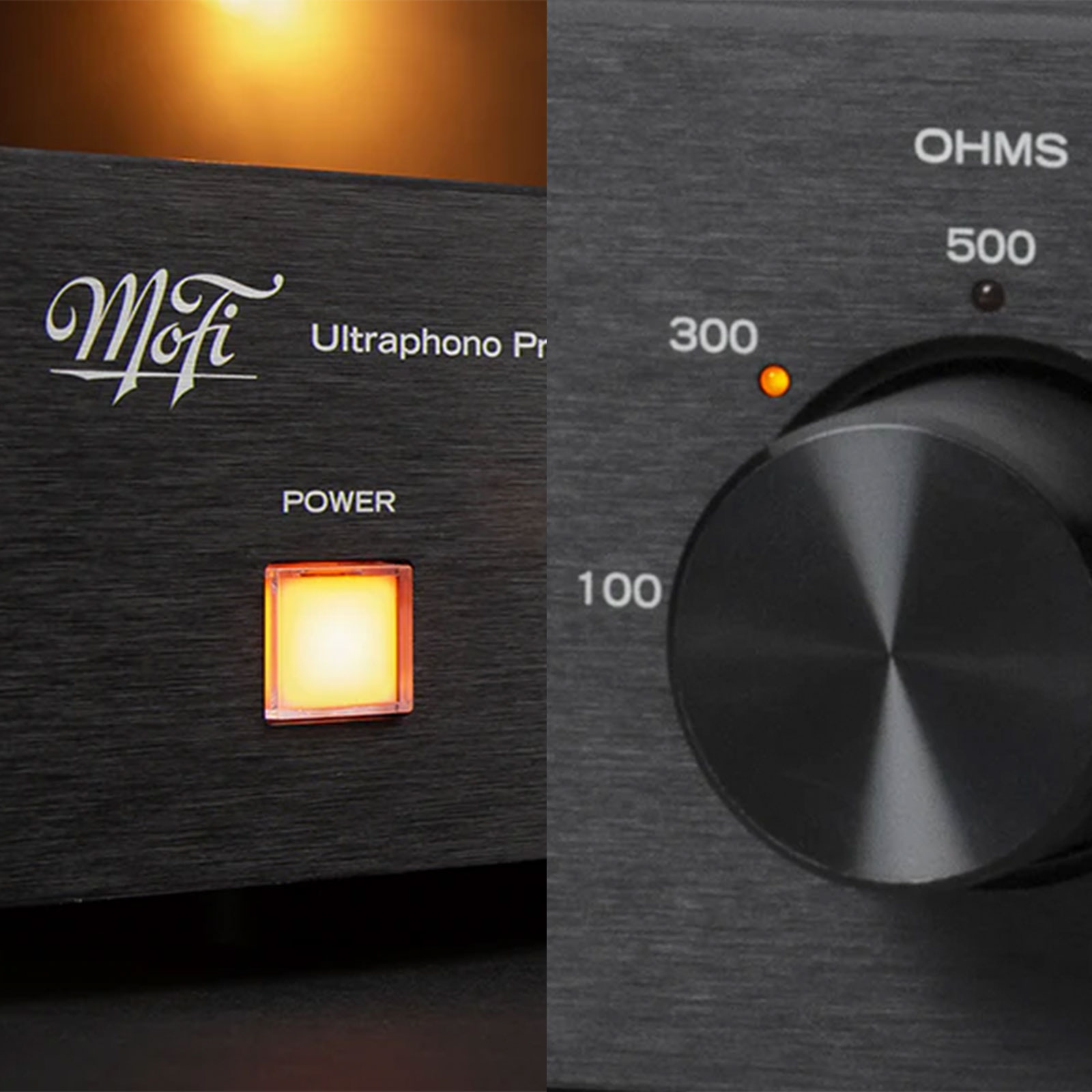
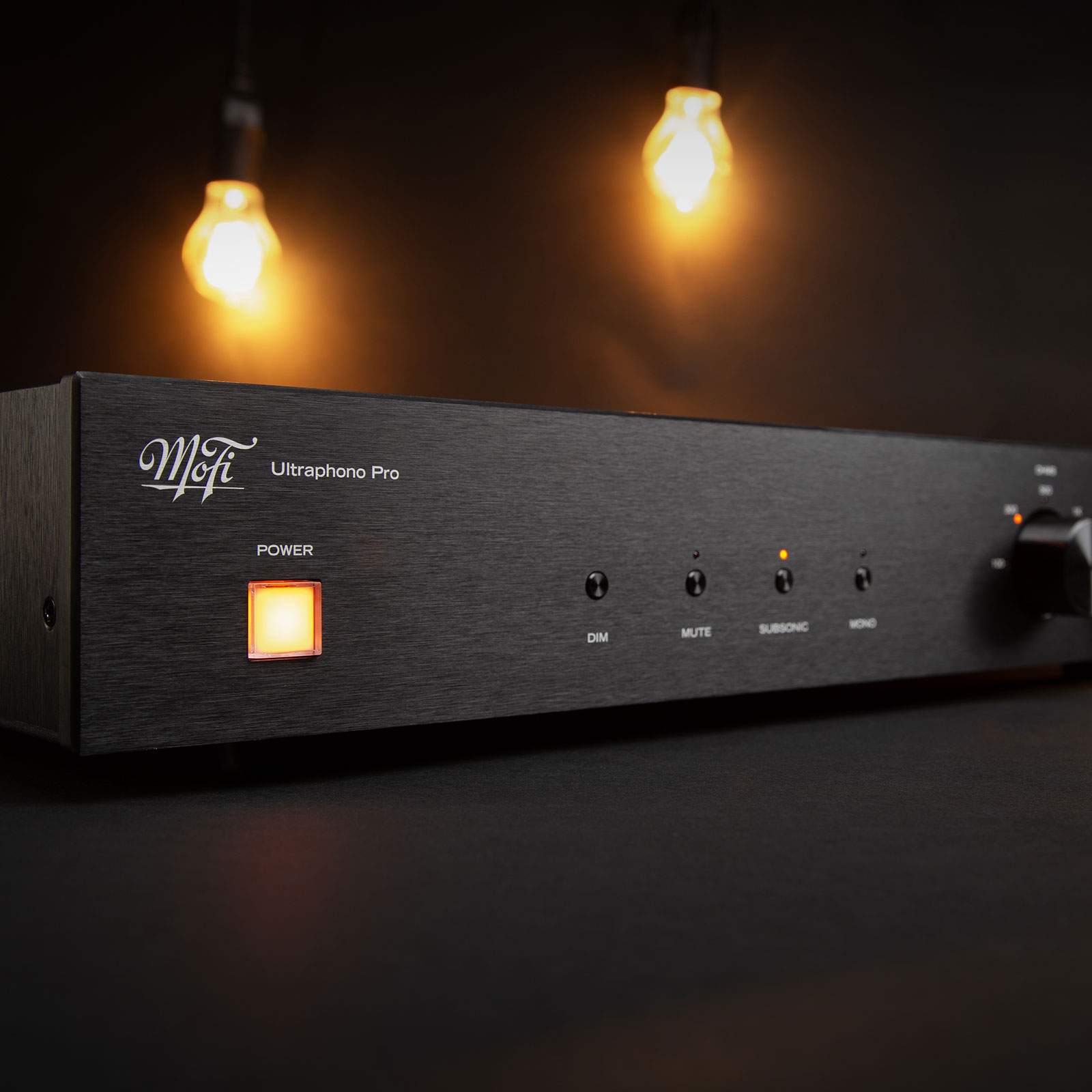
One of the UltraPhono Pro’s most practical features is that gain and loading controls are on the front panel. Many phono preamps, including MoFi’s own original UltraPhono, require you to flip the unit over and adjust tiny DIP switches on the bottom to change settings. With the UltraPhono Pro, you can dial in your cartridge quickly and easily without moving any equipment.
The gain options are 40 dB, 52 dB, and 65 dB via the RCA output (46 dB, 58 dB, 71 dB via balanced output), covering everything from high-output moving magnet cartridges to low-output moving coils. Loading options include 100, 300, 500, 1,000, and 47,000 ohms, giving you the flexibility to fine-tune the match for your specific cartridge.
Beyond gain and loading, the front panel includes a mono button (essential for playing mono records with proper imaging and reduced surface noise), a subsonic filter (which tames low-frequency rumble from warped records or turntable vibration), a mute button, and a display dim control. These are practical, everyday tools that make the UltraPhono Pro a pleasure to live with.
Outputs: Both Balanced and Single-Ended
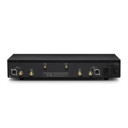
The UltraPhono Pro provides both balanced XLR and single-ended RCA outputs, so it connects to virtually any preamplifier or integrated amplifier. If your amp has balanced inputs, that connection will offer a cleaner signal path (balanced connections reject interference picked up along the cable run) and slightly higher output levels. The input is a single RCA pair with a grounding post — standard for any turntable connection.
Who Is This Phono Preamp Best For?
 You’re a serious vinyl listener looking for a high-performance phono stage that handles both MM and MC cartridges without compromise.
You want much of the MasterPhono’s design DNA and performance at roughly half the price.
You value the convenience of front-panel gain and loading controls instead of crawling behind your rack to flip DIP switches.
You need balanced (XLR) output to connect to a balanced preamplifier or integrated amplifier.
You have a growing vinyl collection that includes mono pressings, warped records, or low-output MC cartridges, and you want a phono stage with the tools to handle all of it.
What’s in the Box
- MoFi Electronics UltraPhono Pro phono preamplifier
- Power supply
- User manual
What the Press Is Saying
The UltraPhono Pro was announced in February 2026 and is a very new product. Full hands-on reviews are forthcoming, but the press response to the announcement has been strong:
ecoustics — February 2026
ecoustics called the UltraPhono Pro a deliberate trickle-down from the MasterPhono, noting it delivers genuine high-end phono design with fully discrete circuitry, very low noise, accurate RIAA, and balanced operation at a price where serious vinyl listeners actually shop. They emphasized that it fills an obvious gap in MoFi’s lineup.
Gear Patrol — February 2026
Gear Patrol highlighted that the UltraPhono Pro was created by the same engineer (Peter Madnick) and is built around the same ultra-low-noise, fully discrete analog topology as the MasterPhono. They described it as potentially a steal for audiophiles looking for an elite phono preamp at half the flagship’s price.
The Absolute Sound — February 2026
The Absolute Sound reported that the UltraPhono Pro offers gain up to 71 dB while maintaining a wide, linear frequency response of 10 Hz–50 kHz (±0.2 dB) and exceptionally accurate RIAA equalization (±0.05 dB), bringing serious performance to the under-$3,000 category.
Tracking Angle — February 2026
Tracking Angle noted the UltraPhono Pro could be a strong contender against established competitors like the PS Audio Stellar Phono and the Parasound JC 3+, praising MoFi’s smart collaborations and unique implementation approach.
Pairs Well With
Building or upgrading your vinyl system? Here are some great companions for the UltraPhono Pro:
- Turntables: The UltraPhono Pro works beautifully with any turntable, including MoFi’s own range. Browse our Turntables.
- Phono Cartridges: MM or MC — the UltraPhono Pro handles both. If you’re upgrading your cartridge, check out our Phono Cartridges.
- Integrated Amplifiers: Connect the UltraPhono Pro’s output to any integrated amp or preamplifier. Explore our Integrated Amplifiers.
- Interconnect Cables: Quality interconnects between the turntable, phono stage, and amplifier make a real difference. Browse our Interconnect Cables.
Features & Specifications
Circuit Design
Fully Discrete J-FET & MOSFET Gain Stages — The amplification circuit uses individual J-FET and MOSFET transistors rather than op-amp chips. This fully discrete approach, inherited from the MasterPhono’s architecture, gives the designer precise control over the signal path for lower noise and more natural sound.
Passive Zero-Feedback RIAA Equalization — The RIAA network uses no feedback loops, preserving the natural timing and transient character of your music. Precision polypropylene film-foil capacitors matched to better than 1% ensure RIAA accuracy within ±0.05 dB — an exceptionally tight tolerance.
Seven-Stage Regulated Balanced Power Supply — Multiple stages of voltage regulation deliver an ultra-quiet foundation for the sensitive gain circuitry. Clean power means lower noise, which means more of the subtle detail in your records is preserved.
Ultra-Low-Noise Component Selection — Critical resistors are specified at 0.1% or 0.5% tolerance. Thermally coupled critical components minimize performance drift as the unit warms up.
Cartridge Matching & Playback Tools
Front-Panel Gain Control — Choose from three gain settings (40/52/65 dB via RCA; 46/58/71 dB via balanced) to match your cartridge’s output level. Moving magnet cartridges typically use the lower settings; low-output moving coils need the higher settings.
Front-Panel Loading Control — Five impedance loading options (100Ω, 300Ω, 500Ω, 1kΩ, 47kΩ) let you optimize the electrical match to your cartridge for the best frequency response and dynamics.
Mono Mode — A front-panel button combines both channels for proper mono playback. Essential for mono pressings — you’ll hear richer tone, better image stability, and less surface noise from your mono records.
Subsonic Filter — Cuts ultra-low-frequency rumble caused by warped records or turntable vibration, preventing woofer cone excursion and keeping your bass clean.
Mute and Display Dim — Practical conveniences for everyday listening.
Inputs & Outputs
Input: Single RCA pair with grounding post (voltage mode, single-ended) — connects directly to your turntable.
Balanced Output: XLR pair — for preamplifiers and integrated amps with balanced inputs. Offers higher gain and better noise rejection over longer cable runs.
Unbalanced Output: RCA pair — standard connection for most amplifiers.
Quick-Reference Specifications
| Performance | |
| Circuit Topology | Fully discrete J-FET & MOSFET, DC-coupled |
| RIAA Equalization | Passive, zero-feedback (±0.05 dB accuracy) |
| Frequency Response | 10 Hz – 50 kHz (±0.20 dB) |
| Max Output (1% THD) | 10 V RMS |
| THD (10mV @ 1kHz, 40dB gain) | 0.005% A-Weighted |
| THD (1mV @ 1kHz, 65dB gain) | 0.013% A-Weighted |
| S/N Ratio (Balanced, 40dB, A-wtd) | 93 dB |
| S/N Ratio (Balanced, 65dB, A-wtd) | 85 dB |
| S/N Ratio (RCA, 40dB, A-wtd) | 83 dB |
| S/N Ratio (RCA, 65dB, A-wtd) | 75 dB |
| Cartridge Matching | |
| Gain (RCA Output) | 40 dB / 52 dB / 65 dB |
| Gain (Balanced Output) | 46 dB / 58 dB / 71 dB |
| Loading Options | 100Ω / 300Ω / 500Ω / 1kΩ / 47kΩ |
| Inputs & Outputs | |
| Input | 1× RCA pair (single-ended, voltage mode) + ground post |
| Balanced Output | 1× XLR pair (230Ω output impedance) |
| Unbalanced Output | 1× RCA pair (115Ω output impedance) |
| Physical | |
| Dimensions (W × H × D) | 17” × 2.5” × 11.35” |
| Weight | 7 lbs |
| Construction | Brushed aluminum panels, rigid steel frame |
| Power Supply | Seven-stage regulated balanced (external) |
Frequently Asked Questions
What’s the difference between the UltraPhono Pro and the original UltraPhono?
The UltraPhono Pro ($2,495) is a completely different product from the original UltraPhono ($499). The Pro features a fully discrete J-FET/MOSFET circuit architecture derived from the MasterPhono, front-panel gain and loading controls (versus bottom-mounted DIP switches on the original), balanced XLR output, a passive zero-feedback RIAA network, a seven-stage regulated power supply, and a full-width component chassis. The original UltraPhono includes a built-in headphone amplifier, which the Pro does not. They serve different segments of the vinyl market.
How does it compare to the MasterPhono?
The MasterPhono ($6,000) is MoFi’s flagship, featuring dual-chassis construction (separate power supply), dual inputs, current-input architecture for ultra-low-impedance MC cartridges, metering, remote control, and firmware upgradability. The UltraPhono Pro uses the same designer (Peter Madnick), the same core circuit concepts, and many of the same parts-selection standards, but in a streamlined single-input, single-chassis design. According to MoFi, the UltraPhono Pro delivers the core musical performance of the MasterPhono at a more accessible price.
Will the UltraPhono Pro work with my cartridge?
Almost certainly yes. With gain settings from 40 dB to 71 dB (balanced) and loading options from 100 ohms to 47k ohms, the UltraPhono Pro handles the vast majority of moving magnet and moving coil cartridges. The 47kΩ loading with 40 dB or 52 dB gain covers standard MM cartridges, while the lower impedance settings and higher gain are designed for MC cartridges. If you’re not sure which settings to use, check your cartridge’s specifications or give us a call — we’re happy to help.
Does the UltraPhono Pro have a headphone output?
No. Unlike the original UltraPhono, the UltraPhono Pro is a dedicated phono preamplifier without a headphone amplifier. It outputs to your preamplifier or integrated amplifier. If you need a phono stage with a built-in headphone amp, the original MoFi UltraPhono includes that feature at $499.
Do I need balanced cables, or will regular RCA work?
Both work. The UltraPhono Pro has both balanced (XLR) and unbalanced (RCA) outputs. If your amplifier has balanced inputs, using the XLR output will give you slightly higher gain and better noise rejection, especially over longer cable runs. If your amp only has RCA inputs, the RCA output works perfectly well. You don’t lose any core performance — the balanced output simply adds an extra layer of noise rejection.
What does the mono button do?
The mono button combines both stereo channels into one. This is the correct way to play mono vinyl records — it reduces surface noise, eliminates vertical stylus movement artifacts, and typically produces richer tone and more stable imaging than playing a mono record in stereo mode. If you have mono pressings in your collection (vintage or reissues like the Mobile Fidelity Bob Dylan series or The Beatles in Mono box set), the mono switch is an essential tool.
What does the subsonic filter do?
The subsonic filter reduces ultra-low-frequency energy below the audible range. This energy can come from warped records, turntable vibration, or acoustic feedback. Without filtering, this inaudible energy wastes amplifier power and causes visible woofer cone movement, which can muddy your bass. The subsonic filter cleans this up without affecting the audible bass you want to hear.
What else do I need to connect this to my system?
You’ll need a turntable with a cartridge (MM or MC), an interconnect cable from the turntable to the UltraPhono Pro’s RCA input (most turntables include one), another pair of interconnects from the UltraPhono Pro’s output to your preamplifier or integrated amplifier, and of course the amp and speakers themselves. If you’re using the balanced XLR output, you’ll need XLR interconnects for that connection. Give us a call and we can help you put together the complete system.
Why Audio Advisor?
 40+ Years of Expertise — Since 1981, we’ve helped over a million music lovers find the right gear.
 60-Day Money-Back Guarantee — Take your time. Listen, enjoy, and make sure it’s right for you.
 Real Experts, Real Help — Our team is here to answer your questions at 800-942-0220, weekdays 9am–6pm EST.
 Free Shipping — On orders over $49, delivered to your door.
 Flexible Payment Options — Financing available so you can start listening now.
Want to learn more about turntables, cartridges, and phono stages? Visit our Learning Center for guides, tips, and expert advice.


