 Free Shipping on US orders above $49


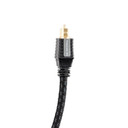


Superior Step-Up Optical Cable
Most optical cables on the market use a single Multi-Mode Plastic Optical Fiber (POF) to keep prices low. But this isn't the best approach for getting the top sonic performance from a fiber optic cable. "I have always found that the Multi-Core cables sound significantly better than POF cables," reports Pangea Audio designer Jay Victor.
For the Pangea Premier SE optical cable, Jay Victor selected a very high end 19-core Multi-Core Plastic Optical Fiber that boat 19 Core that has an attenuation specification of <.136 dB/meter, which is much lower than normal POF fibers, "and some I’ve tested are as much as .8 dB/m," Jay reports. The result is a significant upgrade in audiophile performance.
"Commitment to Uncompromising Sound Quality"
"What sets the Premiere apart is commitment to uncompromising sound quality," reports the MaxReviews Pro channel, on YouTube, October 10, 2024. "This cable promises to deliver an unparalleled listening experience through its use of Premium multicore plastic optical fiber POF."
Superior Termination for Optimal Optical Transparency
Another critical factor in optical cable performance is how the fiber is terminated. Most optical cables are “hot plate terminated”, which is exactly what it sounds like. The end is simply pressed up against a hot steel plate to hopefully create a flat surface. However, this is not really the best way to ensure an optically transparent termination, which is desirable for obvious reasons. A better termination, results in less loss.
For this reason, the Pangea Premier optical cable has a polished termination, which is far superior in optical transparency, results in less loss, and is seldom used in any single POF cables because of cost. Essentially, the termination is polished mechanically, using a very fine grit abrasive material to end up with a very fine, optically transparent end. This is an expensive method, but, if the best performance is desired, this is the method to use.
Step-Index Multimode Fiber (Single POF)
Plastic optical fiber is a step-index multimode optical fiber, composed of a cylindrical "core" surrounded by a "clad" layer. The light refraction index of the core is higher than that of the cladding. Light traveling through the core is therefore reflected at the core-clad interface, so long as the angle of its incidence with the interface is smaller than a certain "critical angle" (theta max). In this way, the light is repeatedly reflected from the interface as it progresses through the core to the end of the optical fiber.
Due to its large core, some of the light rays that make up the digital pulse may travel a direct route, whereas others zigzag as they bounce off the cladding. These alternate paths cause the different groups of light rays, referred to as modes, to arrive separately at the receiving point. "The pulse, an aggregate of different modes, begins to spread out, losing its well-defined shape. The need to leave spacing between pulses to prevent overlapping limits the amount of information that can be sent," notes Jay Victor. "This is the primary drawback of Single POF cables, and I believe the various modes and conversion processes can cause jitter."
The Multi-Core POF Solution
To overcome the scattering effect (modes) of the light waves in a single POF cable, a multi-core POF is the solution. The Pangea Premier SE optical cable utilizes this technology to produce a superior grade optical cable. The difference is that instead of a single optical fiber, a group of smaller optical fibers are used.
In listening to both single POF, and Multi-Core POF cables, I have always found that the Multi-Core cables sound significantly better. There is definitely less transmission loss, but I believe there is also a minimization of timing errors, and a faster, more accurate detection of light pulses, which can ultimately reduce jitter.


