 Free Shipping on US orders above $49




What You Need to Know
What Is This Cable and What Does It Do?
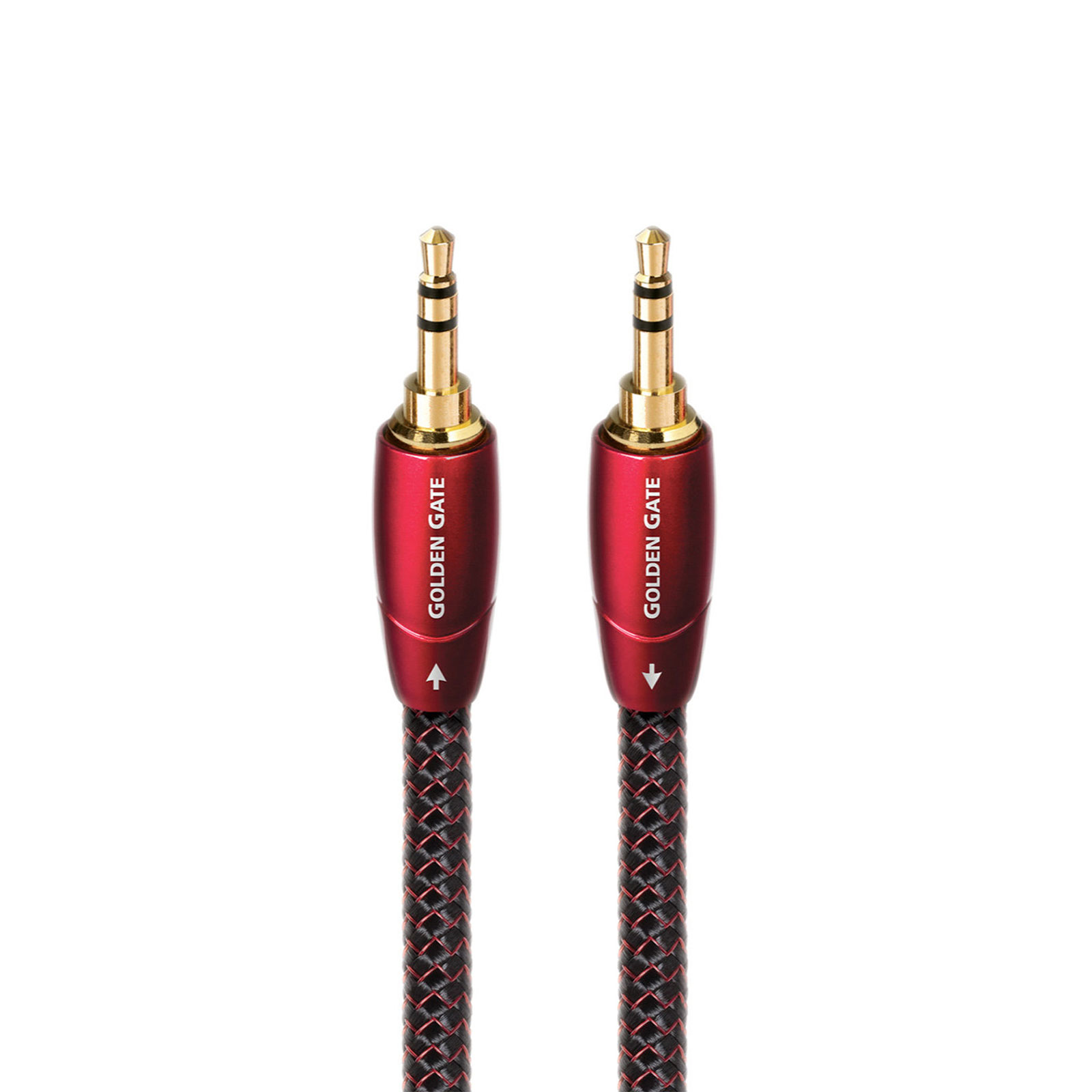
This is an analog stereo audio cable with a 3.5mm mini-plug on each end. The 3.5mm (1/8") mini-plug is the small headphone-style connector found on smartphones, laptops, computer sound cards, portable music players (DAPs), and many powered speakers.
Golden Gate connects two devices that both use 3.5mm jacks. Common uses include a high-quality DAP to a portable headphone amplifier, a desktop computer with a competent USB DAC's headphone output to powered speakers with a 3.5mm input, or a soundbar to a smartphone source.
Golden Gate sits in the middle of the Bridges & Falls line. It's where AudioQuest's mid-line conductor metal — Perfect-Surface Copper — first appears in this scope.
Which AudioQuest Family Is This From?
Golden Gate belongs to AudioQuest's Bridges & Falls series. Cables in this family share a common design approach: solid copper conductors, low-loss insulation, and single-cable stereo construction.
The Bridges & Falls ladder runs Tower → Chicago → Evergreen → Red River → Golden Gate → Mackenzie → Big Sur → Yukon, with Sydney sitting at the top of the family.
What's Different About This One?
Golden Gate's headline change is the conductor metal. It uses solid Perfect-Surface Copper (PSC). PSC is a high-purity copper drawn through a process that leaves the surface unusually smooth. A smoother surface helps with corrosion resistance over time and reduces irregularities at the conductor's outer edge — where AudioQuest argues a lot of the action happens electrically.
"Solid" still means a single core per conductor. AudioQuest's view is that strand-to-strand contact in a stranded cable can introduce small distortions, and a solid core avoids that entirely.
The insulation around the copper is called the dielectric. Golden Gate uses foamed polyethylene — polyethylene with tiny air bubbles foamed in to lower its electrical losses. A lower-loss dielectric helps a small analog signal arrive in better shape.
The conductors are direction-controlled. The arrow on the cable points from the source toward the destination. AudioQuest has been making analog audio cables since Bill Low founded the company in 1980, and Golden Gate is a meaningful step up the same engineering ladder.
Which Connector Configuration Do I Need?
The answer comes from looking at both ends of the connection. The source is usually a portable device with a 3.5mm jack. The destination is whatever you're plugging into.
If both ends are 3.5mm jacks, you need this 3.5mm-to-3.5mm version. If the destination has RCA inputs (small round red and white jacks), you need the 3.5mm-to-RCA version instead.
Where Does This Cable Belong in Your System?
Golden Gate is the right step up when both ends are 3.5mm and the rest of your system is up for it.
- Good fit: a quality DAP into a quality portable headphone amplifier; desktop computer audio with both ends on 3.5mm; high-quality powered speakers with a 3.5mm input; thoughtful portable rigs where the cable's position in the chain actually shows.
- Not ideal: very entry-level systems where the cable would outclass everything else; a 3.5mm source into RCA inputs (use the 3.5mm-to-RCA version instead).
- Different connector configuration? See the Golden Gate 3.5mm-to-RCA or Golden Gate 3.5mm-to-F-connector versions.
Length: Use the shortest cable that comfortably reaches between the two components. Measure the actual route — not the straight-line distance — and add a little slack.
Pairs Well With
Building your system? Here are some natural companions for Golden Gate:
- Portable headphone amplifiers — a quality DAP-to-amp pair is where Golden Gate shines.
- Standalone DACs with 3.5mm outputs.
- Powered speakers with 3.5mm inputs for desktop or computer-audio setups.
- AudioQuest Big Sur 3.5mm-to-3.5mm — the next big step up the ladder, with PSC+ conductors.
- AudioQuest Golden Gate 3.5mm-to-RCA — same model, RCA destination instead of 3.5mm.
Features & Specifications
Golden Gate's most important upgrade is the conductor metal:
- Solid Perfect-Surface Copper (PSC) conductors — higher purity than LGC, with an unusually smooth surface.
- Foamed-polyethylene dielectric — lower electrical loss than the standard PVC found on generic cables.
- Single-cable stereo construction — left, right, and common return in one tidy cable.
- 3.5mm mini-plug on each end — verify body, contact material, and plating per current AudioQuest spec.
- Direction-controlled conductors — arrow marks the preferred source-to-destination orientation.
- Multiple lengths stocked at Audio Advisor — see the length selector for current SKUs.
- Limited lifetime warranty — original owner, authorized U.S. dealer.
Quick-Reference Specifications
| Conductor | Solid Perfect-Surface Copper (PSC) |
| Geometry | Single-cable stereo |
| Dielectric | Foamed Polyethylene |
| Noise Dissipation | Standard shield |
| Connectors | 3.5mm mini-plug, both ends |
| Direction Control | Yes — arrow indicates direction from source to destination |
| Available Lengths | Multiple lengths stocked — see length selector |
| Warranty | Limited lifetime, original owner, authorized U.S. dealer |
Frequently Asked Questions
What kind of source can I connect with this cable?
Anything with a 3.5mm headphone-style output: smartphones, laptops, tablets, portable music players (DAPs), older iPods, and computer sound cards. The other end goes into anything with a 3.5mm input — usually powered speakers, a portable amplifier, or a soundbar.
How does Golden Gate compare to Evergreen in this same configuration?
The big change is the conductor metal. Evergreen uses solid Long-Grain Copper (LGC). Golden Gate uses solid Perfect-Surface Copper (PSC) — a higher-purity copper with an unusually smooth surface. Both use foamed-polyethylene insulation and single-cable stereo construction, so the structural approach is the same.
What does "Perfect-Surface Copper" actually mean?
It's high-purity copper drawn through a process that leaves the surface unusually smooth. A smoother surface helps with corrosion resistance over the cable's lifetime and reduces irregularities at the conductor's outer edge.
How does this cable compare to a generic 3.5mm cable?
Golden Gate uses solid Perfect-Surface Copper conductors and foamed-polyethylene insulation, where most generic cables use stranded copper of unspecified purity and standard PVC. You're paying for higher-grade materials, careful direction-control, and AudioQuest's lifetime warranty.
Will this cable improve the sound of my smartphone or laptop?
That depends on the rest of your system. AudioQuest designs its cables to "do no harm" and pass the signal cleanly. The 60-day return window lets you take it home and listen for yourself.
What length should I get?
Use the shortest cable that comfortably reaches between the two components. Measure the actual route — not the straight-line distance — and add a little slack.
Is the 3.5mm connector stereo?
Yes. The 3.5mm plug has three contacts — left audio, right audio, and a common ground — exactly like a wired-headphone plug. Golden Gate carries a full stereo signal end-to-end.
How do I know which connector configuration I need?
Look at the back of the destination component. RCA jacks are small round single-pin connectors, often color-coded red and white. 3.5mm jacks are small round single-jack connectors of the headphone-plug type. F-connectors are larger threaded screw-on connectors. If both ends of your connection are 3.5mm, this is the right cable.
What's the warranty?
AudioQuest cables purchased from an authorized U.S. dealer carry a non-transferable, original-owner limited lifetime warranty. Audio Advisor is an authorized AudioQuest dealer, so you're covered.
? 40+ Years of Expertise — Since 1981, we’ve helped over a million music lovers find the right gear.
? 60-Day Money-Back Guarantee — Take your time. Listen, enjoy, and make sure it’s right for you.
? Real Experts, Real Help — Call us at 800-942-0220, weekdays 9am–6pm EST.
? Free Shipping — On orders over $49, delivered to your door.
? Flexible Payment Options — Financing available so you can start listening now.
Want to learn more about analog interconnects? Visit our Learning Center for guides, tips, and expert advice.

