 Free Shipping on US orders above $49





What You Need to Know
What Is This Cable and What Does It Do?
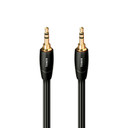
This is an analog stereo audio cable with a 3.5mm mini-plug on each end. A 3.5mm (1/8") mini-plug is the small headphone-style connector you find on smartphones, laptops, computer sound cards, portable music players, and many powered speakers.
Tower connects two devices that both use 3.5mm jacks. Common uses include a portable music player to a portable headphone amplifier, a computer to powered speakers with a 3.5mm input, or a smartphone to a soundbar's 3.5mm AUX jack.
Tower sits at the entry of the AudioQuest interconnect line. It is the friendly first step up from a generic stock cable — built with the same engineering thinking AudioQuest uses across its whole range, just scaled to fit a $50 cable.
Which AudioQuest Family Is This From?
Tower belongs to AudioQuest's Bridges & Falls series — the entry tier of the line. Cables in this family share a common design approach: solid copper conductors, low-loss insulation, and a single-cable stereo build that keeps left, right, and ground tidy in one jacket.
From here, the family steps up through Chicago, Evergreen, Red River, Golden Gate, and beyond. Tower is where the ladder starts.
What's Different About This One?
Three things matter most on a cable like this: the metal, the insulation, and the build.
Tower uses solid Long-Grain Copper (LGC). Solid means a single core per conductor, not a bundle of small strands. AudioQuest's view is that strand-to-strand contact in a stranded cable can introduce small distortions, and a solid core avoids that entirely. Long-Grain Copper is a higher-purity copper with a more uniform crystal structure than ordinary copper.
The insulation around the copper is called the dielectric. Tower uses foamed polyethylene — polyethylene with tiny air bubbles whipped into it to lower its electrical losses. A lower-loss dielectric helps a small analog signal arrive in better shape.
The conductors are direction-controlled. AudioQuest marks an arrow on the cable showing the orientation it considers preferred — pointing from the source toward the destination. Plug it in that way; the rest is taken care of.
AudioQuest has been making analog audio cables since Bill Low founded the company in 1980. Tower is the most accessible expression of four decades of refinement in conductor metallurgy and termination.
Which Connector Configuration Do I Need?
The answer comes from looking at both ends of the connection. The source is usually a portable device with a 3.5mm jack. The destination is whatever you're plugging into.
If the destination has its own 3.5mm jack, you need this 3.5mm-to-3.5mm version. If the destination has RCA inputs (small round red and white jacks), you need the 3.5mm-to-RCA version instead.
Where Does This Cable Belong in Your System?
Tower is the right starting point when both ends of your connection are 3.5mm jacks and you want a real cable instead of whatever shipped in the box.
- Good fit: portable music player to portable headphone amplifier; laptop or computer headphone output to powered speakers with a 3.5mm input; smartphone or DAP to a soundbar's 3.5mm AUX input; tablet to a portable Bluetooth speaker's wired AUX jack.
- Not ideal: connecting a 3.5mm source to RCA inputs (use the 3.5mm-to-RCA version instead); high-end DAC-to-preamp connections, where RCA or XLR is almost always the right choice.
- Different connector configuration? See the Tower 3.5mm-to-RCA version for connecting to RCA inputs, or the Tower 3.5mm-to-F-connector version for Bose Wave systems.
Length: Use the shortest cable that comfortably reaches between the two components. Measure the actual route — not the straight-line distance — and add a little slack.
Pairs Well With
Building your system? Here are some natural companions for Tower:
- Portable headphone amplifiers — a Tower 3.5mm-to-3.5mm pair is a friendly upgrade between a phone or DAP and a portable amp.
- Powered desktop speakers with 3.5mm inputs — a clean computer-to-speaker connection.
- AudioQuest Evergreen 3.5mm-to-3.5mm — the next step up the ladder when you want a little more.
- AudioQuest Tower 3.5mm-to-RCA — same model, RCA destination instead of 3.5mm.
Features & Specifications
Tower is built around a small set of choices that make a measurable difference in long-term reliability and engineering integrity:
- Solid Long-Grain Copper conductors — purer than ordinary copper, with no strand interaction.
- Foamed-polyethylene dielectric — lower electrical loss than standard PVC insulation.
- Single-cable stereo construction — left, right, and common return in one tidy cable.
- 3.5mm mini-plug terminations on both ends — the standard headphone-style plug used on phones, laptops, and most portable players.
- Direction-controlled conductors — arrow marks the preferred source-to-destination orientation.
- Multiple lengths stocked at Audio Advisor — see the length selector for current SKUs.
- Limited lifetime warranty — original owner, authorized U.S. dealer (Audio Advisor is authorized).
Quick-Reference Specifications
| Conductor | Solid Long-Grain Copper (LGC) |
| Geometry | Single-cable stereo |
| Dielectric | Foamed Polyethylene |
| Noise Dissipation | Standard shield |
| Connectors | 3.5mm mini-plug both ends — verify body, plating, and termination per current AudioQuest spec |
| Direction Control | Yes — arrow indicates direction from source to destination |
| Available Lengths | Multiple lengths stocked — see length selector |
| Warranty | Limited lifetime, original owner, authorized U.S. dealer |
Frequently Asked Questions
What kind of source can I connect with this cable?
Anything with a 3.5mm headphone-style output: smartphones, laptops, tablets, portable music players (DAPs), computer sound cards, and most older iPods. The other end plugs into anything with a 3.5mm input — usually powered speakers, a portable amplifier, or a soundbar.
How does this cable compare to a generic 3.5mm cable from a big-box store?
Tower uses solid Long-Grain Copper conductors and foamed-polyethylene insulation, where most generic cables use stranded copper of unspecified purity and standard PVC. You're paying for higher-quality materials, careful direction-control, and AudioQuest's lifetime warranty.
Will this cable improve the sound of my smartphone or laptop?
That depends on the rest of your system. AudioQuest designs its cables to "do no harm" and pass the signal cleanly. If your source and destination are revealing enough to show small differences, you may notice them. If you're skeptical, take the 60-day return window and listen for yourself.
What length should I get?
Use the shortest cable that comfortably reaches between the two components. Measure the actual route the cable will take — not the straight-line distance — and add a little slack. Shorter cables are also easier on portable setups.
Is the 3.5mm connector stereo? Will it carry both left and right channels?
Yes. The 3.5mm plug has three contacts — left audio, right audio, and a common ground — exactly the same arrangement as a wired-headphone plug. Tower carries a full stereo signal end-to-end.
How do I know which connector configuration I need?
Look at the back of the destination component. RCA jacks are small round single-pin connectors, often color-coded red and white. 3.5mm jacks are small round single-jack connectors of the headphone-plug type. F-connectors are larger threaded screw-on connectors, common on cable-TV equipment and certain Bose Wave systems. If both ends of your connection are 3.5mm, this is the right cable.
What's the warranty?
AudioQuest cables purchased from an authorized U.S. dealer carry a non-transferable, original-owner limited lifetime warranty. Audio Advisor is an authorized AudioQuest dealer, so you're covered.
Why Audio Advisor?
 40+ Years of Expertise — Since 1981, we’ve helped over a million music lovers find the right gear.
 60-Day Money-Back Guarantee — Take your time. Listen, enjoy, and make sure it’s right for you.
 Real Experts, Real Help — Our team is here to answer your questions at 800-942-0220, weekdays 9am–6pm EST.
 Free Shipping — On orders over $49, delivered to your door.
 Flexible Payment Options — Financing available so you can start listening now.
Want to learn more about analog interconnects? Visit our Learning Center for guides, tips, and expert advice.

