 Free Shipping on US orders above $49








What You Need to Know
What Is the AMP-F10?
A power amplifier does one job: it takes the signal from your preamplifier or streaming DAC and gives it the power to drive your speakers. No streaming, no DAC, no volume control — just amplification, done well.
The AMP-F10 is EverSolo's first dedicated power amplifier — and it was designed from the start to be a partner for the DMP-A10. Visually, they share the same angular aluminum language. Sonically, they were voiced to work together.
But the AMP-F10 is not a one-system product. It has XLR and RCA inputs, two gain settings, a stereo/bridge switch, and the flexibility to work with virtually any preamp, DAC, or streamer you already own.
Class AB with Class A Bias — What Does That Mean?
Amplifiers are grouped by how their output stage works. Class A amplifiers run their output devices continuously — which sounds great but wastes most of the power as heat. Class AB amplifiers are more efficient, but can introduce a small amount of distortion at the point where the output devices switch on and off.
The AMP-F10 uses a clever middle path. At low and moderate power levels — which covers most real-world listening — it operates in Class A mode. The output devices are always "on," so there's no switching distortion. When you push the volume up into high-power territory, it switches to Class AB to handle the extra demand efficiently.
The result is the sound quality of Class A where it matters most, with the power reserves of Class AB when you need them.
Power Supply — 1000 Watts of Headroom
One of the AMP-F10's most impressive features sits inside the box: a 1000W dual-channel independent linear power supply. Each stereo channel gets its own dedicated power rail — left and right are fully separate. There's no sharing, no crosstalk, no competition for current during loud passages.
A large toroidal transformer sits at the heart of the supply — Stereophile's Tom Fine noted it was "about the size of my stretched out hands." Paired with 160,000µF of capacitance, the power reserve is substantial. When music demands a sudden burst of energy, the AMP-F10 has it ready.
EverSolo also includes an innovative DC filtering circuit between the AC supply and the audio circuit. This removes low-frequency DC interference from the power line before it can affect the audio circuits — reducing transformer hum and keeping the noise floor very low.
MOSFET Output Stage — Five Pairs Per Channel
The output stage uses five pairs of precision-matched Vishay IRFP9240 MOSFET transistors per channel — ten pairs total in the amplifier. MOSFET stands for Metal-Oxide-Semiconductor Field-Effect Transistor. In audio amplifiers, MOSFETs are prized for their smooth, linear behavior and their ability to handle high currents without distortion.
The five pairs are wired in parallel. This spreads the current load evenly across all ten devices, which lowers distortion, reduces heat per device, and gives the amplifier a very robust ability to drive difficult speaker loads — including speakers rated at 2 ohms.
The measured damping factor is greater than 600 at 8 ohms. Damping factor tells you how firmly the amplifier controls the movement of your speaker's woofer. A higher number means better control, tighter bass, and less overhang after a bass note ends.
How Does It Sound?
The AMP-F10 has a distinct character. Reviewers consistently describe it as warm, full, and smooth — with a strong, authoritative low end that gives speakers a feeling of weight and body.
According to Wojciech Pacuła at highfidelity.pl, it is "a smooth, silky-sounding amplifier with a well-maintained rhythm and clearly articulated dynamics." He noted the bass response is "warm, but it doesn't have a smeared front or a blurred 'tail'" and praised its "very good control over the speakers."
Tom Fine at Stereophile found it delivered "a visceral musical experience, felt throughout the body" and was especially effective at giving smaller speakers more presence and low-end weight.
This warm, full presentation suits many music styles and many speaker types. It works particularly well with bookshelf speakers, standmounts, and smaller floorstanders that benefit from extra low-end energy. With speakers that already have strong bass, the character may require some adjustment via EQ. If you're unsure, give us a call at 800-942-0220 and we can help you think through the match.
What Are Reviewers Saying?
Stereophile's Tom Fine praised the AMP-F10's strong, foundational bass — describing it as an amplifier that "will deliver a visceral musical experience, felt throughout the body." He recommended it for bookshelf speakers and standmounts that "could use a little extra bass," calling it "worth a look and listen."
highfidelity.pl called the AMP-F10 "a smooth, silky-sounding amplifier with a well-maintained rhythm and clearly articulated dynamics." The bass was praised as warm but never sluggish — "very good control over the speakers." High frequencies were described as slightly withdrawn, giving it a smooth, non-fatiguing overall character.
Terry Ellis called the AMP-F10 "a very pleasing, enjoyable power amplifier to listen to across a wide selection of music." He praised the visual and sonic match with the DMP-A10: "Using them with the right speakers can create a great hi-fi system that will be very enjoyable."
Who Is This Best For?
 You own or are buying an EverSolo DMP-A10. The AMP-F10 was designed to match it — visually and sonically.
You have bookshelf speakers, standmounts, or smaller floorstanders. Reviewers found the AMP-F10 gave smaller speakers more weight and presence than their size would suggest.
You want lots of power in reserve. 200W per channel at 8Ω handles everything from low-efficiency speakers to large rooms with ease.
You're building a mono-block system. Two AMP-F10s, each run in bridge mode, deliver up to 950W per channel — enough for almost any speaker in any room.
You prefer a warm, smooth, musical amplifier character over an analytical one.
How Does It Connect to Your System?
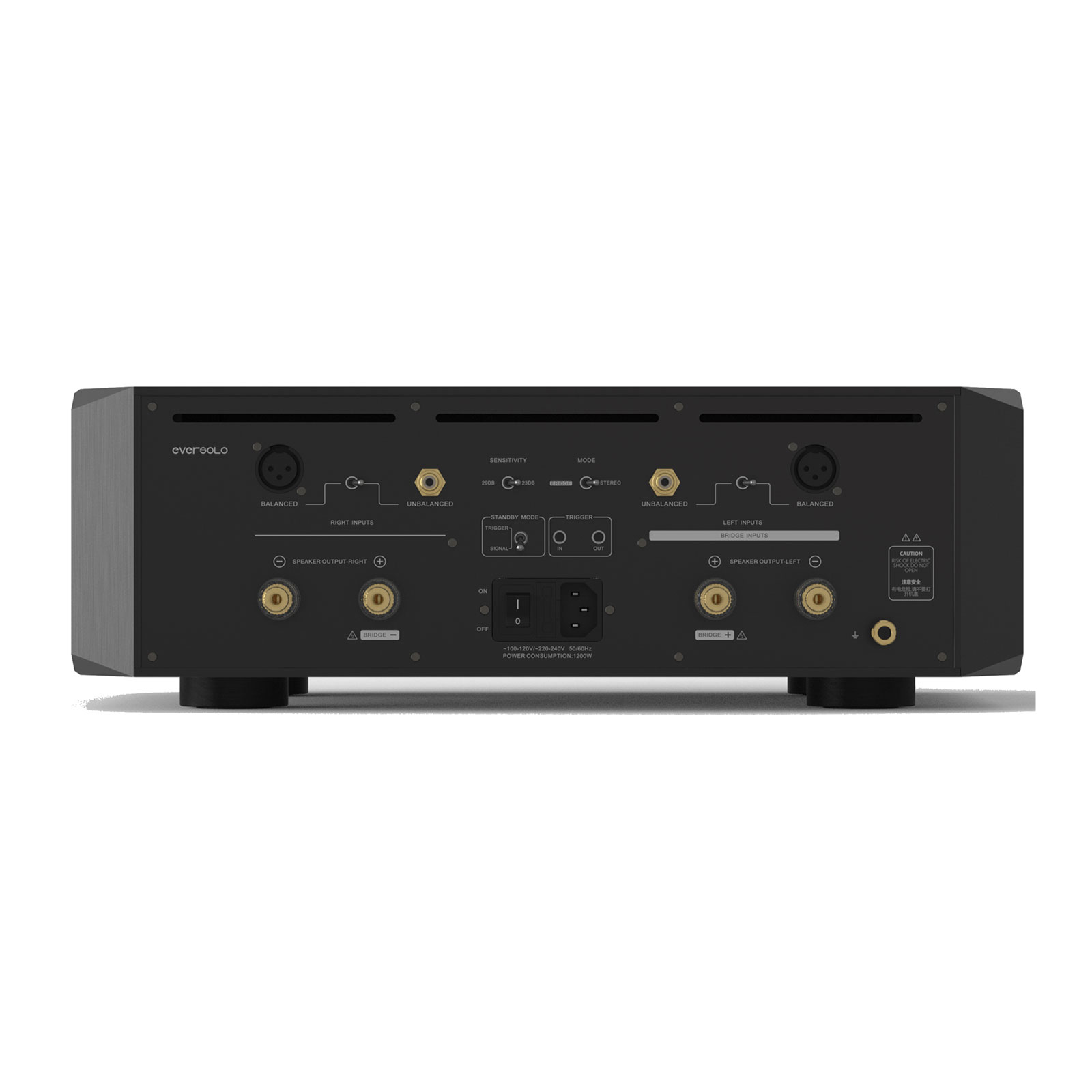
Inputs: One XLR balanced pair and one RCA unbalanced pair. Both have an input impedance of 10kΩ. You select which one to use via a rear panel switch. Only one input can be active at a time.
Gain settings: A rear switch selects between 23dB and 29dB of gain. Use 23dB if your preamp or DAC has a high output level (like the DMP-A10's 4.2V XLR output). Use 29dB if your source has a lower output level. The correct setting lets you use more of your preamp's volume range — giving finer volume control.
Speaker outputs: Four binding posts per channel (two for positive, two for negative), accepting both spade lugs and banana plugs. Stereo pairs clearly labeled left and right.
Stereo / Bridge mode: A rear switch changes the amplifier between stereo and bridged-mono operation. In bridge mode, both channels combine to drive a single speaker at much higher power. To use two speakers in bridge mode, you need two AMP-F10 units.
Standby options: A rear switch sets how the unit powers up — manually, via 12V trigger, or when it detects an incoming audio signal. The 12V trigger connects to the trigger output on a streamer or preamp, so the amp powers up automatically when your system turns on.
Important note on ventilation: The AMP-F10 runs warm in normal use. Stereophile's measurements found the heatsinks reached 139°F (59.5°C) after 30 minutes of use. Leave adequate space around the unit — at least 4–6 inches above and on the sides. Do not stack equipment on top of it.
What's in the Box
- EverSolo AMP-F10 Stereo Power Amplifier
- AC power cable ×1
- Trigger cable ×1
- User manual ×1
Speaker cables and interconnects are not included. Verify the complete packing list with EverSolo before ordering.
What the Pros Are Saying
Stereophile's Tom Fine compared the AMP-F10 directly to a Benchmark AHB2 reference amp, finding it brought "usefully more bass weight." He called its low end "literally foundational to the amplifier's personality." For bookshelf and standmount owners wanting more low-end presence, he said it is "worth a look and listen."
Wojciech Pacuła at highfidelity.pl described the AMP-F10 as "a smooth, silky-sounding amplifier with a well-maintained rhythm and clearly articulated dynamics." He praised the bass as warm but never sluggish and called the control over the speakers "very good." High frequencies were slightly withdrawn — contributing to a non-fatiguing character.
Terry Ellis tested the AMP-F10 in stereo and bridged-mono configurations. He called it "a very pleasing, enjoyable power amplifier to listen to across a wide selection of music" and praised its pairing with the DMP-A10 as genuinely complementary — both visually and sonically.
Building Your System? Here Are Some Great Companions.
- EverSolo DMP-A10 — The DMP-A10's balanced XLR outputs connect directly to the AMP-F10's XLR inputs. The two units were designed together — in size, styling, and sound character. See the DMP-A10.
- EverSolo DMP-A8 — The DMP-A8's balanced XLR outputs work well with the AMP-F10 for a smaller two-box setup at a lower total price. See the DMP-A8.
- Bookshelf & Standmount Speakers — The AMP-F10's warm, full character and high power suit speakers that benefit from extra low-end energy. Browse bookshelf speakers.
- Floorstanding Speakers — 200W per channel handles most floorstanders with authority. Browse floorstanding speakers.
- Balanced XLR Interconnects — Connecting the AMP-F10 via XLR gives you the full benefit of the balanced circuit. Browse interconnects.
- A Second AMP-F10 — Two AMP-F10 units running in bridged-mono mode deliver up to 950W per channel — one of the most cost-effective high-power mono-block setups available. Call us at 800-942-0220 to discuss a two-amp system.
Features & Specifications
Class AB with Class A Bias — Best of Both Worlds
At low to moderate power — most of your daily listening — the AMP-F10 operates in Class A. The output devices are always conducting, so there's no crossover distortion. At high power demands, it shifts to Class AB for efficiency. You get Class A sound quality where it matters most, with Class AB headroom for peaks.
200W Per Channel — Plenty for Almost Any Speaker
The continuous rated output is 200W RMS per channel into 8Ω. It doubles to 320W per channel at 4Ω — and goes further to 450W at 2Ω. Few speakers at any price ask for more than 200W; the AMP-F10 has a generous cushion of reserve power for dynamic peaks in music.
Bridged Mono Mode — Up to 950W
A rear panel switch converts the AMP-F10 to bridged mono operation. In this mode, both channels work together to drive a single speaker at up to 650W (8Ω) or 950W (4Ω). For a full stereo system in bridge mode, you'll need two AMP-F10 units — one per speaker.
1000W Dual-Channel Linear Power Supply
Each channel has its own independent power rail from the 1000W linear supply. A large toroidal transformer anchors the supply, backed by 160,000µF of capacitance. This reserves energy for musical transients — the sudden peaks in drums, bass notes, and orchestral passages — so the amplifier never sounds strained or compressed at high volumes.
DC Filtering Circuit — Cleaner Power Delivery
Between the AC supply and the audio circuits sits EverSolo's DC filtering circuit. It removes low-frequency DC interference from the power line before it can reach the output stage. This reduces hum from the toroidal transformer and keeps the noise floor very low. The result: complete silence from the speakers at idle.
Five Pairs of Vishay IRFP9240 MOSFETs Per Channel
The output stage uses precision-matched Vishay IRFP9240 MOSFET transistors — five pairs per channel, wired in parallel. Current spreads evenly across all devices, which minimizes distortion, reduces heat per transistor, and allows the AMP-F10 to drive even the most demanding speaker loads with stability and control.
Damping Factor Greater Than 600
A high damping factor means the amplifier actively controls the movement of your woofer. The AMP-F10's damping factor exceeds 600 at 8Ω — a very high figure. In practice, this translates to tight, controlled bass with minimal overhang, even at high volumes. The output impedance measured by Stereophile was just 0.03Ω at low frequencies.
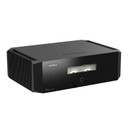
Analog VU Meters on the Front Panel
The front panel features illuminated analog VU meters — one per channel. The logarithmic scale reads in Watts, dB, and 4Ω reference. They respond in real time to the music playing, giving a visual indication of how hard the amplifier is working. It's a design touch that suits the AMP-F10's combination of modern engineering and classic presentation.
Dual Gain Settings — 23dB or 29dB
A rear switch selects between 23dB and 29dB of voltage gain. This lets you match the AMP-F10 to the output level of your preamp or streaming DAC. With a high-output source like the DMP-A10 (4.2V XLR), 23dB keeps the volume control in a comfortable range. With a lower-output source, 29dB prevents the volume control from running out of range at normal listening levels.
Multiple Protection Circuits
The AMP-F10 includes overcurrent protection, overheat protection, and short-circuit protection. These circuits monitor the amplifier continuously and shut it down safely if a fault is detected — protecting both the amplifier and your speakers.
Ventilation Requirements
The AMP-F10 uses large passive heatsink fins on the sides for cooling. During normal use, these get warm. Stereophile's test bench recorded heatsink temperatures of around 139°F (59.5°C) after 30 minutes. Leave at least 4–6 inches of clear space above and around the unit. Do not place other equipment on top of it, and don't install it in a closed cabinet without airflow.
Quick-Reference Specifications
| Output Power (Continuous RMS) | |
| Stereo — 8Ω per channel | 200W |
| Stereo — 4Ω per channel | 320W |
| Stereo — 2Ω per channel | 450W |
| Bridge Mono — 8Ω | 650W |
| Bridge Mono — 4Ω | 950W |
| Performance | |
| Operating Mode | Class AB with Class A bias |
| THD+N | 0.008% @ 1kHz |
| SNR | ≥113 dB (A-weighted) |
| Frequency Response | 10 Hz – 30 kHz (±0.5 dB @ 1W/8Ω) |
| Damping Factor | >600 @ 8Ω / 1kHz |
| Output Impedance | 0.03Ω @ 20Hz and 1kHz (measured by Stereophile) |
| Crosstalk | ≤–95 dB @ 200W/8Ω/1kHz |
| Channel Separation | >110 dB below 3kHz; 83 dB at 20kHz (measured by Stereophile) |
| Output Stage | |
| Transistors | 5 pairs Vishay IRFP9240 MOSFET per channel (10 pairs total), precision-matched |
| Front End | Eversolo Ultra Low Noise Preamp Module (FET-input audio op-amp) |
| Topology | Advanced dual differential amplifier per channel |
| Power Supply | |
| Type | 1000W dual-channel independent linear supply; toroidal transformer; 160,000µF capacitance |
| DC Filtering | Innovative DC filtering circuit between AC supply and audio circuits |
| Mains Input | 110–120V 60Hz / 220–240V 50Hz; 1200W max draw |
| Inputs | |
| Balanced (XLR) | 1× stereo pair; 10kΩ input impedance; pin 2 hot (AES standard) |
| Unbalanced (RCA) | 1× stereo pair; 10kΩ input impedance |
| Input Sensitivity (200W @ 8Ω) | XLR 23dB: 5.2V | XLR 29dB: 2.4V | RCA 23dB: 2.65V | RCA 29dB: 1.3V |
| Controls & Connections | |
| Gain Switch | 23 dB or 29 dB (rear panel) |
| Mode Switch | Stereo / Bridge Mono (rear panel) |
| Input Switch | Balanced / Unbalanced select (rear panel) |
| Standby Switch | Manual / Trigger / Signal-detect (rear panel) |
| 12V Trigger | In and out (1/8" jacks) |
| Speaker Outputs | 4 binding posts per channel; spade lug or banana plug compatible |
| Front Panel | Illuminated analog VU meters (Watts/dB/4Ω logarithmic scale) |
| Protection | Overcurrent, overheat, short-circuit |
| Dimensions & Weight | |
| H × W × D | 148 × 432 × 310 mm (5.8" × 17" × 12.2") — including feet |
| Weight | 18.0 kg (39.7 lbs) |
| Cooling | Passive — large heatsinks on both sides; requires 4–6" clearance around unit |
| Warranty | 1 year (manufacturer) |
Frequently Asked Questions
Does the AMP-F10 include a preamplifier or volume control?
No. The AMP-F10 is a pure power amplifier — it has no volume control, no DAC, and no streaming capability. You need a separate preamplifier or a streaming DAC with a preamp output (like the EverSolo DMP-A10 or DMP-A8) to control the volume before the signal reaches the AMP-F10.
What's the best source to pair with the AMP-F10?
The DMP-A10 is the natural partner — it was designed alongside the AMP-F10. Connect via XLR balanced cables using the DMP-A10's variable XLR outputs and set the AMP-F10's gain to 23dB. The DMP-A8 also pairs well using the same approach. Any preamp or DAC with XLR or RCA outputs will work — give us a call at 800-942-0220 and we can help you choose.
What does "bridge mode" mean, and when should I use it?
Bridge mode combines both channels of the AMP-F10 to drive a single speaker at higher power — up to 950W at 4Ω. To use bridge mode for a stereo system, you need two AMP-F10 amplifiers — one for the left speaker, one for the right. Bridge mode is useful for very large rooms, very inefficient speakers, or listeners who want extreme power reserves. For most home listening setups, stereo mode at 200W per channel is more than adequate.
Which gain setting should I use — 23dB or 29dB?
Use 23dB if your source has a high output level (for example, the DMP-A10's XLR output is 4.2V). This keeps the volume control in a useful range and avoids it being too loud at very low settings. Use 29dB if your source has a lower output level and you find yourself running the volume near maximum to get to a comfortable listening level. Not sure? Call us at 800-942-0220 and we'll help you work it out.
How much space does the AMP-F10 need for ventilation?
The AMP-F10 uses passive cooling — large heatsink fins on the sides do the work. No fan, no noise. But those fins need airflow. Leave at least 4–6 inches above and on both sides of the unit. Don't install it in a closed cabinet, and don't stack equipment on top of it. Stereophile's measurements recorded heatsink temperatures around 139°F (59.5°C) after 30 minutes of normal use — warm but within safe operating range.
What speakers work best with the AMP-F10?
Reviewers found it especially effective with bookshelf speakers, standmounts, and smaller floorstanders — giving them more weight and low-end presence than their size would suggest. Its warm, full character also pairs well with speakers that have a naturally neutral or slightly lean tonal balance. If you have very bass-heavy speakers and already find your system bottom-heavy, the AMP-F10's sonic character may add more warmth than you want. Call us and we can help you assess the match.
Can I use two AMP-F10s as mono blocks?
Yes. Set each unit to bridge mode using the rear panel switch, connect the left speaker to one AMP-F10 and the right speaker to the other. In this configuration each amplifier delivers up to 650W (8Ω) or 950W (4Ω) per channel. Terry Ellis of Pursuit Perfect System tested exactly this configuration and reported on it positively in his March 2025 review.
Does the AMP-F10 have a 12V trigger?
Yes — there are both a 12V trigger input and output. Connect the trigger cable from the DMP-A10 (or any other preamp with a trigger output) to the AMP-F10's trigger input. When your preamp powers on, the AMP-F10 wakes up automatically. You can also set it to power on when it detects an incoming audio signal, or switch it on manually — all controlled by the rear panel standby switch.
How does the AMP-F10 compare to buying a similarly priced integrated amplifier?
A good integrated amplifier at $2,480 combines a preamp, DAC, and power amp in one box. The AMP-F10 is a pure power amplifier only — it requires a separate source and preamp. The advantage of separates is that each component can be optimized for its job, and you can upgrade one piece at a time. If you're already happy with your DMP-A10 or another streaming DAC with a preamp output, the AMP-F10 lets you add serious amplification without replacing what's already working well.
See It in Action
Terry Ellis of Pursuit Perfect System published a full video review of the AMP-F10 on his YouTube channel in March 2025. Search "EverSolo AMP-F10 Pursuit Perfect System" to find it.
Check the official EverSolo YouTube channel for product demonstrations.
Note to editors: Confirm specific YouTube video IDs before embedding.
Why Audio Advisor?
 40+ Years of Expertise — Since 1981, we've helped over a million music lovers find the right gear.
 60-Day Money-Back Guarantee — Take your time. Listen, enjoy, and make sure it's right for you.
 Real Experts, Real Help — Our team is here to answer your questions at 800-942-0220, weekdays 9am–6pm EST.
 Free Shipping — On orders over $49, delivered to your door.
 Flexible Payment Options — Financing available so you can start listening now.
Want to learn more about power amplifiers, how they differ from integrated amps, and how to choose the right one for your system? Visit our Audio Advisor Learning Center for plain-English guides and expert advice.


