 Free Shipping on US orders above $49









What You Need to Know
What Is the DAC-Z10, and What Does It Do?
A DAC — short for Digital-to-Analog Converter — is the component that turns the digital audio data from your computer, streaming device, or media player into the analog signal your amplifier understands. Think of it as the translator between the digital world and the music you hear.
The EverSolo DAC-Z10 is a standalone DAC — it does not stream music on its own. You connect a digital source (like the EverSolo T8 streaming transport, a computer, or a CD player) to the DAC-Z10, and it handles the conversion from digital to analog with exceptional care and precision.
But the DAC-Z10 is more than just a DAC. It also includes a fully balanced preamplifier with analog inputs — so you can connect a turntable or other analog source and control volume from one place. And it has a dedicated headphone amplifier with enough power to drive the most demanding planar magnetic headphones. Three boxes worth of gear, all in one clean chassis.
What Makes the Architecture Special — Fully Isolated Architecture (FIA)
Most DACs run both the left and right audio channels through a single pair of chips. The DAC-Z10 does something different: it uses a dual-mono design, giving each stereo channel its own completely independent signal path from input to output. That means the left channel never shares a circuit, a power supply, or a DAC chip with the right channel.
EverSolo calls this their FIA — Fully Isolated Architecture. Here's what it means in practice:
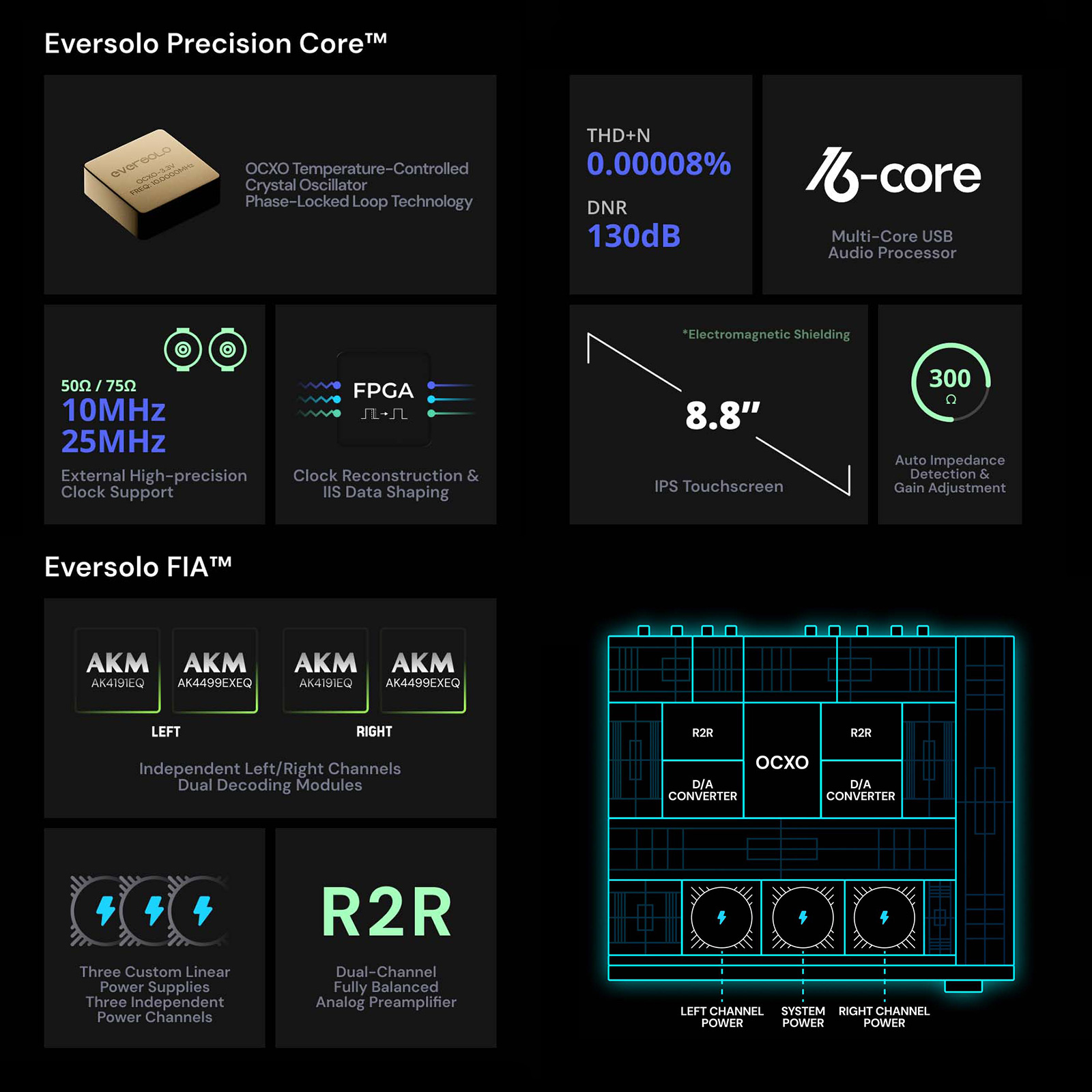
Four AKM DAC chips. The DAC-Z10 uses two sets of AKM's AK4191EQ + AK4499EX chips — one pair for the left channel, one pair for the right. The AK4191 handles digital processing (modulation), while the AK4499EX handles the actual conversion to analog. AKM calls this their "Velvet Sound" topology. Keeping the channels completely separate reduces crosstalk — the faint bleed of one channel's signal into the other — which results in a wider, more precisely positioned soundstage.
Three independent power supplies. Inside the chassis are three separate linear power supplies, each with its own toroidal transformer: one powers the left channel, one powers the right channel, and one powers the system circuitry. Linear power supplies are the quietest type for audio — they produce far less electrical noise than the switching power supplies found in most consumer electronics. The measured noise floor of this arrangement is just 42 microvolts — a remarkably quiet foundation for the audio signal to sit on.
Fully isolated digital inputs. Every digital input on the DAC-Z10 is electrically isolated. This means noise from your computer's USB bus, your TV's HDMI connection, or an S/PDIF cable cannot ride into the DAC's signal path. Each isolation stage acts as a barrier, letting the audio data through cleanly while blocking the electrical interference.
Precision Clocking — The Precision Core System
In digital audio, timing matters enormously. Tiny errors in timing — called jitter — can smear the sound and rob your music of clarity. The DAC-Z10 addresses this with what EverSolo calls the Precision Core clock system.
At the heart of it is an OCXO — an Oven Controlled Crystal Oscillator. An OCXO keeps its internal crystal at a fixed temperature inside a small heated chamber, which prevents the frequency from drifting as the room warms or cools. It's a much more stable foundation than a typical crystal oscillator. On top of the OCXO, EverSolo adds PLL (Phase-Locked Loop) technology to suppress secondary jitter, and an FPGA (a programmable chip) that actively shapes and reconstructs the clock signal and I2S data before it reaches the DAC chips.
For users with a separate master clock generator, the DAC-Z10 also accepts external 10MHz and 25MHz clock signals via BNC connectors — with both 50Ω and 75Ω impedance options. This is a feature typically found only in dedicated professional or high-end reference equipment.
R2R Volume Control — Analog Precision at Every Level
Many DACs control volume digitally — by mathematically reducing the number and lowering the resolution of the audio data at lower volumes. The DAC-Z10 does not do this. Instead, it uses a dual-channel R2R (resistor-to-resistor) ladder network — a precision grid of resistors that adjusts volume purely in the analog domain. Each click of the knob is a relay switching a resistor, not a calculation. The audio signal always passes through the DAC at full resolution, and the volume is trimmed afterward with zero impact on bit depth or dynamic range.
What Are Reviewers Saying?
TechRadar's reviewer awarded the DAC-Z10 a full five stars, calling it "as capable a DAC/preamp/headphone amp as this sort of money can buy." They praised its lavish specification — four AKM DAC chips, twin R2R ladder volume control modules, and three independently shielded linear power supplies — and declared it represented "unarguable value for money" at its price, with "immaculate sound quality that specializes in finding every possible grain of detail in your music."
HiFi Pig reviewer Oscar Stewart awarded the DAC-Z10 their highest "Five Hearts" rating and called it "a fantastic bit of reference kit." He praised the clever dual-mono design, noting that keeping the signal paths separate "translates to a device which excels in terms of imaging and channel separation." His overall verdict: "Eversolo have done a fantastic job at making a reference DAC here."
StereoNET's reviewer tested the DAC-Z10 primarily via I2S input, paired with an Eversolo T8 transport. They described the presentation as "clean, uncoloured and low-noise," with honest and revealing detail that proves "engaging rather than clinical." They noted the I2S input offered a slight edge over USB and coaxial connections, and praised the unit's composure and control across a wide range of music styles.
Who Is This Best For?
 You already have a streamer or server — like the EverSolo T8, a Bluesound Node, or a computer — and you want the best possible DAC and preamp to complete the chain.
You want a separate preamp and DAC in one box. The DAC-Z10 accepts analog inputs (RCA and XLR) and controls all sources through its R2R volume control.
You listen on demanding headphones — including planar magnetic designs from Audeze, HiFiMAN, or ZMF — and want a headphone amp built into your desktop DAC.
You value reference-level transparency. The DAC-Z10 is honest and revealing. It will show you what your music and your upstream gear are truly made of.
You connect a TV to your hi-fi. The HDMI ARC/eARC input lets you route your television's audio directly into the DAC-Z10 for a major upgrade over any soundbar.
How Does It Connect to Your System?
The DAC-Z10 is a pure DAC and preamplifier — it does not stream music on its own. You'll need a digital source to feed it. Here's a plain-language rundown of what connects where.
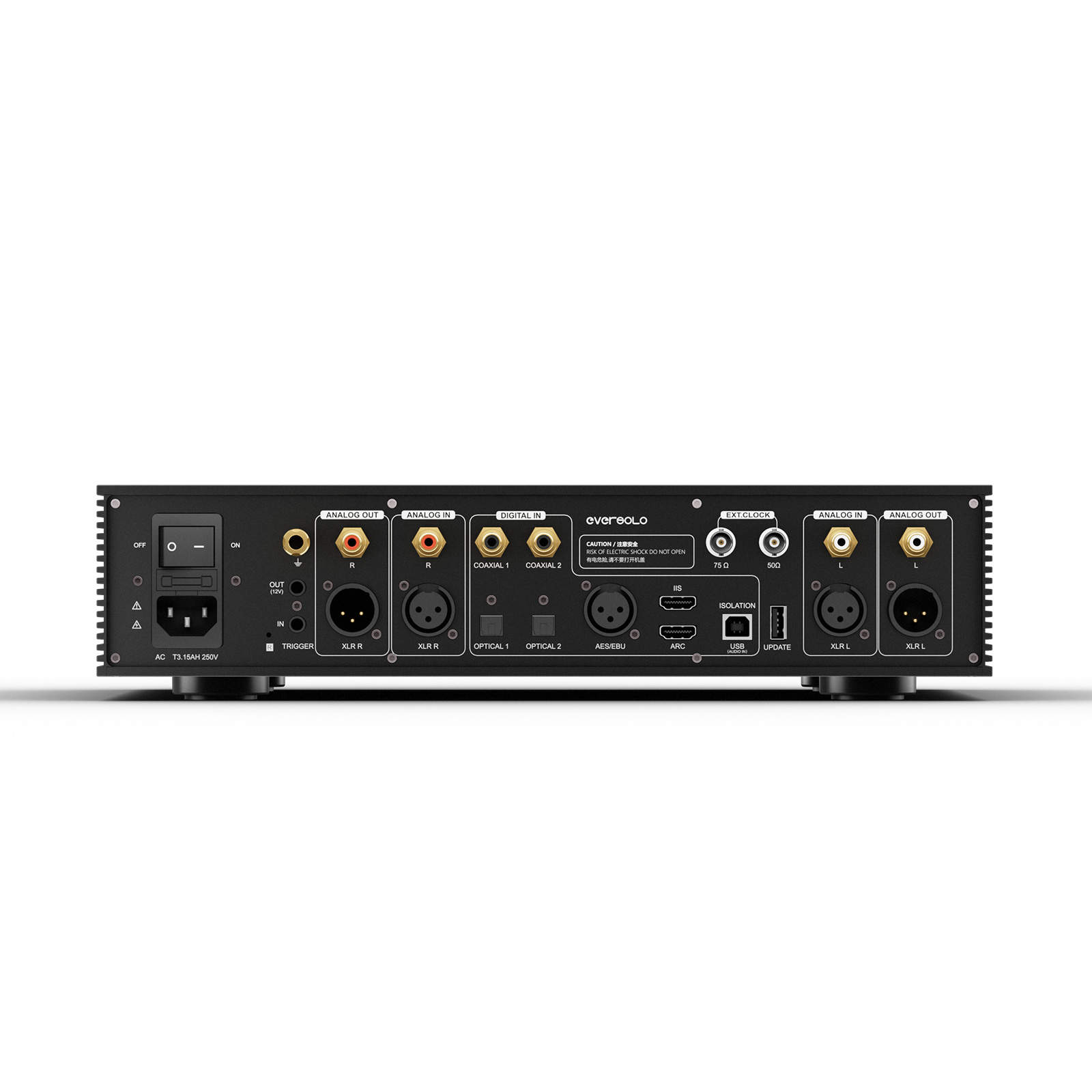
Digital inputs (what you send into the DAC-Z10): A USB-B port connects to a computer and supports up to DSD512 and PCM 768kHz. The I2S input via HDMI handles the same high resolutions and is the preferred connection for compatible EverSolo transports like the T8. Dual coaxial and dual optical (Toslink) inputs handle CD players, TV optical outputs, and most S/PDIF sources (up to 24-bit/192kHz). An AES/EBU (XLR) input works with professional-grade digital sources. HDMI ARC/eARC connects directly to a compatible TV. Bluetooth 5.0 (Qualcomm QCC5125, SBC/AAC) lets phones and tablets connect wirelessly.
Analog inputs (for other sources that already produce analog sound): One XLR stereo pair and one RCA stereo pair let you route other analog sources — like a phono stage or a CD player with analog outputs — through the DAC-Z10's preamp section.
Analog outputs (to your amplifier or powered speakers): One balanced XLR stereo pair and one unbalanced RCA stereo pair connect to your power amp or active speakers. Both can be used simultaneously.
Headphone output: One 6.35mm (¼ inch) single-ended jack on the front panel. Note: there is no balanced 4-pin XLR or 4.4mm Pentaconn headphone output — only single-ended. The amplifier auto-detects headphone impedance and adjusts gain, with three manual gain settings (high, medium, low). Output power is 1W into both 16Ω and 32Ω loads.
External clock inputs: Two BNC connectors accept 10MHz or 25MHz external reference clocks at 50Ω or 75Ω — for users with a separate master clock in their setup.
Trigger in/out: 12V trigger connections let the DAC-Z10 automatically power on and off with a connected amplifier.
Grounding post: A grounding terminal on the rear panel provides an optional path for draining electrical noise — useful in systems with ground loop issues.
What's in the Box
- EverSolo DAC-Z10 High Resolution DAC & Headphone Amplifier
- Remote control (metal, rechargeable via USB-C) ×1
- Power cable ×1
- USB data cable ×1
- USB drive (for firmware upgrade) ×1
- Trigger cable ×1
- Polishing cloth ×1
- User manual ×1
Packing list sourced from Music Direct's product listing. Verify with EverSolo or your Audio Advisor rep before finalizing.
What the Pros Are Saying
TechRadar gave the DAC-Z10 a full five-star review, describing it as "lavishly" specified and calling it "as capable a DAC/preamp/headphone amp as this sort of money can buy." The reviewer was particularly impressed by the combination of four AKM DAC chips, three shielded linear power supplies, and a big 8.8-inch touchscreen — praising the overall package as "unarguable value for money" with "immaculate sound quality" built around finding the finest details in music.
HiFi Pig reviewer Oscar Stewart awarded the DAC-Z10 the publication's highest Five Hearts rating. He called it "a fantastic bit of reference kit" and singled out the FIA dual-mono design for how it translates directly into outstanding imaging and channel separation. He also praised the flexibility of having "a ton of inputs" and noted the headphone output as a genuine bonus in a well-rounded package. His summary: "Eversolo have done a fantastic job at making a reference DAC here."
StereoNET's reviewer ran the DAC-Z10 primarily through its I2S input, fed by an Eversolo T8 transport. They described the DAC's character as "clean, uncoloured and low-noise" — honest and revealing, in a way that proves "engaging rather than clinical." Guitar attack, vocal timbre, bass extension, and treble detail all received praise. Classical material was called composed and controlled; less-than-perfect recordings remained listenable over long sessions. The I2S input was noted as offering a slight edge over USB and coaxial.
Building Your System? Here Are Some Great Companions.
- EverSolo T8 Streaming Transport — The T8 was designed as a natural partner for the DAC-Z10. Connected via HDMI I2S, the pair forms a purpose-built reference streaming front-end. See EverSolo products at Audio Advisor.
- Stereo Power Amplifiers — The DAC-Z10's balanced XLR outputs connect directly to any stereo power amp. Browse stereo amplifiers.
- Active / Powered Speakers — Connect the DAC-Z10's outputs straight to powered monitors or audiophile active speakers — no separate amp required. Browse powered speakers.
- Headphones — The built-in headphone amp handles high-impedance dynamics and planar magnetic designs. Browse headphones.
- Interconnect & Digital Cables — A quality XLR or RCA interconnect between the DAC-Z10 and your amp, and a quality HDMI cable for the I2S connection, are worth the investment. Browse interconnects | Browse digital cables.
Features & Specifications
Dual-Mono AKM Velvet Sound DAC — Four Chips, Total Channel Separation
Four AKM DAC chips handle conversion — two per stereo channel (one AK4191EQ modulator + one AK4499EX converter). This is a true dual-mono implementation. Both channels are kept entirely separate from input to analog output, which results in extremely low crosstalk and a soundstage that reviewers consistently describe as wide, detailed, and precisely positioned. AKM's "Velvet Sound" designation reflects their focus on combining high technical precision with a natural tonal character.
Three Independent Linear Power Supplies — Ultra-Low Noise Floor
Three separate toroidal transformers power the left channel, right channel, and system circuitry independently. Linear power supplies are quieter than switching types — they don't produce the high-frequency noise that switching supplies inherently generate. The result is a measured noise floor of just 42µV. This translates to a deeply quiet background behind the music, letting faint details emerge that noisier designs would mask.
OCXO + PLL + FPGA Clock System — Femtosecond-Class Timing
The Precision Core clock system starts with an OCXO — an Oven Controlled Crystal Oscillator that keeps its internal crystal at a stable temperature to prevent frequency drift. PLL (Phase-Locked Loop) circuitry adds a second layer of jitter suppression, and an onboard FPGA actively reconstructs and shapes both the clock signal and the I2S data before it reaches the DAC chips. External clock inputs (10MHz and 25MHz, BNC, 50Ω and 75Ω) let the DAC-Z10 sync to a master clock generator if you have one.
Dual-Channel R2R Analog Volume Control — No Bit Loss at Any Volume
Each stereo channel has its own independent R2R (resistor ladder) volume control, driven by relay switching. Volume is adjusted entirely in the analog domain — your audio data always passes through the DAC at full resolution. You'll hear each click of the knob as a relay engages. The preamp section adds up to +10dB of analog gain, giving you flexibility when the DAC-Z10 is feeding a low-sensitivity power amplifier.
8.8-Inch IPS Touchscreen — Full Control at a Glance
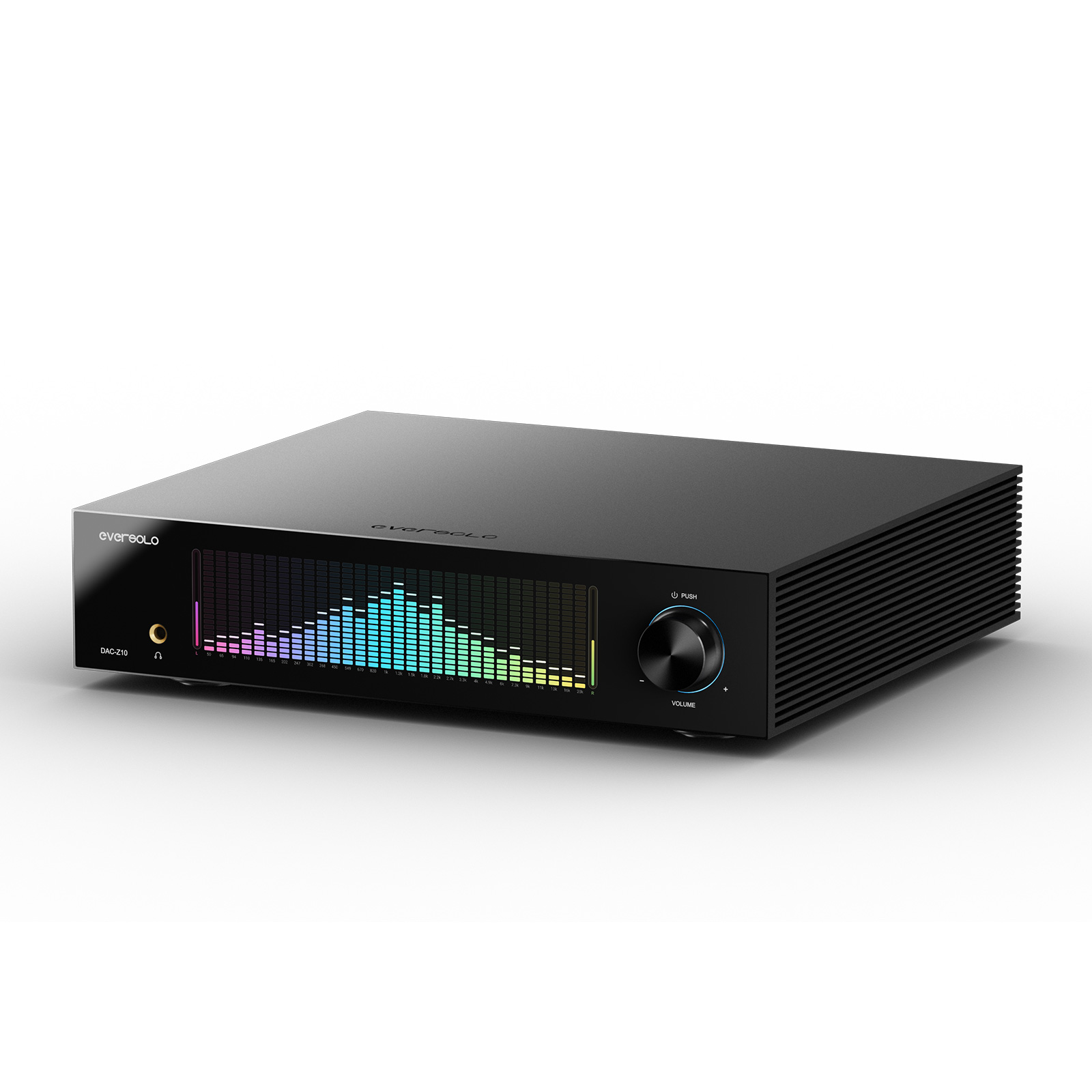
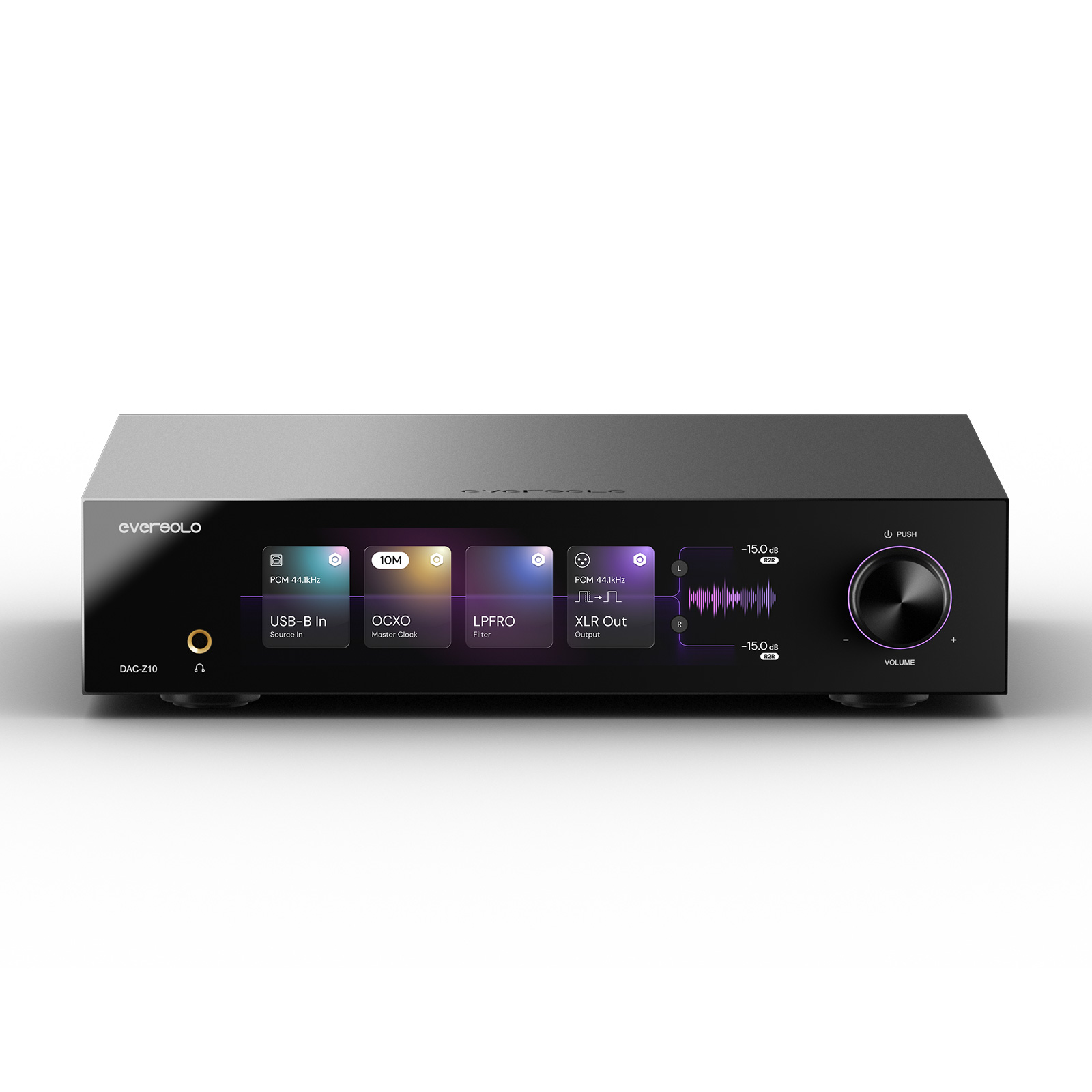
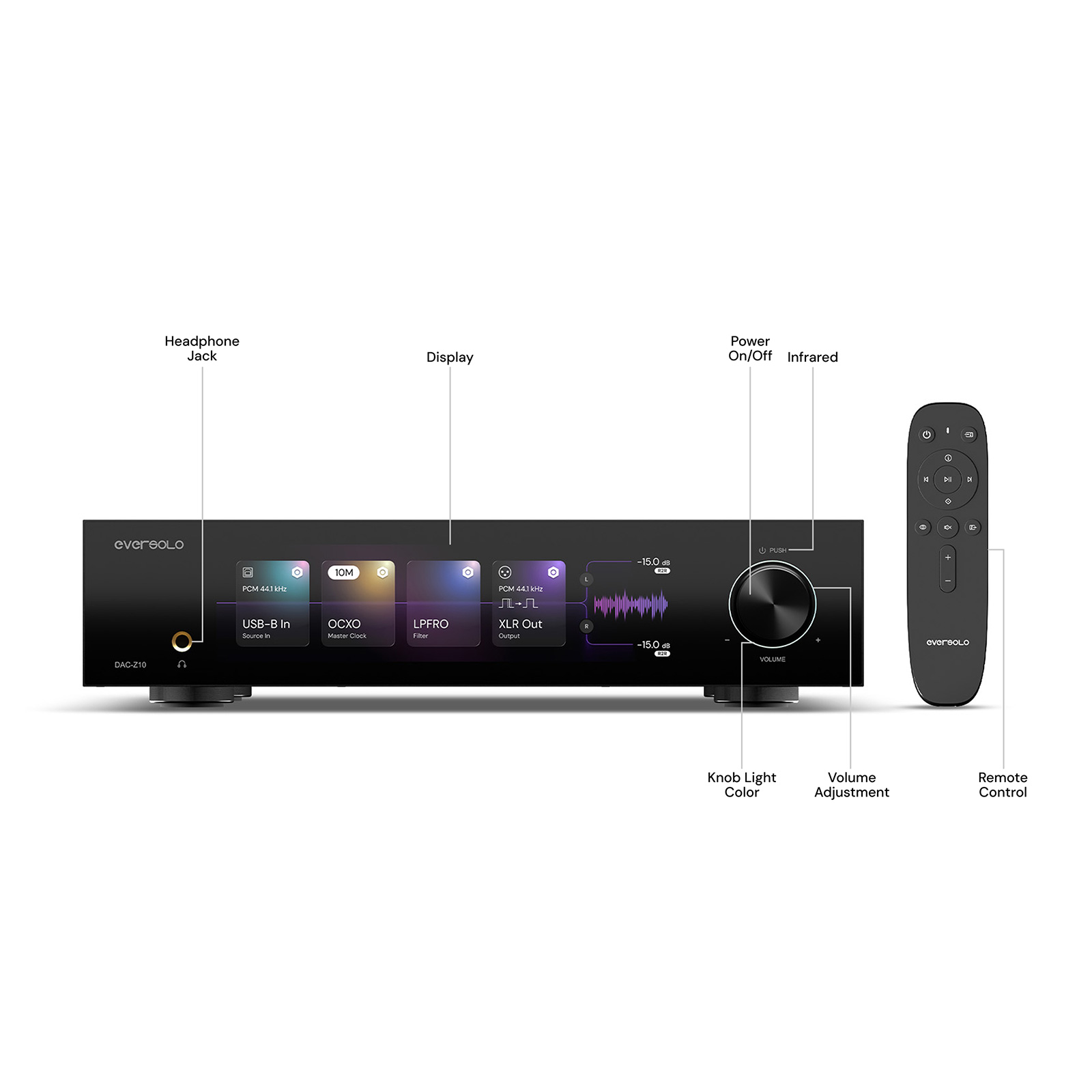
The front panel is dominated by a bright, high-resolution 8.8-inch IPS touchscreen. It shows VU meters (vintage or modern style), spectrum displays, signal path diagrams, and all settings menus. The display is electromagnetically shielded to prevent the screen's electronics from interfering with the audio circuits. A physical volume knob sits to the right; its LED ring is color-customizable via the EverSolo app.
Dedicated Headphone Amplifier — 1W for Planar and High-Impedance Headphones
A separate headphone amplifier module is built into the DAC-Z10, accessible via the 6.35mm (¼ inch) front panel jack. The amp delivers 1 watt into both 16Ω and 32Ω loads — enough for the most demanding planar magnetic headphones from Audeze, HiFiMAN, or similar manufacturers. It automatically detects your headphone's impedance and adjusts gain to match. Three manual gain settings (high, medium, low) are also available. Note: the headphone output is single-ended only — there is no 4-pin XLR or 4.4mm Pentaconn balanced connection.
Comprehensive Isolated Digital Inputs
Every digital input on the DAC-Z10 is electrically isolated. USB-B handles computers on Windows, macOS, Android, and iOS. The I2S input via HDMI accepts 8 switchable pin configurations to match different transports and supports DSD512 and PCM 768kHz natively. Dual coaxial and dual optical inputs offer flexibility for CD players, TVs, and other sources. AES/EBU handles professional-format digital signals. HDMI ARC/eARC connects to televisions. All inputs can pass audio cleanly to the DAC without carrying electrical noise from the source device.
Six DAC Filter Settings
Six digital filter characteristics are selectable from the menu. Each filter shapes the high-frequency digital noise that the DAC chips produce, with slightly different tradeoffs in time-domain behavior and frequency response roll-off. You can switch between them freely to find what sounds best with your particular headphones or speakers and your preferred music.
Fully Balanced Preamplifier with Analog Inputs
The preamp section is fully balanced end-to-end. Analog inputs (both XLR and RCA) let you connect other sources — a phono stage, a CD player with analog outputs, or any other line-level component. Volume is controlled by the same R2R ladder used for digital sources, so analog signals get the same precision attenuation. The analog inputs do not get converted to digital — the signal stays in the analog domain the entire time.
Premium Build Quality
The chassis is made from aviation-grade aluminum, with heatsink-style side panels for passive cooling. Fit and finish have been consistently praised by reviewers as "premium without asterisks" — meaning you won't feel the need to mentally discount the build quality given the price. A metal remote control with USB-C charging is included in the box. Control knob LED color is customizable. Multiple knob color options are available for the DAC-Z10 (verify current availability with Audio Advisor).
Quick-Reference Specifications
| DAC Performance | |
| DAC Architecture | Dual-mono — 4× AKM chips total: AK4191EQ + AK4499EX per stereo channel (Velvet Sound) |
| Dynamic Range | 130 dB |
| THD+N | 0.00008% |
| Noise Floor | 42 µV |
| PCM Support | Up to 32-bit / 768 kHz (via USB-B, I2S) |
| DSD Support | Native DSD512 (via USB-B, I2S) |
| DAC Filters | 6 selectable filter characteristics |
| Clock System | |
| Internal Clock | OCXO (Oven Controlled Crystal Oscillator) + PLL jitter suppression + FPGA clock reconstruction |
| External Clock Input | 10 MHz and 25 MHz via BNC (50Ω and 75Ω impedance options) |
| Preamplifier | |
| Volume Control | Dual-channel R2R relay-based resistor ladder (analog, independent per channel) |
| Analog Gain | Up to +10 dB |
| Analog Inputs | 1× XLR stereo pair, 1× RCA stereo pair (line level; analog pass-through, no A/D conversion) |
| Analog Outputs | 1× XLR stereo pair (balanced), 1× RCA stereo pair (unbalanced) |
| Headphone Amplifier | |
| Output Jack | 6.35mm (¼") single-ended (front panel) — no balanced headphone output |
| Output Power | 1W into 16Ω; 1W into 32Ω (high gain) |
| Gain Settings | High / Medium / Low (auto impedance detection + manual selection) |
| Digital Inputs | |
| USB-B | 1× isolated (Windows 10+, macOS, Android, iOS; up to PCM 768kHz/32-bit, DSD512 native) |
| I2S (HDMI) | 1× (8 switchable pin modes; up to PCM 768kHz/32-bit, DSD512 native) |
| AES/EBU | 1× isolated XLR (up to PCM 192kHz/24-bit, DSD64 DoP) |
| Coaxial S/PDIF | 2× isolated RCA (up to PCM 192kHz/24-bit, DSD64 DoP) |
| Optical S/PDIF | 2× Toslink (up to PCM 192kHz/24-bit, DSD64 DoP) |
| HDMI ARC/eARC | 1× (ARC or eARC selectable in menu; up to PCM 192kHz/24-bit) |
| Bluetooth Input | BT5.0 — Qualcomm QCC5125 module; SBC / AAC |
| Power Supply | |
| Type | Three independent linear supplies, each with a shielded toroidal transformer (left channel / right channel / system) |
| Noise Level | 42 µV |
| Other Connections | |
| Trigger | 12V trigger in and out |
| Grounding Post | Yes (rear panel) |
| USB-A | 1× (for firmware updates) |
| Display & Control | |
| Display | 8.8" IPS touchscreen (electromagnetically shielded) |
| Remote | Metal remote control, USB-C rechargeable (included) |
| App Control | EverSolo Control App (iOS and Android, via Bluetooth) |
| Dimensions & Weight | |
| H × W × D | 78 × 365 × 310 mm (3.1" × 14.4" × 12.2") — per StereoNET review; verify with manufacturer |
| Chassis | Aviation-grade aluminum with heatsink-style side panels |
| Warranty | 1 year (manufacturer) — verify with EverSolo |
Frequently Asked Questions
Does the DAC-Z10 stream music on its own?
No — the DAC-Z10 is a pure DAC, preamplifier, and headphone amplifier. It does not stream music by itself. You'll need a digital source to connect to it — like the EverSolo T8 streaming transport, a computer, a Bluesound Node, or a CD player. If you want streaming built into the DAC itself, take a look at the EverSolo DMP-A8, which combines streaming, DAC, and preamp in one unit. Give us a call at 800-942-0220 if you'd like help deciding which approach fits your system.
What digital source works best with the DAC-Z10?
For the best connection, use the I2S input via HDMI — it's the highest-quality digital interface and the one EverSolo designed the DAC-Z10 around. The EverSolo T8 streaming transport is an ideal partner, as both units were designed to work together via I2S. If you're connecting a computer, USB-B is excellent. Reviewers at StereoNET noted a slight sonic advantage from I2S over USB or coaxial with a compatible transport.
Is the headphone output balanced?
No. The headphone jack is a single 6.35mm (¼ inch) single-ended connection. There is no 4-pin XLR or 4.4mm Pentaconn balanced output. If you own a headphone with a balanced cable and want a balanced headphone output, you'd need an adapter or a separate balanced headphone amplifier. The single-ended output is powerful and well-reviewed, capable of driving demanding planar magnetic headphones — but it is not balanced.
Can the DAC-Z10 replace my preamplifier?
Yes. The DAC-Z10 includes a fully balanced preamplifier section with XLR and RCA analog inputs. You can connect analog sources (like a phono stage or a CD player's analog outputs) alongside your digital sources, and use the DAC-Z10's R2R volume control to run everything. The analog inputs pass through without any digital conversion, so your analog sources stay in the analog domain. The DAC-Z10 can feed a power amplifier or active speakers directly.
How does the DAC-Z10 compare to the DMP-A8?
They do similar jobs differently. The DMP-A8 ($1,980) includes a built-in network streamer — it connects to Wi-Fi or Ethernet and runs Tidal, Qobuz, Roon, and other streaming services on its own. The DAC-Z10 ($1,980) is a pure DAC with no streaming — it uses a more advanced dual-mono architecture (four AKM chips vs. one pair in the A8), three dedicated power supplies vs. two in the A8, and an OCXO-based clock system. If you already have a streamer or prefer to keep your sources separate, the DAC-Z10 is the more focused and technically advanced audio component. If you want an all-in-one box that also streams, the DMP-A8 is the better fit.
Does the DAC-Z10 work with Roon?
The DAC-Z10 itself does not run Roon — it has no network connection. However, it works with Roon as a USB DAC endpoint: simply connect a computer or a Roon Nucleus running Roon to the USB-B input, and the DAC-Z10 will appear as a USB audio output device. For a fully Roon Ready solution, pair the DAC-Z10 with the EverSolo T8 (which is Roon Ready) via I2S.
Can I connect my TV to the DAC-Z10?
Yes. The HDMI ARC/eARC input accepts audio directly from a compatible TV's HDMI ARC or eARC port. You can switch between ARC and eARC in the DAC-Z10's menu system. This is a great way to route your TV's audio — streaming video, gaming, movies — through your hi-fi system with much better quality than any soundbar or TV speaker can offer.
What headphones work well with the DAC-Z10?
The headphone amplifier delivers 1 watt into 16Ω and 32Ω loads, making it more than capable of driving demanding planar magnetic headphones from brands like Audeze, HiFiMAN, ZMF, and Meze. Reviewers at Headfonia tested it with OMNE Hendeka, HEDD HEDDphone, and ZMF Auteur Classic headphones. The amp also auto-detects impedance and adjusts gain, so IEMs and easy-to-drive dynamics will work too — just set gain to low. If you'd like a headphone recommendation to match, give us a call.
What do the six DAC filter settings do?
The six filter profiles shape how the DAC handles the high-frequency digital noise it produces during conversion. Each one represents a slightly different tradeoff between how sharply the filter cuts off frequencies above 20kHz, and how it handles the time-domain behavior of the audio signal. In practice, some filters sound a touch smoother, others a touch more detailed — it's a subtle difference most noticeable in the treble region. Try each one and pick the filter that sounds best to you with your particular headphones or speakers.
Is the remote control good?
Yes. Unlike the plastic remote bundled with some EverSolo products, the DAC-Z10 comes with a metal remote control that reviewers at HiFi Pig called a pleasure to use. It's rechargeable via USB-C, so you won't need to hunt for batteries. The touchscreen is available as an alternative interface, and the EverSolo Control app on your phone or tablet gives full control from the sofa via Bluetooth.
Why Audio Advisor?
 40+ Years of Expertise — Since 1981, we've helped over a million music lovers find the right gear.
 60-Day Money-Back Guarantee — Take your time. Listen, enjoy, and make sure it's right for you.
 Real Experts, Real Help — Our team is here to answer your questions at 800-942-0220, weekdays 9am–6pm EST.
 Free Shipping — On orders over $49, delivered to your door.
 Flexible Payment Options — Financing available so you can start listening now.
Want to learn more about DACs, preamplifiers, and how they fit into a two-channel system? Visit our Audio Advisor Learning Center for guides, tips, and expert advice on building a great hi-fi system.


