Free Shipping on US orders above $49




What You Need to Know
Why Furman, and Why a Power Strip from a Power-Conditioner Company?
The $25 Belkin or APC strip in the back of every office in America has done a serviceable job for 30 years. Plug your gear in, hope you don’t get a lightning strike, replace it every few years when the indicator light goes out. For a desk lamp and a phone charger, that’s plenty. For a $1,500 receiver, a 4K display, a streaming box, and a turntable, it really isn’t.
The PST series is what happens when a company that’s been engineering AC power products for broadcast studios and live-sound rigs since 1974 decides to make a power strip. The technology stack varies by model — the PST-8 and PST-8D bring the full Powell-engineered SMP / LiFT / EVS protection found in Furman’s higher-end Elite line, while the PST-6 and PST 2+6 use a simpler but still genuinely upgraded MOV-based circuit with RFI/EMI filtering. Either way, you’re getting better engineering than the commodity surge strip the buyer was likely replacing, in a form factor that fits the same cable run behind the same equipment rack.
Two things every PST shares. First, zero ground contamination: a Furman-specific circuit choice that does not shunt surge energy onto your circuit ground (the way most MOV-based strips do), so your DAC, streamer, and other digital gear don’t have garbage on their ground reference. Second, signal-line protection: every PST includes coaxial (cable/satellite) and telephone surge inputs, because lightning that comes in through the cable line will fry a TV just as effectively as lightning that comes through the wall. In our experience, a good power conditioner or low-noise power supply will almost always noticeably improve the sound of any high-end audio system, and the same engineering principles that make Furman’s higher-end conditioners audible also drive the design of their power strips.
What Makes the PST-8D the Right Pick
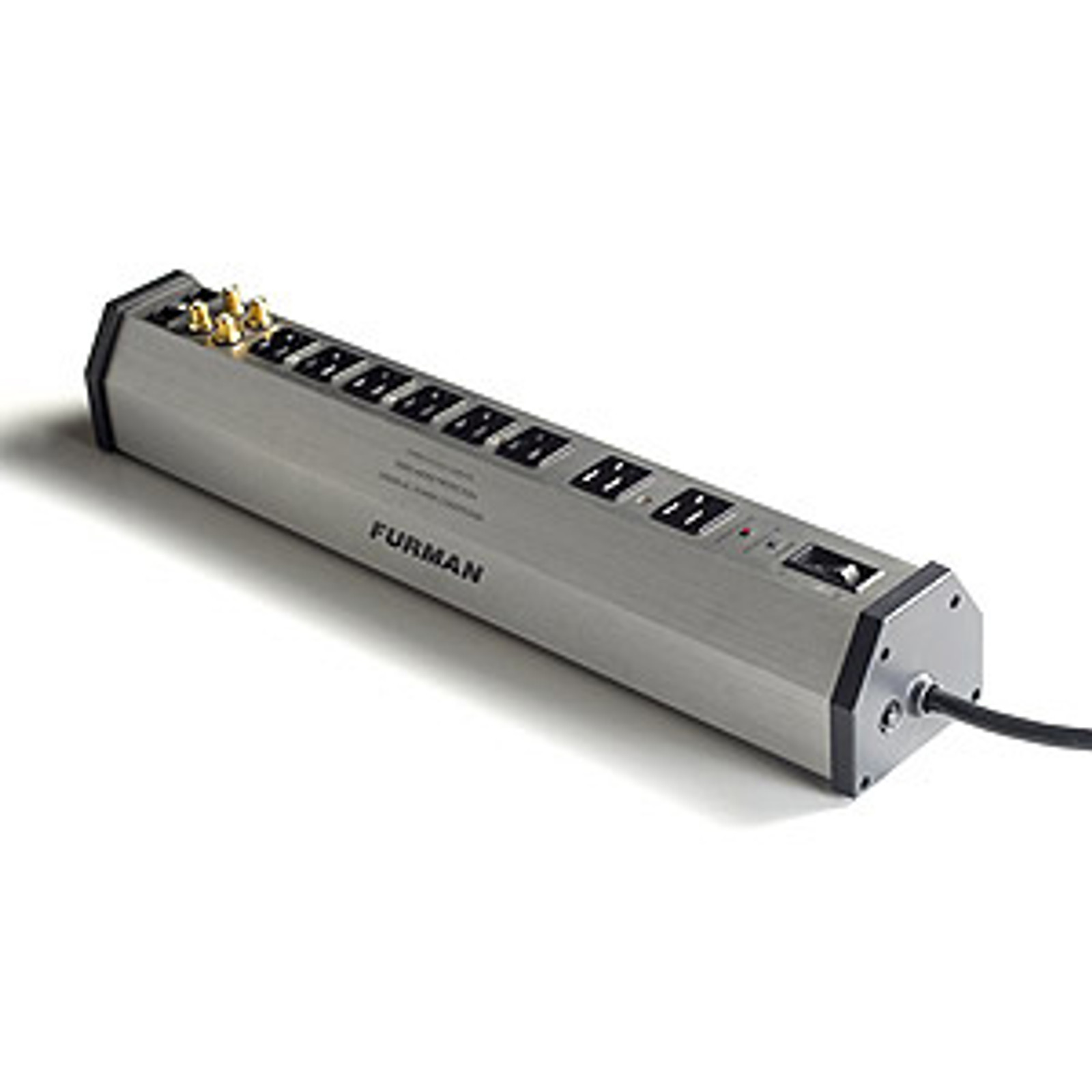
The PST-8D is the top of the PST line. Everything the PST-8 has — non-sacrificial SMP surge protection, LiFT linear filtering, EVS extreme-voltage shutdown — plus one significant addition: the eight outlets are split into two isolated, separately filtered banks.
Why isolation matters in a mixed-gear system: digital components like flat-panel displays, AVRs, streamers, and disc players generate substantial high-frequency switching noise on their power-supply ground. When those components share a single filter bank with your turntable, integrated amp, or preamp, that digital noise can propagate backward through the strip’s shared ground and into the analog gear’s power input, where it shows up as a subtle haze in the listening chair. The PST-8D’s two-bank design physically isolates the two halves with separate filtering, so digital-side noise is confined to the digital side.
The “D” in the name stands for “Digital” — referring to the bank-isolation feature, not to a separate digital filter. Both banks get the full LiFT linear filtering and SMP surge protection; the difference is that they get them independently. In practice:
- One bank for digital gear: TV, streamer, AVR or processor, Blu-ray or disc player, cable box, gaming console. The kind of equipment that runs switch-mode power supplies and generates RF hash on its ground rail.
- The other bank for analog gear: turntable, integrated amp or power amp, preamp, phono stage, tuner. The kind of equipment that’s most sensitive to picking up that hash from neighboring components.
Same aluminum chassis as the PST-8, same 8-foot captive cord with angled NEMA plug, same SMP / LiFT / EVS protection circuit. The PST-8D is the right pick for systems where digital and analog gear coexist and you want the best chance of keeping them sonically separate. If your system is purely digital (a home theater rig with no turntable) or purely analog (a vintage stereo with no streamer), the PST-8 with its single filter bank is the simpler choice. If you have both, the PST-8D is the upgrade that the PST line offers.
One footnote worth mentioning: the engineer who developed Furman’s SMP, LiFT, and broader power-product circuit design is Garth Powell. Powell spent years refining Furman’s AC products before moving on to lead power-product engineering at AudioQuest, where his work on the Niagara line carries forward many of the same design principles. When you buy a Furman from this era, you’re buying into that engineering lineage — even at the entry level.
The Technology Inside the PST-8D
Series Multi-Stage Protection (SMP) — Non-Sacrificial Surge Protection
This is the centerpiece of the PST-8 and PST-8D. Most power strips and surge protectors rely on MOVs that physically sacrifice themselves when they absorb a large spike — after one big surge, the protection is used up even though the indicator light still glows. Furman’s SMP circuit is non-sacrificial: it clamps surges without destroying itself, so one PST keeps protecting after hit after hit. SMP is the same surge-protection technology Furman uses in its higher-end Elite series of power conditioners, packaged here in a power-strip form factor at a fraction of the price.
Linear Filtering Technology (LiFT) — Noise Reduction Without Choking Dynamics
Most “filtered” surge strips use simple non-linear filters that produce a narrow notch-and-ring response — they reduce some noise, but they also introduce resonant peaking that can actually add noise in places. Furman’s LiFT circuit is a linear low-pass filter engineered to attenuate AC line noise smoothly across a wide frequency band: greater than 40 dB from 150 kHz to 100 MHz, and greater than 80 dB across the 100 kHz to 1 GHz range. In practical terms: cleaner AC, no resonant peaking, no current limiting that would squeeze your amplifier’s dynamics.
Extreme Voltage Shutdown (EVS) — Protection from Sustained Over-Voltage
EVS monitors the incoming line and cuts power to everything downstream if the voltage drifts above approximately 135 to 137 volts — the threshold where a sustained over-voltage condition (utility transformer fault, miswired generator, neighbor pulling power on a shared circuit) starts to cause cumulative damage to gear. Brownouts and sustained over-voltage events damage more audio equipment than surges do, and EVS is specifically designed to stop them before your amp’s power supply ever sees them.
Zero Ground Contamination
Older surge-protection designs shunt surge energy to circuit ground, which sounds reasonable until you realize that your DAC, streamer, and other digital sources all reference signal to that same ground. Garbage on the ground rail shows up in the listening chair as hum, hash, and a slightly elevated noise floor. Furman’s circuit design deliberately avoids this — surges are clamped without dumping anything to ground.
Build Quality and the Metal Chassis
One thing that sets the PST-6, PST-8, and PST-8D apart from most surge protectors in their price range: the chassis is aluminum, not plastic. Walk into any office-supply store and you’ll find a wall of plastic-cased surge strips — flimsy, cheap to mold, prone to creaking when an outlet fits tightly, and offering essentially zero EMI shielding. Furman’s metal chassis brings real benefits: structural rigidity that doesn’t deform under power-cord pull, vibration damping for the internal components, and a continuous metallic enclosure that contributes to RF shielding for the protection and filtering circuitry inside.
The captive 8-foot power cord is also a step above commodity practice — heavier-gauge wire than the typical 16-AWG cord on a $25 strip, with a 36-degree NEMA 5-15 plug (angled away from the wall to make installation cleaner behind furniture). Small things, but the kind of thing you notice when you’re routing a permanent install.
Frequently Asked Questions
How is this different from a $25 surge strip from an office store?
Three meaningful ways. (1) Surge protection that actually keeps working. Generic strips use sacrificial MOVs that silently degrade after large hits — your indicator light says “protected” while the protection has actually failed. Furman uses non-sacrificial SMP on the PST-8/PST-8D, designed to keep protecting after repeated hits. (2) RFI/EMI filtering. Generic strips do nothing about the noise riding on your AC line; the PST series filters that noise across the audio-sensitive frequency range. (3) Zero ground contamination. Generic strips shunt surge energy to ground, which can actually add noise to your digital sources. Furman’s design avoids that.
Which PST should I buy?
Quick guide: PST 2+6 if you want Furman protection in the most affordable form factor and you value the audible surge alarm and diagnostic LEDs (plastic chassis, 8 outlets including 2-3 spaced for wall-warts). PST-6 if you want a metal-chassis Furman in a 6-outlet configuration with the same entry-tier protection circuit. PST-8 if you want the full SMP / LiFT / EVS technology stack — same protection found in the Elite series, in a power-strip form factor with 8 outlets in one bank. PST-8D if you have a system with both digital gear (TV, streamer, AVR) and analog gear (turntable, integrated amp) and you want the two banks isolated from each other to keep digital noise out of the analog chain.
Will this limit my amplifier’s current?
For the audio gear most people plug into a Furman power strip — receivers, integrated amps, source components, displays — no. The 15-amp current rating across all outlets is plenty of headroom for typical home systems. Where you’d run into trouble is plugging a pair of high-current monoblock power amplifiers into a Furman PST and expecting them to deliver full transient performance — that’s not what these are designed for, and you’d want a higher-end conditioner with a Power Factor Technology bank (the Furman Elite-15 PFi or Elite-20 PFi) for that application. For everything else, the PST series is correctly sized.
Why are the cable and phone connectors on this thing?
Lightning that comes in through your coax cable line or telephone line will fry a TV or modem just as effectively as lightning that comes through the wall outlet. The PST series includes signal-line surge suppression for one cable/satellite coax connection and one telephone line — pass-through connectors that surge-protect those signals before they reach your gear. If you don’t have cable TV or a landline, you can simply ignore those connectors. If you do, they’re a useful inclusion that most generic surge strips lack entirely.
What’s the warranty?
Furman backs the PST series with a 1-year limited warranty covering defects in materials and workmanship. Important note: Furman’s warranty is only valid on units purchased from authorized dealers. Audio Advisor is an authorized Furman dealer, so your warranty is in place when you buy from us. Purchases from unauthorized internet sellers or auction sites do not qualify for warranty coverage.
Why Buy the Furman PST-8D from Audio Advisor?
40+ Years of Expertise — Audio Advisor has helped over one million audiophiles build better-sounding systems since 1981.
60-Day Money-Back Guarantee — Listen in your own room, on your own system, for 60 days. If it’s not right, send it back.
Real Experts, Real Help — Our staff has decades of combined experience. Call us: 800-942-0220, weekdays 9am–6pm EST.
Free Shipping on orders over $49.
Flexible Payment Options — Affirm financing available at checkout.
Want to learn more about power conditioning and surge protection? Visit our Learning Center for guides, tips, and expert advice on AC power quality, surge protection, and protecting your audio investment.