 Free Shipping on US orders above $49







What You Need to Know
What Does the M8x DAC Do?
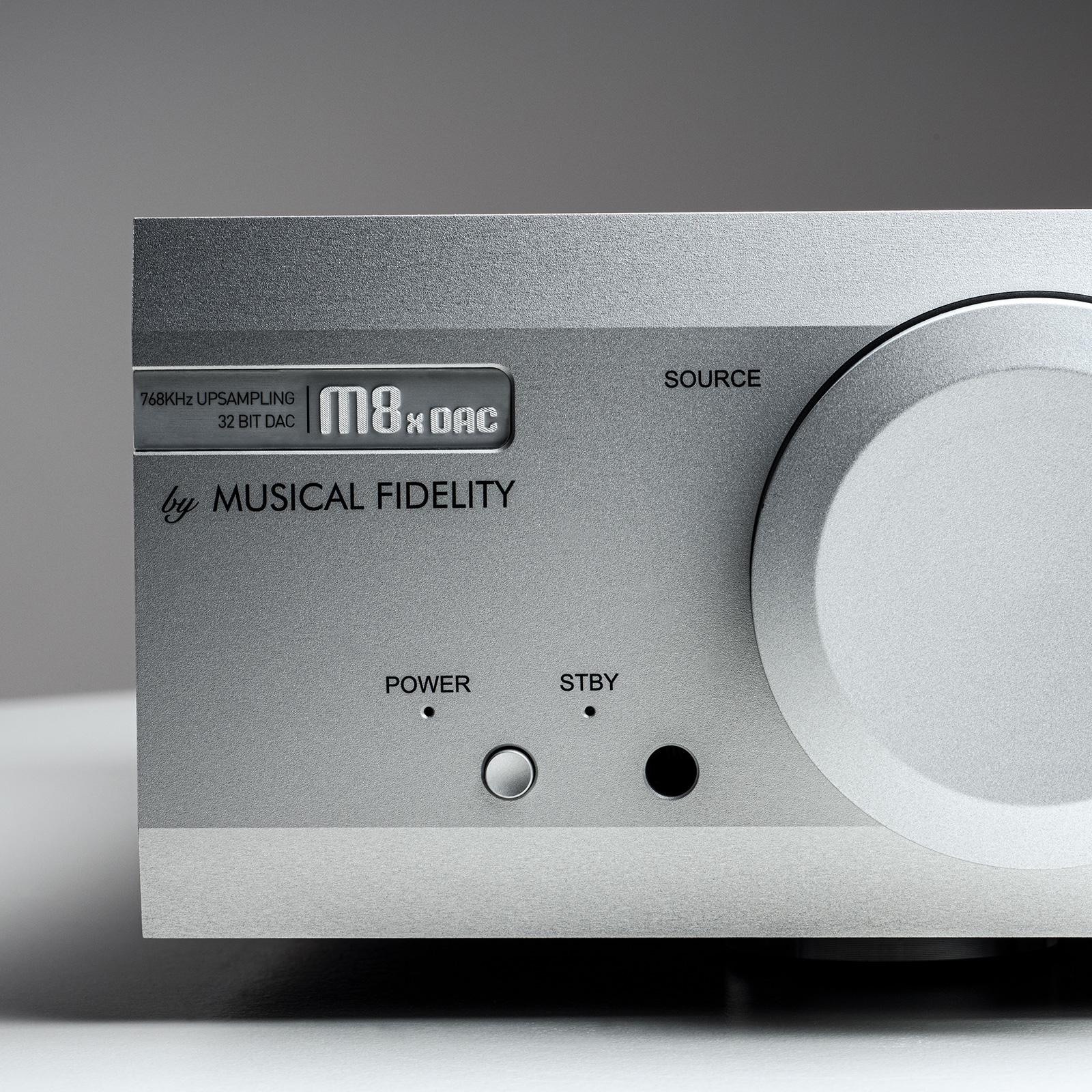
A DAC — short for digital-to-analog converter — is the component that takes the digital music files from your streamer, computer, CD transport, or TV and translates them into the analog audio signal your amplifier and speakers need. Every digital source has a DAC somewhere in the chain. The question is how good that DAC is. The Musical Fidelity M8x is designed to be the best DAC in your system by a wide margin — the kind of component that makes everything upstream and downstream sound better.
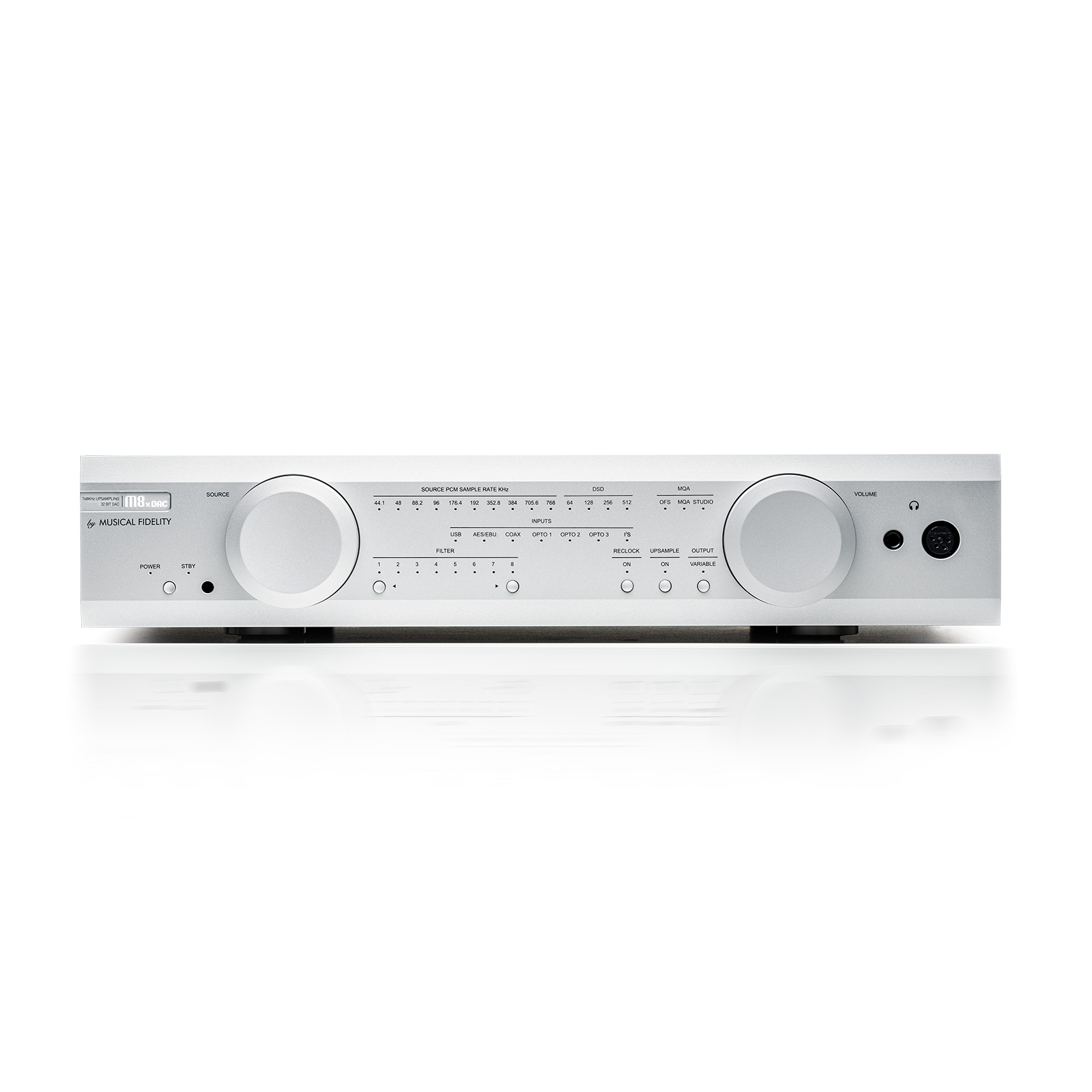
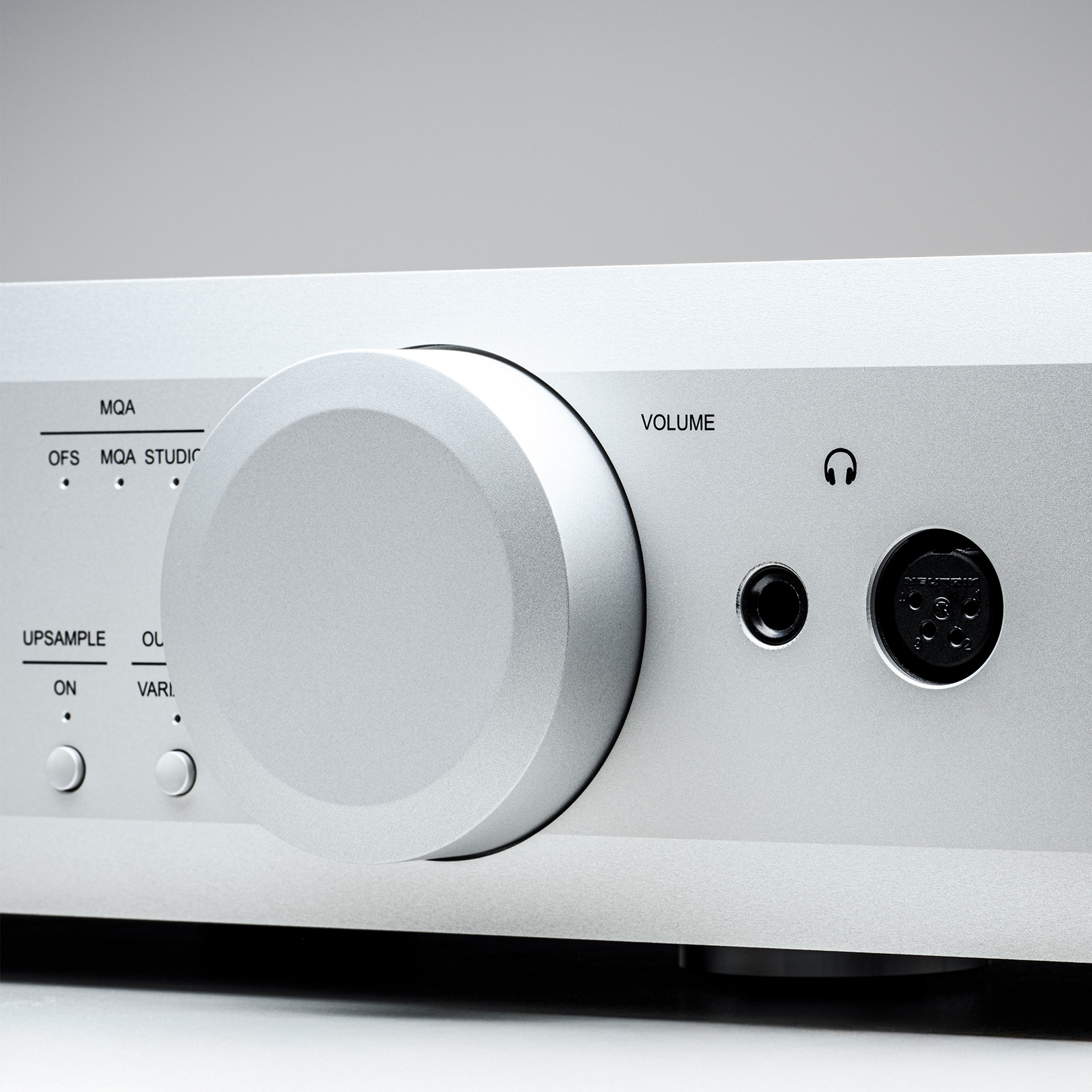
The M8x is also a serious headphone amplifier. It includes a fully balanced, Class A headphone circuit with both a standard 6.3mm jack and a balanced 4-pin XLR output. Musical Fidelity didn't treat the headphone section as an afterthought — it delivers 3.2 watts into 32-ohm headphones, enough to drive virtually any pair on the market with authority.
Dual Mono, Dual Differential — Why It Matters
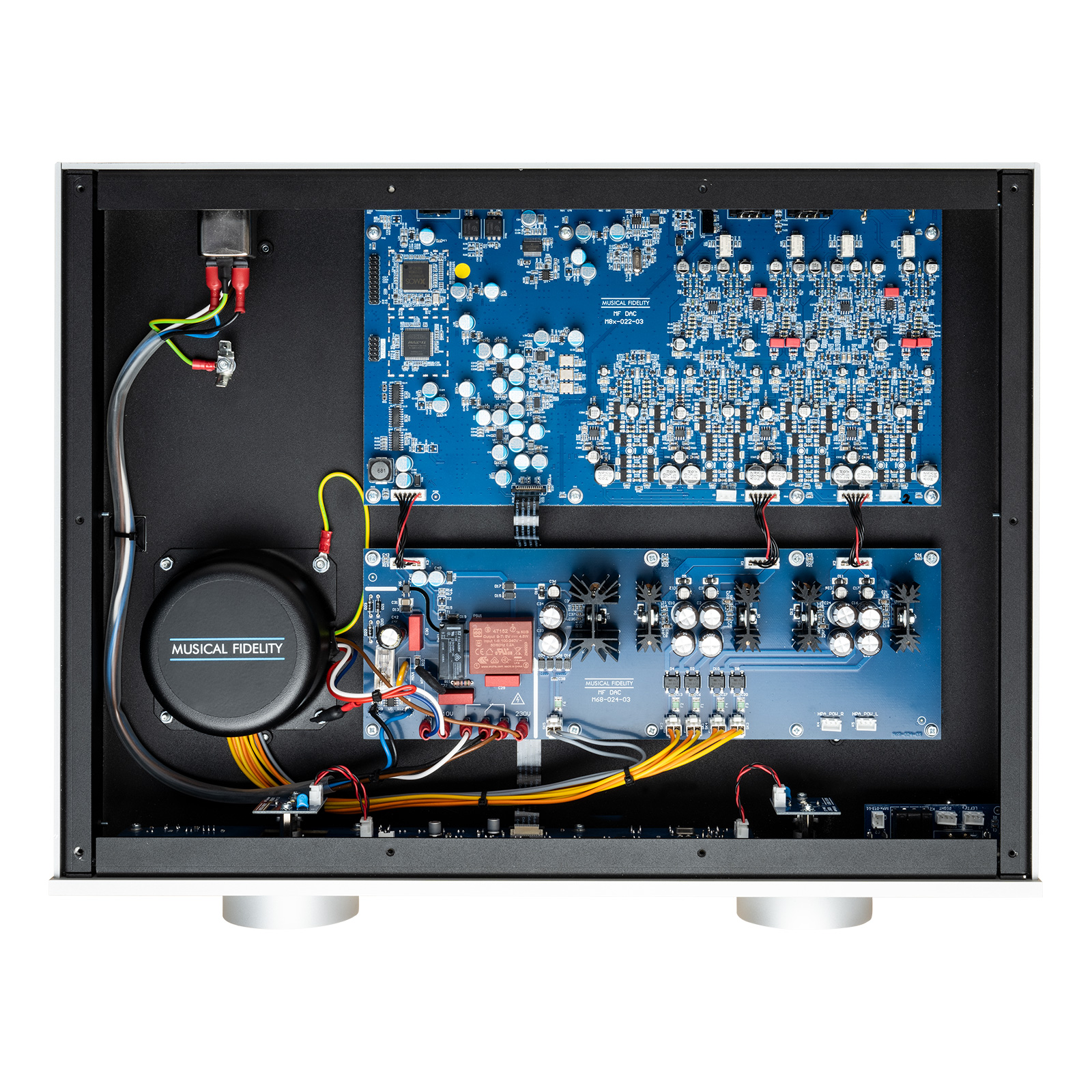
Inside the M8x, two ESS ES9038Q2M Sabre DAC chips run in a dual-mono, dual-differential configuration. Here's what that means in plain language: each stereo channel gets its own dedicated DAC chip, and each chip runs both of its internal conversion paths simultaneously in opposite phase, then combines the result. This cancels out tiny errors and noise that would otherwise color the sound. The practical benefit is a signal-to-noise ratio exceeding 120 dB — meaning the noise floor is so low that it's effectively inaudible, even with sensitive headphones in a quiet room.
The analog output stage that follows the DAC chips is fully discrete and fully balanced. Musical Fidelity chose to build this stage from individual transistors rather than using integrated circuit op-amps. Discrete output stages give the designer more control over the signal path and typically deliver a more natural, open sound — especially in the midrange, where the human ear is most sensitive.
Built for Purists — No Wi-Fi, No Bluetooth, No Screen
The M8x deliberately omits wireless connectivity. There's no Wi-Fi, no Bluetooth, and no large display. This is a design decision, not a cost-cutting measure. Wi-Fi and Bluetooth radios generate radiofrequency interference (RFI) that can bleed into sensitive analog circuits. The aluminum chassis acts as a Faraday cage, shielding the internals from external electromagnetic fields, and eliminating onboard radio sources keeps the signal path as quiet as possible. If you want wireless streaming, you connect an external streamer (like a Bluesound Node) to the M8x via its USB or digital inputs — keeping the noise source outside the DAC chassis.
What the Critics Are Saying
The Absolute Sound — Phil Wright — March 2026
Wright found that the M8x significantly elevated his reference system's performance, describing it as more refined and more detailed than his comparison DAC, with stronger bass, more texture, and a presentation closer to the sound of live musicians. He called it a valuable addition to the Musical Fidelity roster that fully justifies its asking price.
Hi-Fi News — Review — 2025
Hi-Fi News described the M8x as superb, noting that its performance emphasizes cohesion and delicate detail while never losing sight of the fact that music is about emotion, not analysis.
hi-fi+ — Phil Wright — 2026 Awards
Awarded Highly Commended in the DACs Under £10k category. Wright called the M8x flexible and sonically formidable, noting that it elevated his system's performance and drew him closer to the music.
Who Is the M8x DAC Best For?
- You've already invested in a quality amplifier and speakers, and you want a DAC that lets the rest of your system perform at its full potential.
- You're a headphone enthusiast who wants a single box that serves as both a reference DAC and a high-power balanced headphone amp.
- You value signal purity and don't need wireless features built into your DAC — you'd rather keep streaming devices separate.
- You listen to high-resolution files (DSD, hi-res PCM) and want a DAC that handles the most demanding formats natively.
- You want a component you can live with for years — one that won't become the bottleneck as you upgrade the rest of your system.
How Does It Connect to Your System?
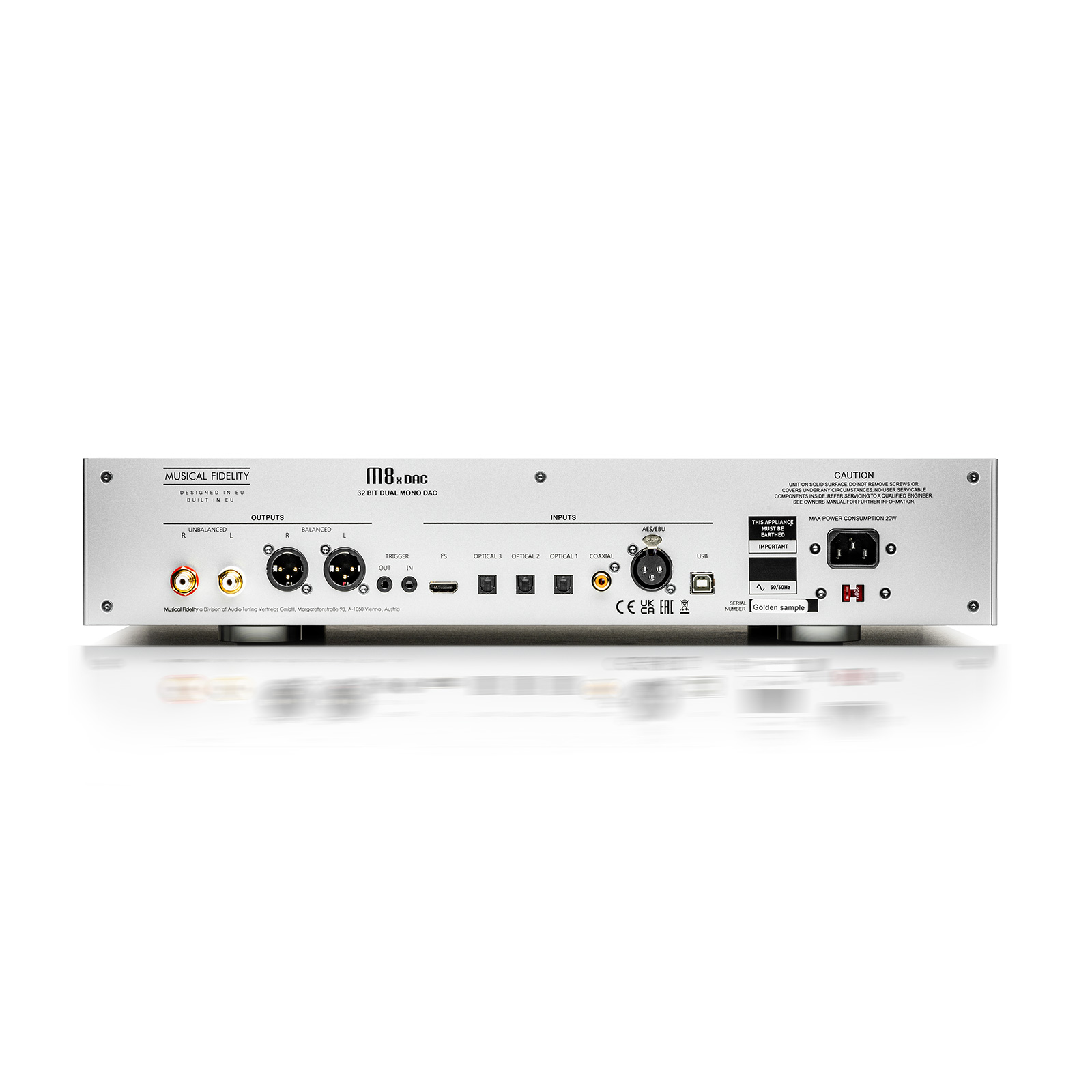
The M8x offers one of the most comprehensive input panels in its class:
- USB-B (asynchronous) — Connect a computer or USB streamer. Supports PCM up to 768 kHz and native DSD up to DSD512 — the highest resolution formats available. This is the input to use for maximum format flexibility.
- AES/EBU (XLR) — The professional-standard digital connection. Supports up to 24-bit/192 kHz. Ideal for connecting a CD transport or high-end streamer with AES output.
- Coaxial S/PDIF — A standard 75-ohm digital input for CD players, streamers, and other digital sources. Supports MQA decoding.
- Optical S/PDIF (x3) — Three optical inputs for TVs, streaming devices, game consoles, and other sources with Toslink output. Also supports MQA decoding via SPDIF inputs.
- I²S (HDMI) — A dedicated I²S input designed for Musical Fidelity's upcoming CD player. I²S carries clock and data on separate lines, which can reduce jitter compared to standard S/PDIF connections.
On the output side:
- Balanced XLR outputs — For connecting to amplifiers with balanced inputs. Switchable between fixed and variable output (variable lets you use the M8x as a preamp and control volume with the remote).
- RCA outputs — Standard unbalanced outputs for any amplifier with RCA inputs. Also switchable fixed/variable.
- 6.3mm headphone jack — Single-ended headphone output.
- Balanced XLR headphone output (4-pin) — For headphones with balanced cables. This is the M8x's strongest headphone output path, delivering 3.2 watts into 32 ohms.
The M8x can drive headphones with impedances ranging from 8 ohms to 300+ ohms with ease. If you're not sure whether your headphones are a good match, give us a call — we're happy to help.
Pairs Well With
Building your system? Here are some great companions for the M8x DAC.
- Integrated Amplifiers — The M8x's balanced XLR outputs pair beautifully with a quality integrated amp. Browse our Integrated Amplifiers.
- Streamers & Network Players — Since the M8x doesn't include built-in streaming, a dedicated network player makes an ideal source. Browse our Streamers & Digital Sources.
- Headphones — With 3.2W into 32 ohms and a balanced XLR output, the M8x drives even demanding planar magnetic headphones with authority. Browse our Headphones.
- Digital Cables — A quality USB cable or AES/EBU cable ensures the cleanest possible signal to the M8x. Browse our Digital Cables.
- XLR Interconnects — Take advantage of the balanced outputs with proper balanced cables to your amplifier. Browse our XLR Interconnects.
Features & Specifications
Audio Performance
- Dual-Mono, Dual-Differential Conversion — Two ESS ES9038Q2M 32-bit Sabre DAC chips, each handling one channel in dual-differential mode. This architecture cancels conversion errors and pushes the noise floor well below audibility, achieving a signal-to-noise ratio exceeding 120 dB.
- Fully Discrete Balanced Output Stage — The analog output after the DAC chips uses individual transistors rather than IC op-amps. Discrete stages give the designer precise control over the signal path and typically deliver a more natural, open midrange.
- Ultra-Low Jitter Clock — A proprietary clock design with Musical Fidelity's Time Domain Jitter Eliminator keeps the digital signal precisely timed. Jitter (tiny timing errors in the digital stream) can blur fine detail — less jitter means cleaner, more focused sound. Total correlated jitter is less than 100 femtoseconds peak to peak.
- High-Resolution Format Support — PCM up to 32-bit/768 kHz, DSD256 via DoP, native DSD512 via USB, and full hardware MQA decoding on USB and all SPDIF inputs. Whatever format your music library uses, the M8x handles it.
- Switchable Upsampling & Reclocking — Upsampling converts lower-resolution sources to higher sample rates, which can smooth the sound on older recordings. Reclocking regenerates the timing signal, which is especially useful when the source has a less precise clock (like a budget CD transport). Both features can be toggled on or off to suit your preference.
- Eight Selectable Digital Filters — Choose from eight filter profiles to fine-tune the DAC's sound character. Differences between filters are subtle, but listeners with resolving systems may prefer one over another depending on the recording.
Headphone Amplifier
- Class A, Fully Balanced — The headphone amp is a separate dedicated circuit, not shared with the line output. It runs in Class A — the simplest and most linear amplifier topology — for the lowest distortion at any volume level.
- Serious Power — 3.2 watts into 32 ohms and 400 milliwatts into 300 ohms. That's enough to drive everything from easy portable headphones to demanding planar magnetics and high-impedance studio monitors.
- Balanced XLR & Standard 6.3mm Outputs — Use whichever output matches your headphones. Balanced delivers even more power and channel separation.
Design & Build
- Aluminum Faraday Cage Chassis — The heavy aluminum enclosure shields the sensitive analog circuits from external electromagnetic interference. It's built to last and feels substantial in hand.
- Low-Noise Toroidal Transformer — A dedicated linear power supply with a toroidal transformer provides clean, stable power — no switching noise that could contaminate the audio signal.
- No Wireless, No Large Display — Deliberate omissions to eliminate radiofrequency interference sources inside the chassis, keeping the signal path as clean as possible.
- Fixed or Variable Output — Switchable between fixed output (for use with a separate preamp) and variable output (for direct connection to a power amplifier, with volume controlled by the M8x's remote).
Processing
- 16-Core XMOS Processor — Handles USB audio input processing with low latency and precise timing.
- Altera MAX II CPLD — A dedicated programmable logic device manages signal routing and digital filter control.
- Roon Tested — Certified compatible with Roon for seamless integration into Roon-based systems.
Frequently Asked Questions
Is the M8x DAC just a DAC, or does it also work as a preamp?
Both. The M8x has a switchable output mode. In fixed mode, it outputs a full-strength signal designed to feed a separate preamplifier or integrated amplifier. In variable mode, you can control the volume from the included remote control and connect the M8x directly to a power amplifier — no preamp needed. This makes it a very flexible component depending on how your system is set up.
Can I use the M8x as a standalone headphone amplifier?
Yes, and it's genuinely excellent in this role. The headphone section is a fully separate Class A amplifier circuit — not a tap off the main output. With 3.2 watts into 32 ohms and a balanced 4-pin XLR headphone output, it has the power and refinement to drive demanding planar magnetic headphones like the Audeze LCD series or HiFiMAN Susvara with authority. It also handles easy-to-drive headphones without hiss or noise, thanks to the very low noise floor.
Why doesn't the M8x have Bluetooth or Wi-Fi?
By design. Wireless radios generate radiofrequency interference that can bleed into sensitive analog circuits and raise the noise floor. Musical Fidelity left them out intentionally to keep the signal path as pure as possible. If you want wireless streaming, connect an external streamer (like a Bluesound Node or similar) to the M8x's USB or digital inputs. This way the noise source stays outside the DAC chassis where it can't affect the analog circuits.
What formats does the M8x support?
Virtually everything. Via USB, it handles PCM up to 32-bit/768 kHz and native DSD up to DSD512 — the highest resolution digital audio formats currently available. Via its SPDIF inputs (coaxial and optical), it handles PCM up to 24-bit/192 kHz. It also includes full hardware MQA decoding on both USB and SPDIF inputs. If your music library includes standard CD-quality files, hi-res downloads, or DSD recordings, the M8x plays them all.
What does the reclocking feature do?
Reclocking regenerates the timing signal of the incoming digital audio using the M8x's own high-precision internal clock. This is most useful when your source device has a less accurate clock — for example, a budget CD transport or an older streamer. The M8x essentially replaces the source's timing with its own, reducing jitter (tiny timing errors) and cleaning up the sound. You can toggle reclocking on or off and listen for yourself — the difference is most noticeable with lesser source components.
What's the I²S input for?
The I²S input uses an HDMI-style connector but carries a specialized digital audio signal where the clock and data travel on separate wires. This can reduce jitter compared to standard S/PDIF connections. Musical Fidelity designed this input to work with their upcoming CD player in the M8x series. It may also work with other I²S-compatible sources, but compatibility should be confirmed before purchase since I²S implementation varies between manufacturers.
How does the M8x compare to the DAC built into Musical Fidelity's M8xi integrated amplifier?
Musical Fidelity's own Heinz Lichtenegger has been candid about this: he has stated that it's difficult to include a proper-sounding DAC inside an amplifier that requires so much current and power, and that if you want DAC performance on the same level as the M8xi amplifier, you need a separate DAC. The M8x is that separate DAC. It has a dedicated chassis, its own power supply, its own shielding, and a more sophisticated output stage. If you already own an M8xi, the M8x DAC is the natural upgrade for the digital side of your system.
What else do I need to use the M8x?
At minimum, you need a digital source (streamer, computer, or CD transport) and either an amplifier with speakers or a pair of headphones. If you're connecting to an amplifier, you'll want either a pair of XLR interconnects (for balanced) or RCA interconnects (for unbalanced), plus a digital cable appropriate for your source (USB, coaxial, optical, or AES/EBU). If you're starting from scratch and need help putting it all together, call us at 800-942-0220 — we do this every day.
What's in the Box
- Musical Fidelity M8x DAC (Black)
- Remote control
- Power cord
- Documentation and warranty information
Note: Digital cables, interconnects, headphones, and amplifier are sold separately. Verify included accessories with manufacturer documentation if a complete packing list is critical to your purchase decision.
Why Audio Advisor?
 40+ Years of Expertise — Since 1981, we've helped over a million music lovers find the right gear.
 60-Day Money-Back Guarantee — Take your time. Listen, enjoy, and make sure it's right for you.
 Real Experts, Real Help — Our team is here to answer your questions at 800-942-0220, weekdays 9am–6pm EST.
 Free Shipping — On orders over $49, delivered to your door.
 Flexible Payment Options — Financing available so you can start listening now.
Want to learn more about DACs and how they affect your sound? Visit our Learning Center for guides, tips, and expert advice.


