 Free Shipping on US orders above $49






What You Need to Know
What Is a Power Conditioner, and Why Might You Need One?
The AC power in your home runs on technology that’s about 100 years old. It was built for light bulbs and electric motors. It was never built for the audio and video gear we use today.
Modern homes are full of noise on the AC line. WiFi, cell signals, dimmer switches, LED bulbs, and computer power supplies all add electrical noise — and so do your neighbors’ homes.
AudioQuest has measured what this does. Up to a third of a high-resolution audio signal can be lost or covered up by AC noise before it ever reaches your speakers. Once that detail is gone, no other piece of gear can bring it back.
A power conditioner sits between the wall and your equipment. It filters out the noise, gives your amp the current it needs on big musical peaks, and protects your gear from voltage spikes and surges.
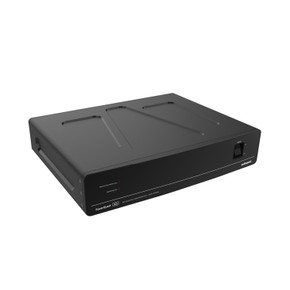
In our experience, a good power conditioner will almost always noticeably improve the sound of any high-end audio system. The PowerQuest 303 is the entry point to AudioQuest’s rack-mount conditioner line — a 12-outlet unit with real Non-Sacrificial Surge Protection, linear noise filtering, and an AudioQuest power cable already in the box.
What Makes the PowerQuest 303 Notable?
The PowerQuest 303 was designed by Garth Powell, AudioQuest’s Senior Director of Engineering — the same designer behind the flagship Niagara line. It’s the entry point to the PowerQuest rack-mount lineup, sitting below the 505 and 707, and it delivers a meaningful subset of Powell’s engineering at a price that’s genuinely approachable.
Linear Noise-Dissipation — Greater Than −22 dB
The 303 attacks differential-mode AC line noise (the kind riding between the hot and neutral conductors) across a wide 30 kHz to 1 GHz bandwidth.
This is the most common kind of power-line noise in modern homes — injected by switching power supplies, LED dimmers, and appliances. The 303 addresses it consistently across the audio and RF range, not just in a narrow window.
Twelve Outlets, Two Purpose-Built Banks
Four High-Current outlets for your amplifier, integrated amp, AV receiver, powered subwoofer, or powered speakers. Eight Linear-Filtered outlets for your source gear: streamers, DACs, CD players, preamps, phono stages, TVs, game consoles, routers, and networking equipment. Same outlet count and layout as the step-up PowerQuest 505.
Non-Sacrificial Surge Protection
Most surge protectors are “sacrificial” — they work once. After a big surge, the parts inside are used up and the unit stops protecting your gear, even though it still passes power.
The PowerQuest 303 doesn’t work that way. It’s rated to withstand repeated 6,000V / 3,000A surges — the most that can pass through a home’s electrical panel — without wearing out.
Extreme Voltage Shutdown adds a second layer of safety. If incoming voltage goes above 140VAC, the main relay opens in under a quarter of a second. It resets on its own once power is safe.
And at This Price: A Proper AudioQuest Cable in the Box
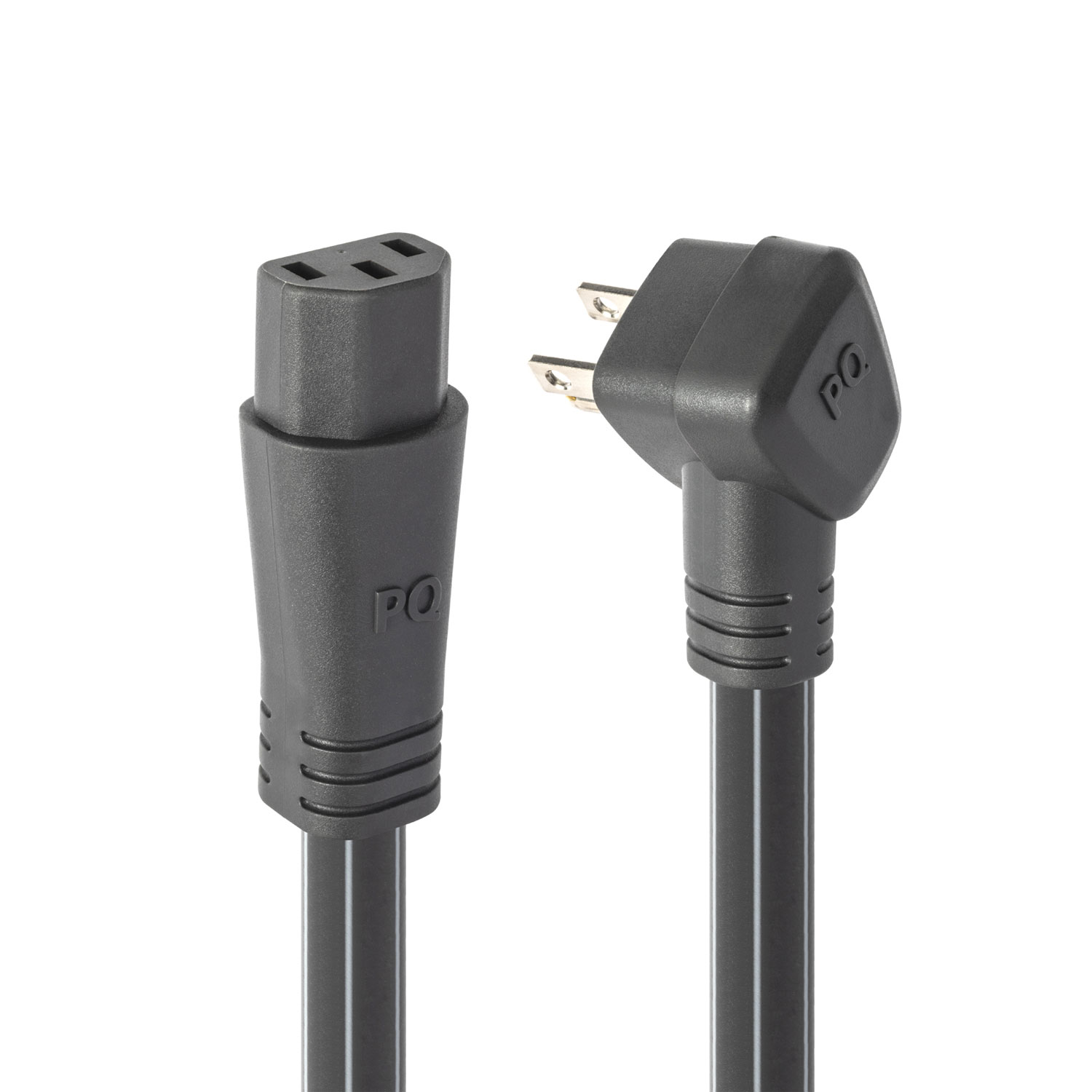
The 303 ships with a proper AudioQuest PQ-415 power cable already included — a 2-meter detachable RF-noise-dissipating cable with Semi-Solid Concentric Long-Grain Copper conductors and a flat-to-wall plug. Many conditioners at this price ship with a generic cord from a bin, or no cord at all. The 303 comes ready to run.
What the Pros Are Saying
Audiophilia found the PowerQuest 303 an effective, affordable entry into power conditioning. Once a noise issue with their DAC became apparent, the 303 provided real benefit in their system without the typical cost barrier. The reviewer flagged that at extreme listening levels the 303’s current delivery has limits — fair for a 15-amp conditioner at this price. But they called it “hardly a deal breaker” for normal listening.
Alpha Audio reviewed the 303 as part of a three-way group test with the 505 and 707, putting each on their engineering bench with deliberately noisy switching amplifiers in the system. Across the PowerQuest lineup they observed that with a PowerQuest plugged in, overall noise drops and the impact from the dirty switching amplifier is reduced.
Most reviews and customers say the same things about the 303: quieter backgrounds, more clarity in the midrange, and a cleaner soundstage. For home theater buyers, the picture also gets a clear bump in contrast once the AC is cleaned up.
How Does It Connect to Your System?
The back panel has 12 total outlets arranged in two banks, and it matters which outlet you use for what:
Four High-Current outlets — for your power amplifier, integrated amp, AV receiver, powered subwoofer, or powered speakers. These are engineered for gear that pulls more current on musical or dynamic peaks.
Eight Linear-Filtered outlets — for your lower-draw gear: streamers, DACs, CD players, preamps, phono stages, TVs, media players, game consoles, routers. These get the heaviest filtering for the quietest background.
The 303 is rack-friendly at 3.4” tall (3.5” with feet), 17” wide, and 13.4” deep, and weighs just 10.2 lbs — so it slots easily into any rack or sits neatly on a shelf. Rack-mount ears (2-RU) are included in the box.
The 303 ships with its own AudioQuest power cable — the detachable 2-meter PQ-415, with a flat-to-wall plug for tight installations. Plug it into the wall, plug your gear into the 303, and you’re running.
Who Is This Product Best For?
 You’re new to power conditioning and want a legitimate AudioQuest product without the investment of a Niagara or a higher-tier PowerQuest.
You’re putting together a multichannel home theater and need surge protection plus noise filtering across 12 outlets, in a rack-ready chassis.
You want real Non-Sacrificial Surge Protection — not a disposable strip you have to replace after the next thunderstorm.
You want a turnkey solution. The 303 ships with a proper AudioQuest power cable already in the box.
You’re running a moderately-resolving system and don’t need the common-mode filtering of the PowerQuest 505 or the 45-amp Transient Power Correction of the 707 — you just want cleaner power and reliable protection at a fair price.
Building Your System? Here Are Some Great Companions.
The 303 ships ready to run with the included PQ-415 cable. Two clear upgrade paths beyond that:
- Upgrade the wall cable — AudioQuest NRG-X3. The next step up from the included PQ-415. Perfect-Surface Copper (PSC) conductors and AudioQuest’s RF/ND-Tech for noise dissipation — a modest, easy-to-justify upgrade. Browse AudioQuest NRG cables.
- Step up within the PowerQuest line. If noise on your AC is heavy (lots of LEDs, computers, WiFi, or switching power supplies), the PowerQuest 505 adds common-mode filtering that the 303 doesn’t have. If you’re running a serious power amp where dynamics matter, the PowerQuest 707 adds a 45-amp Transient Power Correction reservoir.
- Component cables. Upgrading the cables running from the 303 to each of your components is the natural next step. Browse all AudioQuest power cables.
Features & Specifications
Twelve Outlets, Two Purpose-Built Banks
Four High-Current outlets for your amplifier, AV receiver, powered subwoofer, or powered speakers. Eight Linear-Filtered outlets for your lower-draw gear — streamers, DACs, preamps, TVs, game consoles, networking gear.
Linear Noise-Dissipation > −22 dB
Wide-bandwidth linear noise reduction across the differential-mode path — not just a narrow window. The 303 addresses the kind of AC noise injected by switching power supplies, LED dimmers, and appliances across 30 kHz to 1 GHz.
Non-Sacrificial Surge Protection
Withstands repeated surges of up to 6,000V / 3,000A — the maximum that can pass through a home’s AC electrical panel — without wearing out. Most surge protectors use MOVs that degrade every time they absorb a surge. The 303 doesn’t.
Extreme Voltage Shutdown
If incoming AC voltage rises above 140VAC, the main relay opens in under 0.25 seconds to protect connected gear. It resets automatically once line voltage returns to a safe range.
AudioQuest PQ-415 Power Cable — Included
A proper 2-meter detachable AudioQuest power cable is in the box, using Semi-Solid Concentric Long-Grain Copper conductors with a flat-to-wall plug.
Compact, Rack-Ready Form Factor
At just 3.4” tall (3.5” with feet) and 10.2 lbs, the 303 is easy to place on a shelf or in a rack. A 2-RU rack-mount kit is included in the box — not optional, not sold separately.
Designed by Garth Powell
AudioQuest’s Senior Director of Engineering and the designer of the entire Niagara and PowerQuest lines.
Quick-Reference Specifications
| Power & Filtering | |
| Rated Current | 15 Amps (RMS) @ 120V |
| Linear Noise-Dissipation | > −22 dB |
| Differential Mode Filter | 30 kHz – 1 GHz |
| Common Mode Filter | Not included (available on PowerQuest 505 and up) |
| Surge Protection | Non-Sacrificial, withstands repeated 6,000V / 3,000A surges |
| Extreme Voltage Shutdown | 140VAC; relay opens <0.25s; auto-resets when safe |
| Outlets | |
| Total Outlets | 12 |
| High-Current Outlets | 4 |
| Linear-Filtered Outlets | 8 |
| Main Power Cable | 2m detachable PQ-415 (Semi-Solid Concentric LGC, flat-to-wall plug) — included |
| Dimensions & Weight | |
| H × W × D | 8.6 × 43.2 × 34.0 cm (3.4” × 17” × 13.4”; 3.5” H with feet) |
| Weight | 4.6 kg (10.2 lbs) |
| Rack Mount | 2-RU rack-mount kit included |
| Warranty | |
| Standard Warranty | 5 Years |
Frequently Asked Questions
Will this actually improve the sound of my system?
In our experience, a good power conditioner will almost always noticeably improve the sound of any high-end audio system. AudioQuest states the PowerQuest 303 reduces AC noise with Linear Noise-Dissipation and protects your gear from surges.
Results vary with how dirty your AC is and how detailed your system sounds. Most users report darker backgrounds, better detail, and — in home theater setups — a noticeable bump in picture contrast.
Which outlets do I plug my amp into, and which are for my source gear?
Plug power amplifiers, integrated amps, AV receivers, powered subwoofers, and powered speakers into the four High-Current outlets (clearly labeled on the rear panel). Plug streamers, DACs, CD players, preamps, phono stages, TVs, game consoles, and networking gear into the eight Linear-Filtered outlets.
How does the 303 differ from the 505 or 707?
All three use the same 12-outlet rack-ready chassis, the same Non-Sacrificial Surge Protection, and the same Extreme Voltage Shutdown. The 303 has differential-mode filtering only.
The 505 adds a common-mode filter (30 kHz – 100 MHz) that handles noise riding on both hot and neutral together — common with modern switching power supplies and wireless devices.
The 707 adds a wider 30 kHz – 1 GHz common-mode filter plus Transient Power Correction — a 45-amp current reservoir for power amps. Pick the 303 if budget is tight and your AC isn’t very dirty. Step up to the 505 or 707 if it is, or if you have a demanding power amp.
Do I need this if I already have a good surge protector?
Surge protection and power conditioning are two different jobs. A basic surge strip blocks voltage spikes but does nothing for AC noise — and most use throwaway MOV parts that wear out with every surge.
The PowerQuest 303 handles both jobs: Non-Sacrificial Surge Protection that withstands repeated 6,000V / 3,000A surges, plus Linear Noise-Dissipation that no surge strip can provide.
Do I need to buy a separate power cable?
No — the 303 ships with a 2-meter AudioQuest PQ-415 detachable power cable already in the box, with Semi-Solid Concentric Long-Grain Copper conductors and a flat-to-wall plug. If you later want to upgrade, AudioQuest’s NRG-X3 is the natural next step.
Is the surge protection guaranteed? What happens after a surge?
AudioQuest’s Non-Sacrificial Surge Protection is rated to withstand repeated 6,000V / 3,000A surges — the most that can pass through a home’s electrical panel — without needing to be replaced. There’s no joule threshold after which protection stops.
Extreme Voltage Shutdown adds a second layer. If incoming voltage exceeds 140VAC, the main relay opens in under a quarter second. The PowerQuest 303 itself comes with a 5-year warranty.
See It in Action — Garth Powell on AudioQuest Power Conditioners
AudioQuest’s Senior Director of Engineering, Garth Powell, designed the entire PowerQuest line. In this discussion from AudioQuest’s official channel, Garth explains the first principle behind his power-conditioner designs: a power amplifier’s first job is unrestricted current delivery to the loudspeaker, and nothing in the AC chain should impede that transfer of energy.
What’s in the Box
- AudioQuest PowerQuest 303 Power Conditioner
- Detachable 2m AudioQuest PQ-415 power cable (Semi-Solid Concentric Long-Grain Copper, flat-to-wall plug)
- Two 2-RU rack-mount brackets and mounting hardware
- Owner’s manual and warranty documentation
- 5-year warranty
Why Audio Advisor?
 40+ Years of Expertise — Audio Advisor has served over one million audiophiles since 1981.
 60-Day Money-Back Guarantee — Try it in your system. If it’s not right, send it back.
 Real Experts, Real Help — Call 800-942-0220 and talk to a real person who knows this gear.
 Free Shipping — On all US orders over $49.
 Flexible Payment Options — Affirm financing available at checkout.
Want to learn more about power conditioning and how it affects your audio system? Visit our Learning Center for guides, tips, and expert advice. For a deeper technical dive from AudioQuest’s Senior Director of Engineering, Garth Powell, download AudioQuest’s “Power Demystified” whitepaper.


