 Free Shipping on US orders above $49


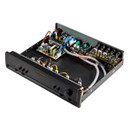


What Is the Parasound Halo P6?
A preamplifier is the "brain" of a component audio system. It takes all your music sources — turntable, streaming device, CD player, TV audio, even a phone plugged into the front panel — and lets you switch between them, control the volume, and send the signal to a separate power amplifier that drives your speakers.
The Parasound Halo P6 goes well beyond a basic preamp. It packs a high-quality digital-to-analog converter (DAC), a phono stage for vinyl playback, a headphone amplifier, and full subwoofer bass management all into a single component. Reviewers have called it an audiophile "Swiss Army knife," and for good reason: it replaces three or four separate boxes with one well-built unit that handles virtually everything between your music sources and your power amp.
The P6 is the successor to Parasound's popular Halo P5, and it shares its preamplifier foundation with the well-regarded Halo HINT 6 integrated amplifier. Parasound has been building high-value audio components for over 40 years, and the P6 carries that tradition forward with meaningful upgrades over the previous generation.
Why Does the P6 Matter for Your Listening?
Several key design choices set the P6 apart from a typical preamp at this price.
The Burr-Brown analog resistor ladder volume control is a highlight. Instead of the older motorized potentiometer used in the P5, Parasound moved to an electronically controlled resistor ladder. In plain terms, this means no mechanical sliding contacts touch your signal. The result, according to Parasound, is a quieter background, better left-right channel matching at every volume level, and greater dynamic range. The solid aluminum volume knob rides on ball bearings for smooth, precise adjustment, and a dimmable two-digit display shows your level from 0 to 99.
The built-in DAC uses an ESS Sabre32 Reference chip (ES9018K2M), which is a well-regarded converter found in dedicated DACs costing several hundred dollars on their own. It handles high-resolution files up to 384 kHz/32-bit PCM and native DSD256 through its USB input, and up to 192 kHz/24-bit through its coaxial and optical digital inputs. If you stream music from a computer, a Bluesound Node, or similar device, the P6's DAC can decode those digital signals with very good fidelity.
The phono stage supports moving magnet (MM), moving coil (MC), and even moving iron (MI) cartridges via a three-position rear-panel switch. According to the reviewer at Audio Pursuit, the phono stage is strong enough to make vinyl lovers reconsider buying a separate outboard phono preamp. According to the reviewer at Part-Time Audiophile, the phono stage is "surprisingly enjoyable" for the price.
The 2.1 channel bass management is something you rarely find in a dedicated stereo preamp. Adjustable high-pass and low-pass crossovers (with a 12 dB per octave slope) let you blend a subwoofer seamlessly with your main speakers. There's a front-panel subwoofer level knob, plus three subwoofer outputs — one balanced XLR and two RCA — for flexible sub hookup. If you've ever struggled to integrate a subwoofer into a two-channel system, the P6 was designed with exactly that challenge in mind.
The Home Theater Bypass input lets you use the P6 in a combined two-channel and surround-sound setup. When you select Bypass, the P6 passes your surround processor's front left, right, and sub channels straight through to your amplifier with no coloring or volume adjustment from the P6 — so your surround receiver stays in control during movie night, and the P6 takes over for dedicated music listening.
What Are Reviewers Saying?
The Parasound Halo P6 has been reviewed widely, and the consensus is strongly positive, particularly for its feature set and value.
The P6 delivers performance that goes beyond its price class, with the ability to render excellent detail, impressive build quality, and a strong built-in DAC and bass management section. Seeger considered it an easy recommendation for anyone shopping in this category.
— Dylan Seeger, Home Theater Review, March 16, 2020
According to Dylan Seeger at Home Theater Review (March 2020), the P6 delivers performance that punches above its price point, with strong build quality and an impressive built-in DAC and bass management section. He considered it an easy recommendation for shoppers looking for a digitally capable preamplifier in this range.
The reviewer described the P6 as representing outstanding value, noting that purchasing separate components matching each built-in feature would likely cost roughly double. The P6 appeals to audiophiles on a budget, secondary-system builders, and anyone downsizing without sacrificing performance.
— Future Audiophile, January 2023
At Future Audiophile (January 2023), the reviewer described the P6 as offering unparalleled value, noting that buying separate components to match each of the P6's built-in features would likely cost roughly double its asking price. The reviewer at Part-Time Audiophile (Summer 2022) did note that the P6 can lean slightly dry-sounding with certain sources, but concluded that its sheer number of features makes it very hard to pass up, especially for its bass management flexibility.
Tested alongside the Parasound A 23+ power amplifier, the P6 combo delivered impressive dynamics, rich midrange, and strong resolution. The reviewer found the sonic quality at this price point remarkable.
— Roy Ervin Solstad, Stereo+ (Norway), January 2019
According to Roy Ervin Solstad at Stereo+ in Norway (January 2019), the P6 paired with the Parasound A 23+ power amp delivered impressive dynamics, a rich midrange, and strong resolution at a price that seemed "almost unnatural."
The P6 impressed with its sheer flexibility, solid phono stage, quality remote control, and complete absence of signal bleed between inputs. The reviewer considered the built-in phono section strong enough to give separate outboard units a run for their money.
— Audio Pursuit, June 2021
The reviewer at Audio Pursuit (June 2021) praised the P6 for having zero signal bleed-through between inputs, solid phono stage performance, and noted that it works well with a variety of power amplifiers — not just Parasound's own.
Paired with the A 23+, the P6 delivered balanced, precise, and musical sound with a warm tonal character. The reviewers praised its supple reproduction, realistic imaging, and pinpoint instrument placement.
— LowBeats (Germany), November 2020
Germany's LowBeats (November 2020) called the P6 and A 23+ pairing "pleasingly balanced and precise," noting warm tonality, supple reproduction, and excellent imaging.
Positive Feedback's reviewer found the P6's feature set to be well-executed for its price, noting that the combination of functional improvements and audible performance over the previous P5 justified the step up. The Burr-Brown volume control's logarithmic taper was highlighted as a thoughtful design choice.
— Positive Feedback, 2019
Who Is This Preamplifier Best For?
 You're building (or upgrading) a two-channel system with a separate power amplifier and want a preamp that handles analog and digital sources, vinyl, and a subwoofer — all from one component. You want a high-quality built-in DAC and phono stage so you don't need to buy those as separate boxes. You have a home theater receiver and want to share your best speakers between surround sound and dedicated stereo listening using the Home Theater Bypass feature. You want proper bass management with adjustable crossovers to blend a subwoofer into your music system — something most stereo preamps don't offer. You're looking for a well-built, feature-rich preamp from a company with a strong track record, at a price that doesn't require a second mortgage.
How Does It Connect to Your System?
The P6 offers a generous set of connections. On the analog side, there are five pairs of RCA line-level inputs, one pair of balanced XLR inputs, and a dedicated phono input with a ground terminal. There's also a front-panel auxiliary input with a 3.5mm jack and an automatic +12 dB gain boost — handy for connecting a phone or portable player that doesn't output a very strong signal.
For digital sources, you get one USB-B input (for connecting a computer or USB streamer), two optical (Toslink) inputs, and one coaxial (S/PDIF) input.
Outputs include balanced XLR and unbalanced RCA preamp outputs for your power amplifier, plus one balanced XLR and two RCA subwoofer outputs. There's also a 3.5mm headphone jack on the front panel, a 12-volt trigger output, and rear-panel IR input/loop output jacks for custom installations.
Keep in mind: The P6 is a preamplifier — it does not have a built-in power amplifier. You'll need a separate stereo amplifier (or powered speakers) to drive your loudspeakers. Parasound's own Halo A 23+ is a natural companion, and many reviewers tested them together with excellent results. If you need help choosing an amp to pair with the P6, give us a call.
Pairs Well With
Building your system? Here are some great companions for the Halo P6.
- Stereo Power Amplifiers — The Parasound Halo A 23+ is a natural match. Browse all our Stereo Amplifiers.
- Turntables — The P6's built-in phono stage is ready for your turntable. Explore our Turntable collection.
- Subwoofers — Take advantage of the P6's bass management with a quality sub. Shop Subwoofers.
- Interconnect Cables — Connect with confidence using balanced XLR or RCA interconnects. Browse Interconnect Cables and Digital Cables.
- Audio Furniture — The P6 is rack-mountable (with the optional Parasound HRA-2 kit). See our Audio Racks.
Frequently Asked Questions
Do I need a separate amplifier to use the P6?
Yes. The P6 is a preamplifier and DAC — it controls your sources and volume, but it doesn't power speakers on its own. You'll need a separate stereo power amplifier (like the Parasound Halo A 23+) or a pair of powered/active speakers. If you'd prefer an all-in-one solution with a built-in power amp, take a look at the Parasound HINT 6 integrated amplifier, which shares many of the P6's features plus 160 watts per channel.
How does the P6 compare to the Parasound HINT 6?
The P6 and HINT 6 share the same DAC, phono stage, and Burr-Brown volume control design. The big difference is that the HINT 6 adds a built-in 160-watt-per-channel power amplifier, making it a true integrated amp. The P6 is the better choice if you already have a power amp you love (or plan to buy a specific one), because separating the preamp from the amp often gives you more flexibility and can improve performance. The HINT 6 is the better choice if you want everything in a single box.
Can I use the P6 with my home theater receiver?
Absolutely. The P6's Home Theater Bypass input is designed for exactly that. Connect your receiver's front left, right, and subwoofer preamp outputs to the P6's Bypass inputs. When you select Bypass on the P6, the signal passes straight through to your power amp — your receiver controls the volume. When you switch to any other input on the P6, it becomes your dedicated stereo preamp. Just make sure your receiver has preamp-level (line-level) outputs.
Will the phono stage work with my cartridge?
The P6's phono input covers the most common cartridge types. The MM setting (47kΩ) works with all standard moving magnet cartridges. The MC 100Ω setting handles the majority of moving coil cartridges, including many low-output models. The MC 47kΩ setting is an alternative for MC cartridges that prefer a higher load, and it's also the setting recommended by Soundsmith and Grado for their moving iron designs. If you're unsure which setting to use, try both MC options and go with whichever sounds best to you.
Does the USB input work with Windows and Mac without installing drivers?
On Mac, yes — it's plug-and-play. On Windows, Parasound provides drivers on their website for full functionality including DSD playback. The USB input uses an asynchronous Savitech SA9227 controller, which means the P6's internal clock controls the timing rather than your computer — resulting in lower jitter and better sound quality.
Can I connect two subwoofers?
Yes. The P6 has two RCA sub outputs and one XLR sub output, all carrying the same mono signal. You can connect up to three subwoofers simultaneously. If you'd like your two subwoofers to run in stereo (left and right), you can connect them to the main left and right preamp outputs instead of the sub outputs — just set the high-pass crossover to "Off" in that case. Note that the front-panel sub level control only adjusts the dedicated sub outputs.
What does the front-panel Aux input do?
The Aux input is a 3.5mm (1/8") jack on the front panel with an automatic +12 dB gain boost. It's designed for portable devices like phones, tablets, or media players that have a weak headphone output. Plug in with a standard 3.5mm cable and the P6 boosts the signal so it matches the level of your other inputs.
Is the P6 rack-mountable?
Yes. It fits a standard 19" equipment rack at a 2U height. You'll need the optional Parasound HRA-2 rack adapter kit (sold separately), which provides steel mounting brackets. The HRA-2 also fits the Parasound Halo A 23+, JC 3+, and P 7.
Does the volume control work when Home Theater Bypass is selected?
No. When Bypass is active, the P6's volume control, tone controls, and all other processing are completely removed from the signal path. Your surround receiver or processor controls the volume during Bypass mode. This is by design — it keeps the P6 transparent and avoids double volume control.
What headphone plug does the P6 use?
The P6 uses a 3.5mm (1/8") stereo mini plug. If your headphones have a larger 1/4" (6.3mm) plug, you'll need a simple adapter. When headphones are plugged in, the main speaker outputs and preamp outputs are muted automatically — the record outputs remain active.
See It in Action
Parasound P6 vs. PrimaLuna Preamp — Audio Excellence Canada
Shootout comparison between the Parasound P6 and PrimaLuna preamp.
Parasound Halo P6 Review — Audio Arkitekts
An in-depth video review exploring whether you need a dedicated preamplifier like the P6.
PS Audio Stellar vs. Parasound P6/A23+ — Audiolympian
A head-to-head comparison of two popular preamp/amp combinations in a similar price range.
 40+ Years of Expertise — Since 1981, we've helped over a million music lovers find the right gear.
 60-Day Money-Back Guarantee — Take your time. Listen, enjoy, and make sure it's right for you.
 Real Experts, Real Help — Our team is here to answer your questions at 800-942-0220, weekdays 9am–6pm EST.
 Free Shipping — On orders over $49, delivered to your door.
 Flexible Payment Options — Financing available so you can start listening now.
Learn More
Want to learn more about preamplifiers, DACs, and building a great two-channel system? Visit our Audio Advisor Learning Center for guides, tips, and expert advice.


